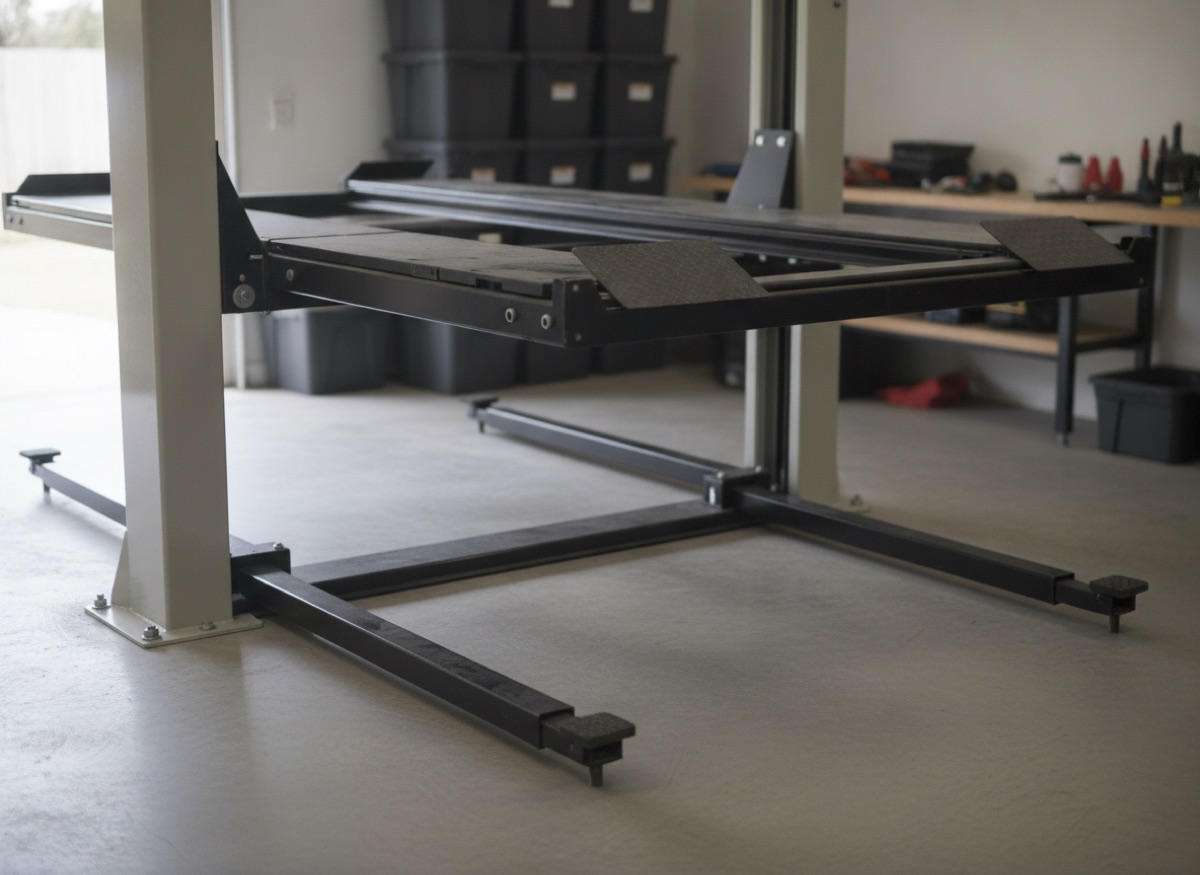
Illustration of a typical 2-post lift — not a photograph of the ME 10000lbs Double S Two Post Lift.
ME 10000lbs Double S Two Post Lift Review: Commercial-Grade Cable Equalization
The ME 10,000 lb Double S is a symmetric clear-floor overhead 2-post with a 2HP 220V power unit, 70 in of rise, 114 in between posts and a double S cable equalization routing that the name refers to, priced around $2,699 with an 18-month warranty. This review explains what the cable routing does, the 12 ft ceiling the 145 in columns need, and where it sits against the Triumph NTO-9A and the KATOOL 11,000.
Sold through equipment dealers — not currently listed on Amazon
See Top-Rated 2-Post LiftsAffiliate Disclosure: Car Lift For Garage is a participant in the Amazon Services LLC Associates Program, an affiliate advertising program designed to provide a means for sites to earn advertising fees by advertising and linking to Amazon.com. We may earn a commission from qualifying purchases made through links on this page, at no additional cost to you.
How this review was researched
This is a research-based review built from the manufacturer's specifications and manuals, ALI certification records and the pricing and owner feedback available for this class of lift. We have not installed or operated this unit ourselves, and we do not publish a star rating without at least 10 verified owner ratings. How we evaluate lifts.
Pros
- Commercial-grade cable equalization keeps columns perfectly synchronized
- Symmetric arm design centers vehicle precisely between columns
- Solid 10,000 lb capacity with comfortable margins for trucks
- Heavy-duty steel construction throughout the frame and arms
- Smooth hydraulic operation with well-controlled descent speed
- Double S cable routing reduces cable stress and extends service life
Cons
- Symmetric arms do not allow full door opening while vehicle is raised
- Cable equalization system requires periodic inspection and adjustment
- Brand recognition is limited, making resale value uncertain
- Installation manual could be more detailed for first-time installers
What the Double S in the name means
On a cable-equalized 2-post, two steel cables run from the carriage in one column, up over sheaves at the top, across the overhead beam and down to the carriage in the other column. Their job is to keep the two carriages at the same height even when the load is off center. Every time a cable bends over a sheave it fatigues a little, and sharp reverse bends, where the cable goes one way over a sheave and then the other way over the next, are the usual place a cable wears.
ME's Double S routing lays the cables out so each bends in a smoother S path rather than a series of tight reversals, which the company says reduces cable stress and extends service life. It is a real, if modest, idea; commercial lift makers have used similar routings for years. It does not change how the lift is used or maintained: the cables still need inspection and tension adjustment on a schedule, and the manual is thin on how to do that.
Capacity, rise and ceiling
The 10,000 lb rating covers everything from a compact car to a three-quarter-ton pickup. 70 in of rise is an inch more than the APlusLift HW-9KOH and 2 in less than the 10,000 lb HPDMC and WEIZE lifts, enough to stand under a car and a little low under a truck for a tall mechanic. The 114 in inside width is a normal drive-through for full-size vehicles. The arms are symmetric, so the vehicle sits centered between the columns and the doors barely open with the car in the air; there is no asymmetric setting.
Overall height is 145 in, or 12 ft 1 in, and with the shut-off bar above the beam the practical minimum ceiling is about 12 ft 4 in. That rules out standard attached garages and puts the ME in the same ceiling bracket as the DMC-FPPS overhead and the Double Safety Lock 10,000. Buyers with ceilings between 11 ft and 12 ft should look at the APlusLift lifts or the Atlas 9KOHX instead.
Available on Amazon in this category:
* Affiliate link - we may earn a commission
Installation and power
The power unit is a 2HP 220V single-phase motor, so a garage with only 110V needs an electrician first; there is no 110V option on this lift. Anchoring is into a minimum 4 in concrete slab with included hardware. At 1,520 lb the columns want an engine hoist or a third person, and the overhead beam needs a tall ladder and two sets of hands. Plan on a full weekend.
The manual is the weakest part of the package. It covers assembly adequately and cable tensioning barely, and because the equalization routing is the lift's distinguishing feature, the lack of a clear adjustment procedure is a real gap for a first-time installer. There is no dealer install option and no established support line; the seller is the contact. A buyer who has not installed a 2-post before should budget for a local installer or a friend who has.
Safety hardware and certification
The ME has automatic mechanical locks in each column that engage as the carriage rises and arm restraints that hold the arms under load, which is the standard hardware for the class. The descent is controlled by a flow valve, and the lift's literature describes the lowering speed as well regulated. It is CE self-certified, not ALI/ETL listed, which is normal at this price and disqualifying for a commercial shop or most insurers.
The equalization system deserves the same caution as any cable-equalized lift: the cables need periodic inspection for broken strands and periodic tension checks, and a lift that has been left with slack cables will lift unevenly and wear its lock ladders. The Double S routing should make the cables last longer, but it does not make them maintenance-free, and the cons list is right to say so. Correct arm placement on the manufacturer's lift points matters more than any of this.
Compared with the Triumph NTO-9A, KATOOL 11,000 and Double Safety Lock 10,000
The Triumph NTO-9A at about $2,695 is the comparison that matters: 9,000 lb, clear-floor, symmetric, dual-point safety locks, automatic arm restraints, a 1-year warranty and an importer that has sold lifts for years. It gives up 1,000 lb of rating and gains better safety hardware and a company behind it, for the same money. The KATOOL 11,000 lb asymmetric at around $2,849 adds 1,000 lb, door clearance and a 110V option for $150 more, with a 2-year warranty.
The Double Safety Lock 10,000 lb at about $2,800 is another unbranded 10,000 lb lift with redundant locks and 72 in of rise, and it faces the same accountability problem. Among the four, the ME's only unique claim is the cable routing. We would take the NTO-9A for the arm restraints and the track record, and the KATOOL if door clearance or 110V matters; the ME needs a price advantage it does not currently have.
Who should buy it (and who shouldn't)
Buy the ME 10,000 lb Double S if the garage has 12 ft 4 in of ceiling, 220V and a sound 4 in slab, if a symmetric clear-floor lift is the goal, and if it is available for enough less than the Triumph NTO-9A to offset the shorter warranty and the absence of a known brand. Buy it if the cable routing is a feature you value and you are comfortable adjusting equalization from a thin manual.
Skip it if the ceiling is under 12 ft 4 in. Skip it if door clearance matters; there is no asymmetric setting. Skip it for commercial work, where an ALI listing is required. And skip it at the current price, because the NTO-9A offers better safety hardware and a longer track record for the same money. It is not a bad lift. It is an anonymous one.
Final Verdict
The ME 10,000 lb Double S is a conventional symmetric 2-post with one engineering idea, a cable routing that reduces bending stress at the sheaves, and a brand nobody has heard of. Its numbers are fine: 10,000 lb, 70 in of rise, 114 in between posts, 1,520 lb of steel, 220V. The 18-month warranty is shorter than the 2 years on a KATOOL or the 3 years on an APlusLift, and there is no ALI listing and no dealer network. Buy it if it turns up meaningfully cheaper than the Triumph NTO-9A and the seller confirms parts availability. Otherwise the NTO-9A at about $2,695 has dual-point locks, automatic arm restraints and a company with a phone number for the same money, and that is the lift we would choose.
The ME 10000lbs Double S Two Post Lift isn't currently sold on Amazon. Here's our top-rated 2-post lifts pick that is:

Our top-rated 2-post lifts currently available on Amazon.
Price incl. tax, excl. shipping.
* Affiliate link - we may earn a commission
Specifications
- Lifting Capacity
- 10,000 lbs
- Lift Type
- Overhead, Clear Floor
- Motor
- 220V Single Phase, 2HP
- Rise Height
- 70 inches
- Overall Height
- 145 inches
- Width Between Posts
- 114 inches
- Arm Type
- Symmetric Swing Arms
- Equalization
- Double S Cable System
- Warranty
- 18-Month Limited
- Weight
- 1,520 lbs
Wheels off? Check the tires
A lift puts every tire at eye level, so it is an easy time to check pressure. Fanttik makes cordless tire inflators.
See Fanttik tire inflatorsTags
Related Reviews
Need Help Choosing?
Use our comparison tool to see how the ME 10000lbs Double S Two Post Lift stacks up against other lifts, or read our buying guide for expert recommendations.