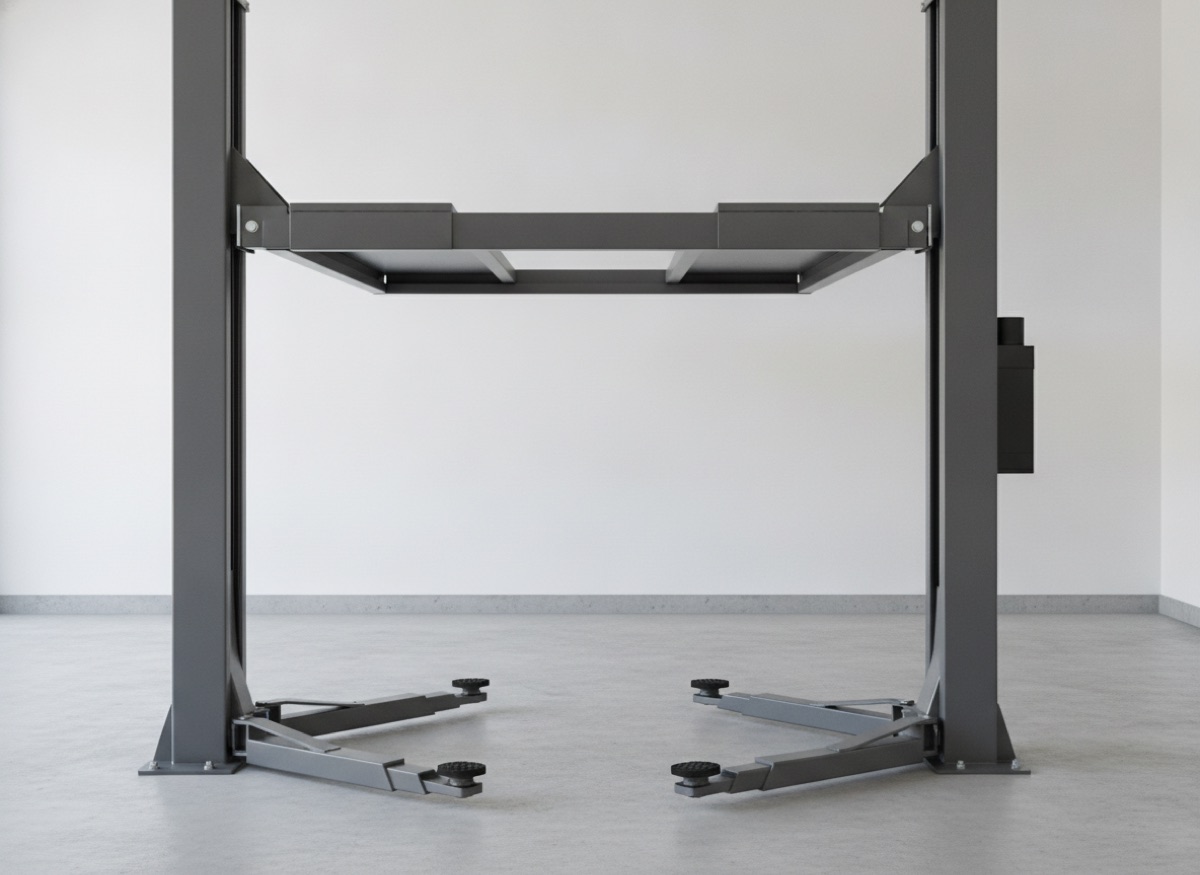
Illustration of a typical 2-post lift — not a photograph of the 10000lbs Two Post Car Lift Double Safety Lock.
10000lbs Two Post Car Lift Double Safety Lock Review: Heavy-Duty Protection for Serious Shops
This unbranded 10,000 lb clear-floor 2-post sells for about $2,800 with a double mechanical safety lock in each column, a 2HP 220V power unit, 72 in of rise and a 2-year warranty. This review covers what the redundant locks actually add, the 146 in column height and ceiling it implies, and why a no-name lift at this price has to beat the APlusLift and Atlas alternatives on more than a spec sheet.
Affiliate Disclosure: Car Lift For Garage is a participant in the Amazon Services LLC Associates Program, an affiliate advertising program designed to provide a means for sites to earn advertising fees by advertising and linking to Amazon.com. We may earn a commission from qualifying purchases made through links on this page, at no additional cost to you.
How this review was researched
This is a research-based review built from the manufacturer's specifications and manuals, ALI certification records and the pricing and owner feedback available for this class of lift. We have not installed or operated this unit ourselves, and we do not publish a star rating without at least 10 verified owner ratings. How we evaluate lifts.
Pros
- Double safety lock system provides redundant protection
- Full 10,000 lb capacity handles trucks and SUVs with ease
- Clear floor design maximizes workspace underneath vehicles
- Heavy-duty steel frame feels solid and inspires confidence
- Smooth 220V motor delivers consistent lifting speed
- Well-organized hardware kit simplifies installation
Cons
- Requires 220V dedicated circuit — not available in all home garages
- Brand name is not well-established, making long-term support uncertain
- No ALI certification limits commercial insurance applicability
- Assembly instructions could benefit from better illustrations
A generic lift with one specific feature
This lift is sold on Amazon under a descriptive title rather than a brand, which is common for 2-posts that come out of the same Chinese factories as the named imports. The specifications are mainstream for a 10,000 lb clear-floor overhead: 72 in of rise, 146 in overall height, 114 in between posts, symmetric swing arms, a 2HP 220V single-phase power unit and a shipping weight of 1,520 lb. The warranty is 2 years limited, which is better than the 1 year on an Atlas 9KOHX and shorter than the 3 years on an APlusLift HW-9KOH.
The feature in the name is the double mechanical safety lock. Each column has two independent lock mechanisms engaging the carriage as it rises, so that if one pawl fails to seat, the other still holds. That is the same idea as the dual-point locks on the Triumph NTO-9A, and on a symmetric lift where the load is centered it is a real, if modest, improvement over a single pawl. It is the reason to consider this lift over the cheaper named imports, and the only one.
Capacity, dimensions and ceiling fit
The 10,000 lb rating covers everything from a compact car to a three-quarter-ton pickup. The 72 in rise is 3 in more than the HW-9KOH's 69 in, which is a real difference for a tall mechanic standing under a truck. The 114 in inside width is a comfortable drive-through for full-size trucks and leaves room for the arms to swing on a wide SUV.
The 146 in overall height, 12 ft 2 in, is the number that decides whether it fits. Add the shut-off bar above the beam, and the realistic minimum ceiling is about 12 ft 6 in, taller than the HW-9KOH's 11 ft 6 in or the Atlas 9KOHX's 11 ft 2 in. Buyers with standard 10 ft garages should not consider it, and buyers with 12 ft ceilings should measure to the lowest obstruction before ordering. The symmetric arms center the vehicle between the columns, which means limited door opening with the vehicle raised; there is no asymmetric setting.
* Affiliate link - we may earn a commission
Installation and power
Power is 220V single phase on a dedicated circuit, and the cons list is right that many home garages do not have it; budget an electrician if the panel is in the house. The lift anchors into a minimum 4 in concrete slab, and at 1,520 lb shipping weight the columns are heavy enough that two people need an engine hoist or a third helper to stand them. The overhead beam and cable crossover need a 12 ft ladder and a second pair of hands.
Owner reviews on Amazon give the hardware kit credit for being organized, and criticize the instructions for sparse illustrations, which is a familiar combination for lifts in this class. Plan on a full weekend. Because there is no brand, there is no dealer install option and no manufacturer's technical line to call mid-install; the Amazon seller is the only contact, and the response quality varies with the seller of the day.
The double lock, and what certification it lacks
The redundant lock is worth understanding rather than just trusting. On a standard 2-post, a single spring-loaded pawl in each column drops into a ladder of lock positions as the carriage rises, and it holds the load if hydraulic pressure is lost. A second pawl on a separate pivot means a bent spring or a chip of debris under one pawl does not leave the carriage unsupported. It is a low-cost addition that the more expensive Triumph NTO-9A also uses, and it does make the lift safer against one specific failure.
It does not make the lift certified. There is no ALI/ETL listing, and the cons list is right that this limits commercial use; an insurer will not accept a second pawl in place of a third-party test. The lift also depends, like every 2-post, on correct arm placement and a slab that meets spec, and no lock design compensates for a vehicle set off its lift points. For a home garage the double lock is a reasonable reassurance; for a shop it is not a substitute for the label.
Compared with the DMC-FPPS, Atlas 9KOHX and WEIZE
The DMC-FPPS 9,000 lb overhead at about $2,500 is the closest rival: asymmetric arms, a 3-year warranty, and a listed ALI/ETL certification, for $300 less. If that certification checks out in the ALI directory, it is the better lift on every count except capacity and the second lock. The Atlas 9KOHX at about $2,399 is 9,000 lb, symmetric, with extra-wide columns, a lower ceiling requirement and Greg Smith Equipment's parts network behind it.
The WEIZE 10,000 lb at about $1,899 matches this lift's capacity for $900 less with lighter steel, a 1-year warranty and a single lock. Between the four, the Double Safety Lock lift is the most expensive and the least accountable. Its rise and its second pawl are real advantages; its price and its anonymity are real disadvantages, and we think the second pair outweighs the first for most buyers.
Who should buy it (and who shouldn't)
Buy it if the garage has 12 ft 6 in of ceiling, 220V and a sound slab, if the extra 3 in of rise and the redundant locks are worth about $600 over the HW-9KOH, and if the seller answers a pre-purchase question about parts availability in a way that inspires confidence. Buy it if the 2-year warranty is acceptable given that it is backed by a storefront rather than a manufacturer.
Skip it if the ceiling is under 12 ft 6 in; most of the competition fits lower. Skip it if a brand with a phone number matters, which for a piece of equipment expected to hold a truck over someone's head it probably should. Skip it for commercial use where an ALI listing is required. And skip it if the budget can only stretch to one of these: the APlusLift HW-9KOH does nearly the same job with a longer warranty from a company that has sold thousands of them.
Final Verdict
The Double Safety Lock 10,000 lb is a conventional clear-floor symmetric 2-post with one distinguishing feature, a second mechanical lock in each column, and one distinguishing problem, no brand behind it. Its numbers are competitive: 10,000 lb, 72 in of rise, 114 in between posts, a 2HP 220V unit and a 2-year warranty. At about $2,800 it costs more than the APlusLift HW-9KOH and Atlas 9KOHX, both of which come from companies that will still ship parts in a decade. Buy it if the redundant locks matter to you and the seller confirms parts availability in writing. Otherwise we would spend $600 less on the HW-9KOH; a second lock pawl is nice, but a company that answers the phone is nicer.
- Double safety lock system provides redundant protection
- Full 10,000 lb capacity handles trucks and SUVs with ease
- Clear floor design maximizes workspace underneath vehicles
- Heavy-duty steel frame feels solid and inspires confidence
Price incl. tax, excl. shipping. Last updated September 5, 2026.
* Affiliate link - we may earn a commission
Specifications
- Lifting Capacity
- 10,000 lbs
- Lift Type
- Clear Floor, Two Post
- Motor
- 220V Single Phase, 2HP
- Rise Height
- 72 inches
- Overall Height
- 146 inches
- Width Between Posts
- 114 inches
- Safety System
- Double Mechanical Safety Lock
- Warranty
- 2-Year Limited
- Weight
- 1,520 lbs
- Arm Type
- Symmetric Swing Arms
* Affiliate link - we may earn a commission
Wheels off? Check the tires
A lift puts every tire at eye level, so it is an easy time to check pressure. Fanttik makes cordless tire inflators.
See Fanttik tire inflatorsTags
Related Reviews


Need Help Choosing?
Use our comparison tool to see how the 10000lbs Two Post Car Lift Double Safety Lock stacks up against other lifts, or read our buying guide for expert recommendations.