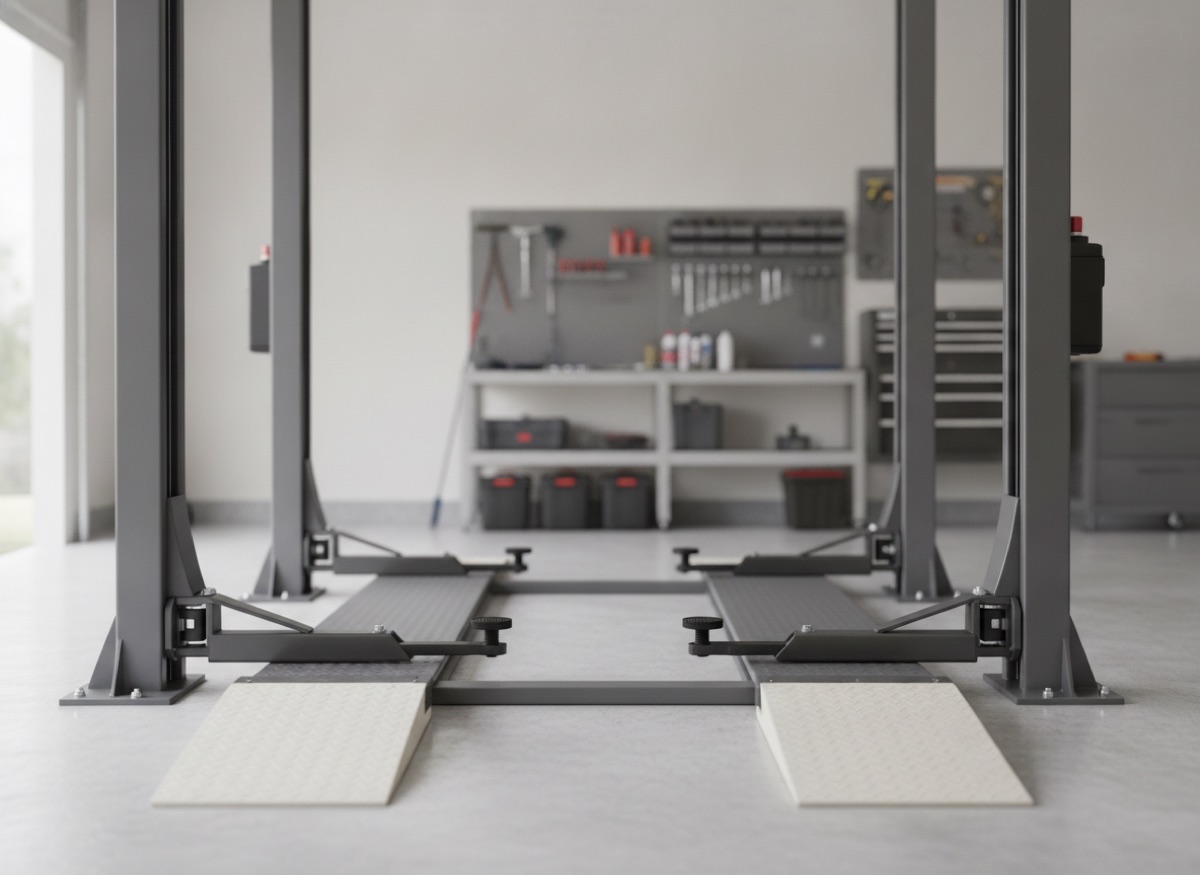
Illustration of a typical 2-post lift — not a photograph of the KATOOL 11000lbs 2 Post Lift Asymmetric.
KATOOL 11000lbs 2 Post Lift Asymmetric Review: Versatile Dual-Voltage Option
The KATOOL 11,000 lb asymmetric is an overhead 2-post that can be ordered with either a 110V or a 220V motor, with 71 in of rise, asymmetric swing arms, automatic mechanical locks and a 2-year warranty, at around $2,849. This review covers what the voltage choice commits a buyer to, the 12 ft 6 in ceiling the 147 in columns imply, and where it sits against the HPDMC and WEIZE 11,000 lb lifts.
Sold through equipment dealers — not currently listed on Amazon
See Top-Rated 2-Post LiftsAffiliate Disclosure: Car Lift For Garage is a participant in the Amazon Services LLC Associates Program, an affiliate advertising program designed to provide a means for sites to earn advertising fees by advertising and linking to Amazon.com. We may earn a commission from qualifying purchases made through links on this page, at no additional cost to you.
How this review was researched
This is a research-based review built from the manufacturer's specifications and manuals, ALI certification records and the pricing and owner feedback available for this class of lift. We have not installed or operated this unit ourselves, and we do not publish a star rating without at least 10 verified owner ratings. How we evaluate lifts.
Pros
- Dual 110V/220V motor options eliminate electrical guesswork
- 11,000 lb capacity handles heavy trucks with comfortable margins
- Asymmetric arms provide excellent door clearance for interior access
- Heavy-duty frame with thick column steel inspires confidence
- Reasonable pricing for the capacity and versatility offered
- Comprehensive safety lock system with audible engagement
Cons
- Must specify voltage at time of purchase — not field-switchable
- Arm swing radius is slightly shorter than some competitors
- Paint tends to show scuffs more readily in the standard color
- Limited third-party reviews make long-term reliability uncertain
What the KATOOL 11,000 lb asymmetric is built for
KATOOL is a newer name in 2-posts, and this 11,000 lb asymmetric is its truck-capacity overhead lift. The spec sheet is close to the HPDMC and WEIZE 11,000 lb lifts: 71 in of rise, 147 in overall height, 115 in between posts, asymmetric swing arms, automatic mechanical locks, 1,620 lb shipping weight and a 2-year limited warranty. Its one unusual feature is the motor: KATOOL offers the lift with either a 110V or a 220V single-phase power unit, chosen when ordering.
That makes it the only 11,000 lb 2-post in this review series that can run on a dedicated 20A household circuit. Every other truck-capacity lift here needs 220V. For a detached garage, a rented shop or a house with a full panel, that is the reason to look at this lift at all, and at around $2,849 it is priced between the WEIZE 11,000 at about $3,000 and the HPDMC 11,000 at about $3,200, both of which are 220V only.
Capacity, rise and ceiling
The 11,000 lb rating covers a three-quarter-ton crew cab diesel, a one-ton dually with a service body, or a heavy camper van with 2,000 lb of margin over a 9,000 lb lift. 71 in of rise puts a truck frame at standing height for most mechanics. The 115 in inside width lets a full-size truck drive through with the mirrors folded, and the asymmetric layout sets the vehicle back so the doors open, which on a crew cab is the whole point of asymmetric.
Overall height is 147 in, or 12 ft 3 in, and with the shut-off bar above the beam the practical minimum ceiling is about 12 ft 6 in. That is not an attached-garage number. The arm swing radius is a little shorter than on the HPDMC and BendPak lifts, which occasionally makes it awkward to reach the lift points on a long-wheelbase truck without repositioning the vehicle; it is a minor annoyance rather than a limitation, but it is real.
Available on Amazon in this category:
* Affiliate link - we may earn a commission
Choosing 110V or 220V, and why it cannot be changed later
The voltage option is a different motor and power unit, not a switch, so the choice is made at purchase and stays made. The 220V unit lifts faster and runs cooler; the 110V unit needs a dedicated 20A circuit and raises a loaded truck noticeably more slowly, in the neighborhood of a fifth longer per cycle. On an 11,000 lb lift that will regularly carry 7,000 lb trucks, the slower rise is more noticeable than on a 9,000 lb lift carrying cars.
The right way to decide is to price the 220V circuit first. If an electrician can add one for a few hundred dollars, buy the 220V lift and enjoy the speed. If the panel is full, the garage is detached with a long run, or the property is rented, buy the 110V lift and run it on its own circuit with no extension cord, because voltage drop on a long cord is how 110V lift motors overheat. Either way, the rest of the lift is identical.
Installation, slab and safety hardware
At 1,620 lb the columns need an engine hoist or a forklift and two people, and the overhead beam needs a tall ladder. Anchoring is into a minimum 4 in concrete slab, and for a lift that will carry trucks, a test hole to confirm thickness is worth the hour. KATOOL's manual is in line with the other imports, adequate on assembly and thin on cable tensioning, and there is no dealer install network to fall back on.
The safety hardware is standard for the class: automatic mechanical locks in each column that engage with an audible click as the carriage rises, and arm restraints that hold the arms under load. The lift is CE self-certified and not ALI/ETL listed, which is the norm under $3,500 and disqualifying for a commercial shop. The paint is the one build complaint worth flagging: the standard color shows scuffs readily, and the finish is not as thick as HPDMC's. That is cosmetic, but it is the first thing an owner will notice after the install.
Compared with the HPDMC 11,000, WEIZE 11,000 and ME 10,000
The HPDMC 220V 11,000 lb at about $3,200 is the better lift for a 220V garage: 1/4 in box-section columns, truck arm extensions in the box, 72 in of rise and a 36-month warranty, for about $350 more. The WEIZE 11,000 lb 3HP at about $3,000 is faster with a double safety lock, a 1-year warranty and a thinner finish; it costs $150 more than the KATOOL and is a wash on quality. Neither offers 110V.
The ME 10,000 lb Double S at around $2,699 is a symmetric clear-floor lift with a cable equalization system as its selling point, 220V only, with an 18-month warranty. It is $150 cheaper and 1,000 lb lighter in rating, and it gives up door clearance. Among these, the KATOOL is the only choice for a 110V garage and a middling choice for a 220V one. We would buy it for the voltage option and for nothing else.
Who should buy it (and who shouldn't)
Buy the KATOOL 11,000 lb asymmetric if the garage cannot get 220V, has 12 ft 6 in of ceiling and a sound slab, and needs to lift a three-quarter-ton or one-ton truck with the doors open. In that garage it has no competition. Buy the 220V version only if the price beats the HPDMC 11,000 lb by more than the difference in warranty is worth to you.
Skip it if 220V is available, because the HPDMC has heavier columns and a longer warranty for $350 more. Skip it if the ceiling is under 12 ft 6 in. Skip it if the heaviest vehicle is a half-ton, where a 9,000 lb lift does the job for $500 less. And do not order the 110V version expecting 220V speed; the slower rise is the trade, and it is permanent.
Final Verdict
The KATOOL 11,000 lb asymmetric is the truck-capacity 2-post for a garage that cannot run 220V, because it is the only lift in this bracket offered with a 110V motor, and its 71 in rise, 115 in inside width and asymmetric arms are the right geometry for a crew cab. The 2-year warranty is a step up from the WEIZE 11,000's 1 year and a step down from the HPDMC 11,000's 36 months. The voltage is fixed at purchase, the finish scuffs, and KATOOL has a short history in lifts and no ALI listing. Buy the 110V version if that is the constraint. If 220V is available, the HPDMC 11,000 lb costs about $350 more with a longer warranty and heavier columns, and that is the lift we would buy instead.
The KATOOL 11000lbs 2 Post Lift Asymmetric isn't currently sold on Amazon. Here's our top-rated 2-post lifts pick that is:

Our top-rated 2-post lifts currently available on Amazon.
Price incl. tax, excl. shipping.
* Affiliate link - we may earn a commission
Specifications
- Lifting Capacity
- 11,000 lbs
- Lift Type
- Overhead, Two Post
- Motor Options
- 110V or 220V Single Phase
- Rise Height
- 71 inches
- Overall Height
- 147 inches
- Width Between Posts
- 115 inches
- Arm Type
- Asymmetric Swing Arms
- Safety System
- Automatic Mechanical Lock
- Warranty
- 2-Year Limited
- Weight
- 1,620 lbs
Wheels off? Check the tires
A lift puts every tire at eye level, so it is an easy time to check pressure. Fanttik makes cordless tire inflators.
See Fanttik tire inflatorsTags
Related Reviews
HPDMC 220V Two Post Lift 11,000 LBS Review: Truck-Ready Power at a Mid-Range Price
$3,199.99
WEIZE 11000lbs Two Post Lift 3HP Motor Review: Fast Lifting at a Competitive Price
$2,999.99
ME 10000lbs Double S Two Post Lift Review: Commercial-Grade Cable Equalization
Est. $2,699 MSRP
Need Help Choosing?
Use our comparison tool to see how the KATOOL 11000lbs 2 Post Lift Asymmetric stacks up against other lifts, or read our buying guide for expert recommendations.