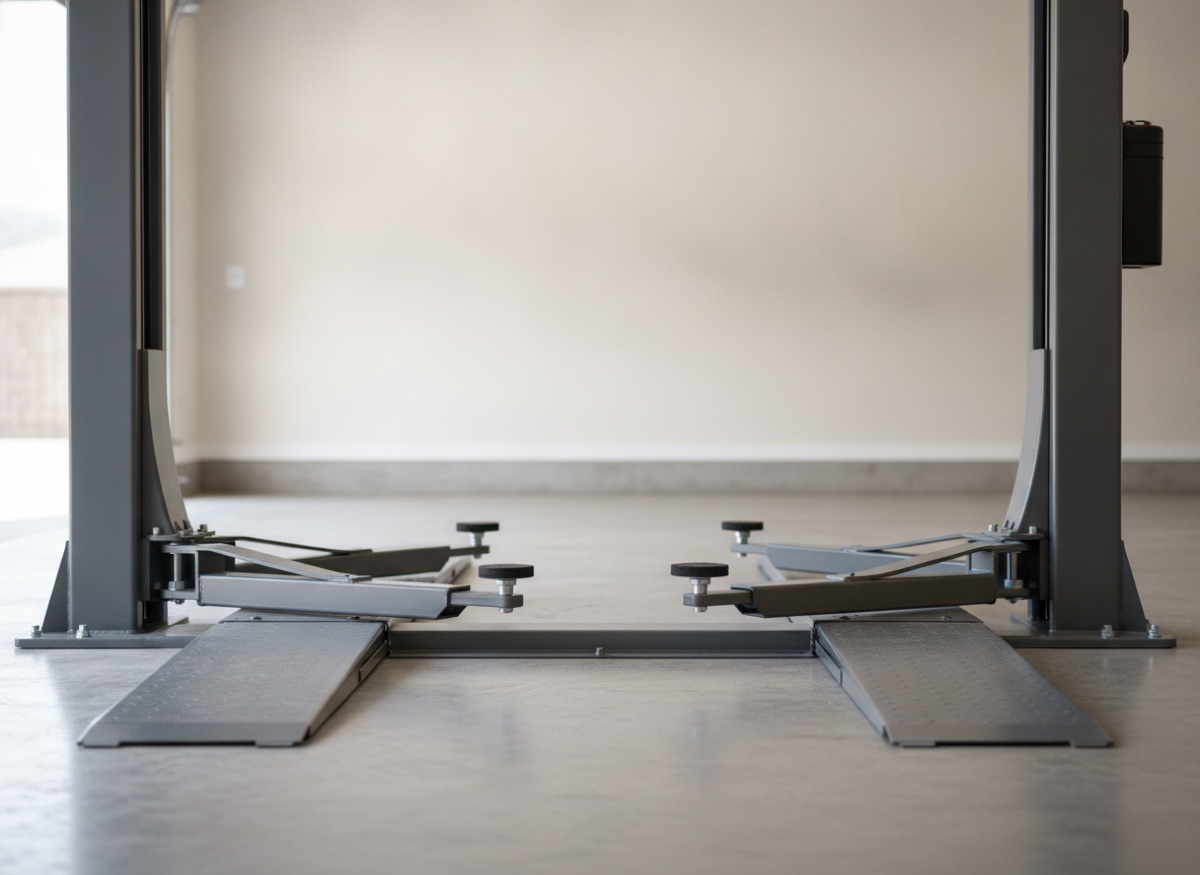
Illustration of a typical 2-post lift — not a photograph of the WEIZE 11000lbs Two Post Lift 3HP Motor.
WEIZE 11000lbs Two Post Lift 3HP Motor Review: Fast Lifting at a Competitive Price
The WEIZE 11,000 lb 3HP is a clear-floor overhead 2-post with a double mechanical safety lock in each column, 72 in of rise, and a 3HP motor that WEIZE rates at about 60 seconds for an unloaded rise, priced around $3,000 with a 1-year warranty. This review covers the 146 in column height, the thin powder coat and loud motor that owner reviews mention, and whether it beats the HPDMC 11,000 lb.
Affiliate Disclosure: Car Lift For Garage is a participant in the Amazon Services LLC Associates Program, an affiliate advertising program designed to provide a means for sites to earn advertising fees by advertising and linking to Amazon.com. We may earn a commission from qualifying purchases made through links on this page, at no additional cost to you.
How this review was researched
This is a research-based review built from the manufacturer's specifications and manuals, ALI certification records and the pricing and owner feedback available for this class of lift. We have not installed or operated this unit ourselves, and we do not publish a star rating without at least 10 verified owner ratings. How we evaluate lifts.
Pros
- Fastest lift time in the sub-$3,000 category at approximately 60 seconds
- 11,000 lb capacity handles heavy trucks and commercial vehicles
- Double safety lock system provides redundant protection
- 3HP motor delivers consistent power without overheating
- Clear floor design maximizes workspace below the vehicle
- Competitive pricing for the capacity and features offered
Cons
- Powder coat finish is thinner than premium competitors
- Arm bushing quality is adequate but not premium-grade
- Limited dealer network for parts and service support
- Motor noise is noticeable during operation at full power
Speed and capacity at a budget price
WEIZE's pitch for this lift is that it is the fastest thing under $3,000. The 3HP single-phase motor moves more fluid per second than the 2HP units on most 9,000 and 10,000 lb lifts, and WEIZE rates the unloaded rise at roughly 60 seconds. Under a 7,000 lb truck that number stretches, but the motor is sized so that it does not stall or overheat doing it, which is the practical benefit of the extra horsepower rather than the stopwatch figure.
The rest of the spec sheet is a conventional clear-floor overhead 2-post scaled for trucks: 11,000 lb rating, 72 in of rise, 146 in overall height, 114 in between posts, 1,600 lb shipping weight. The arms are symmetric. The safety system is a double mechanical lock in each column. The warranty is 1 year limited, which is the shortest in this capacity class and the main thing the price buys down. WEIZE is a battery and tire brand that moved into lifts recently, and this is its truck-capacity entry.
Capacity, rise and ceiling
11,000 lb covers a one-ton dually with a service body, a lifted three-quarter-ton diesel with a loaded bed, or a heavy camper van, with margin left over. 72 in of rise puts a truck frame at standing height for a tall mechanic. The 114 in inside width is enough for a full-size truck with the mirrors folded, and the symmetric arms center the vehicle between the columns, which limits door opening in the air; there is no asymmetric setting on this lift.
Overall height is 146 in, or 12 ft 2 in, and the shut-off bar above the beam pushes the practical minimum ceiling to about 12 ft 6 in. That rules out the standard attached garage. It also matters that a tall truck raised 72 in has to clear the ceiling itself; a 6 ft 6 in truck at full rise needs about 12 ft 6 in of clearance, and a high-roof van needs more than that. Measure the tallest vehicle as well as the room.
* Affiliate link - we may earn a commission
Installation and the 220V circuit
At 1,600 lb shipping weight the columns need an engine hoist or a forklift and two people; the overhead beam needs a tall ladder and a second pair of hands. Anchoring is into a minimum 4 in concrete slab, and for a lift that will regularly carry 8,000 lb, the slab matters more than any other single factor. A drilled test hole before the crate ships is cheap insurance. Owner reviews on Amazon describe the assembly as straightforward with the usual thin manual coverage of cable tensioning.
Power is 220V single phase on a dedicated circuit sized for the 3HP motor, which draws more than a 2HP unit and will trip an undersized breaker under load. Budget an electrician if the panel is not in the garage. The arm pivot bushings are adequate rather than premium and want grease on a schedule, which is a five-minute job and worth doing before the first squeak.
The double safety lock, noise and finish
The double lock is the feature to understand. In each column, two independent pawls engage the lock ladder as the carriage rises, so a bent spring or debris under one pawl leaves the other holding. It is the same idea the Triumph NTO-9A uses, and on a truck-capacity lift it is a sensible addition. The lift is CE self-certified, not ALI/ETL listed; no lift in this price bracket is, and a commercial buyer should look at the BendPak XPR-10AS instead.
The two consistent complaints in owner reviews are noise and finish. The 3HP pump is loud at full power, louder than the 2HP units on smaller lifts, and in an attached garage that is worth knowing. The powder coat is thinner than on the HPDMC or APlusLift lifts and scuffs at the arm ends and column edges. Neither affects the lift's ability to hold a truck; both affect how it feels to own after a year, and the 1-year warranty means the owner is on their own for whatever comes after.
Compared with the HPDMC 11,000, MOTOOL 12,000 and WEIZE 10,000
The HPDMC 220V 11,000 lb at about $3,200 is the direct rival: same capacity, same 3HP motor, same 72 in rise, but 1/4 in box-section columns, asymmetric arms with truck extensions, a thicker finish and a 36-month warranty, for $200 more. That is the better lift, and the margin is not close. The MOTOOL 12,000 lb 4HP at about $3,500 adds another 1,000 lb, 74 in of rise and a single-point lock release, with a 2-year warranty and a 40A circuit requirement.
WEIZE's own 10,000 lb overhead at about $1,899 is the lift to consider if the truck is a half-ton; it gives up the 3HP motor, the double lock and 1,000 lb of rating for $1,100 less. Between the two 11,000 lb lifts, the WEIZE wins only on price and only by $200. We would pay the difference for the HPDMC's warranty alone.
Who should buy it (and who shouldn't)
Buy the WEIZE 11,000 lb 3HP if the budget is a hard $3,000, the garage has 12 ft 6 in of ceiling, 220V and a sound slab, and the heaviest vehicle is a three-quarter-ton or one-ton truck. Buy it if the fast rise and the double lock matter and a 1-year warranty is an acceptable risk. It will lift the truck.
Skip it if another $200 is possible, because the HPDMC 11,000 lb has a 36-month warranty, heavier columns and asymmetric arms for that money. Skip it if the garage is attached to living space and the pump noise will carry. Skip it if the truck is a half-ton, where the WEIZE 10,000 lb does the job for $1,100 less. And skip it for commercial use, where nothing in this bracket carries the ALI label an insurer wants.
Final Verdict
The WEIZE 11,000 lb 3HP is the cheapest way to put a fast, high-capacity 2-post in a home garage, and its double safety lock is a real feature rather than a marketing line. WEIZE rates the unloaded rise at about 60 seconds, which the 3HP motor makes plausible, and 72 in of rise with 114 in between posts is the right geometry for trucks. Against that, the warranty is 1 year, the powder coat is thin, the motor is loud, and WEIZE has no dealer network. It needs 220V, a 4 in slab and roughly 12 ft 6 in of ceiling. Buy it if $200 matters and speed matters. Skip it in favor of the HPDMC 11,000 lb if a 36-month warranty and heavier columns are worth $200, which for a lift that will carry a truck over someone's head, we think they are.
- Fastest lift time in the sub-$3,000 category at approximately 60 seconds
- 11,000 lb capacity handles heavy trucks and commercial vehicles
- Double safety lock system provides redundant protection
- 3HP motor delivers consistent power without overheating
Price incl. tax, excl. shipping. Last updated September 5, 2026.
* Affiliate link - we may earn a commission
Specifications
- Lifting Capacity
- 11,000 lbs
- Lift Type
- Clear Floor, Overhead
- Motor
- 220V 3HP Single Phase
- Rise Height
- 72 inches
- Overall Height
- 146 inches
- Width Between Posts
- 114 inches
- Lift Speed
- Approximately 60 seconds (unloaded)
- Safety System
- Double Mechanical Safety Lock
- Warranty
- 1-Year Limited
- Weight
- 1,600 lbs
* Affiliate link - we may earn a commission
Wheels off? Check the tires
A lift puts every tire at eye level, so it is an easy time to check pressure. Fanttik makes cordless tire inflators.
See Fanttik tire inflatorsTags
Related Reviews

Need Help Choosing?
Use our comparison tool to see how the WEIZE 11000lbs Two Post Lift 3HP Motor stacks up against other lifts, or read our buying guide for expert recommendations.