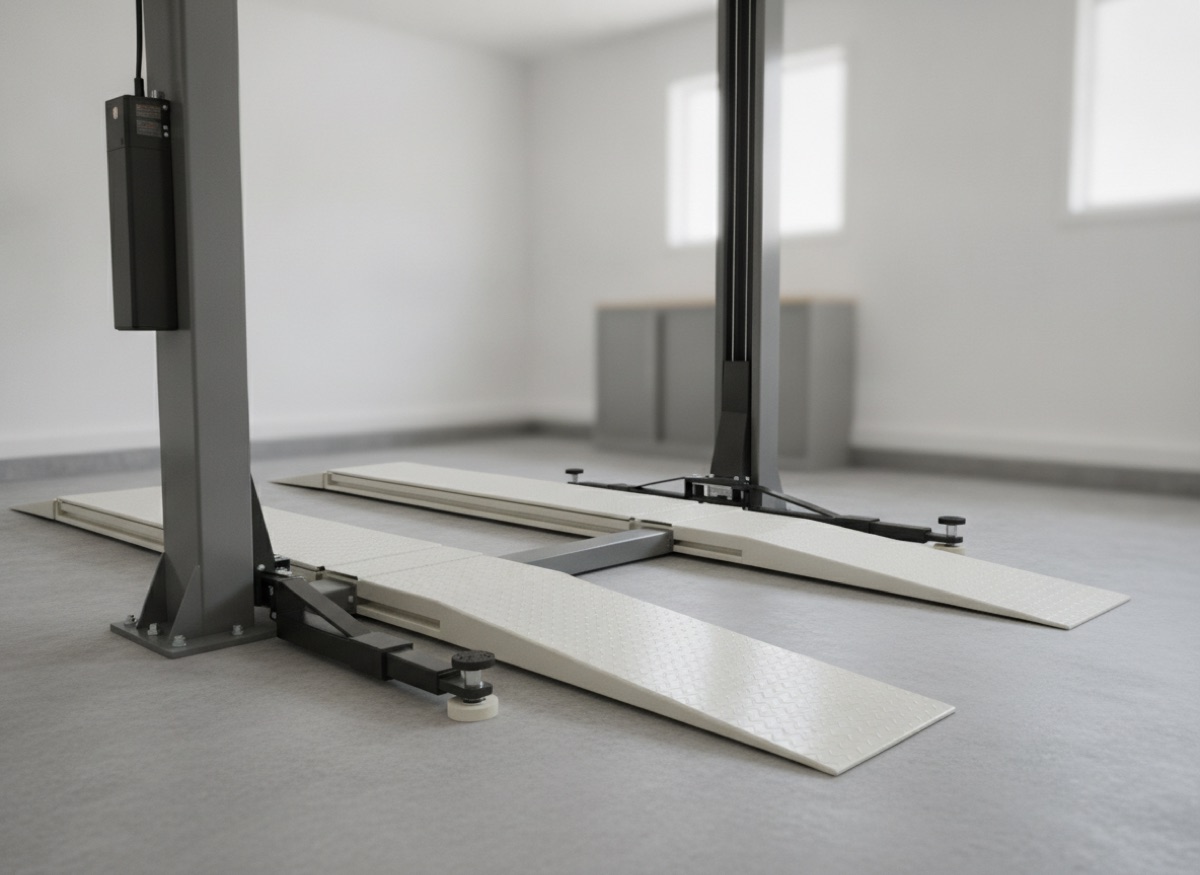
Illustration of a typical 2-post lift — not a photograph of the HPDMC 220V Two Post Lift 11,000 LBS.
HPDMC 220V Two Post Lift 11,000 LBS Review: Truck-Ready Power at a Mid-Range Price
The HPDMC 220V 11,000 lb is a clear-floor overhead 2-post built around 1/4 in box-section columns, a 3HP motor, 72 in of rise and asymmetric arms with truck extensions in the box, for about $3,200 with a 36-month warranty. This review covers who needs 11,000 lb, the 12 ft 6 in ceiling it wants, and whether it beats the WEIZE 11,000 and the BendPak XPR-10AS.
Affiliate Disclosure: Car Lift For Garage is a participant in the Amazon Services LLC Associates Program, an affiliate advertising program designed to provide a means for sites to earn advertising fees by advertising and linking to Amazon.com. We may earn a commission from qualifying purchases made through links on this page, at no additional cost to you.
How this review was researched
This is a research-based review built from the manufacturer's specifications and manuals, ALI certification records and the pricing and owner feedback available for this class of lift. We have not installed or operated this unit ourselves, and we do not publish a star rating without at least 10 verified owner ratings. How we evaluate lifts.
Pros
- Genuine 11,000 lb capacity handles full-size trucks and heavy SUVs
- Reinforced column and arm design for heavier vehicle applications
- 36-month warranty covers structural and hydraulic components
- 220V motor delivers fast, consistent lifting even under heavy loads
- Truck-compatible arm extensions included in the standard package
- Excellent equalization system keeps carriages synchronized
Cons
- Heavier components make installation more challenging than lighter models
- Requires a taller ceiling — minimum 12.5 feet recommended
- Higher power consumption increases ongoing electrical costs marginally
- No ALI certification at this price is disappointing given the capacity
Who needs 11,000 lb
Most home garages do not. A half-ton pickup weighs 5,000 to 6,000 lb, a three-quarter-ton crew cab diesel about 7,500 lb, and a one-ton dually with a service body can pass 9,000 lb. The 9,000 lb lifts that dominate this market carry the first two with margin and the third with none. The HPDMC 11,000 lb is aimed at the garage with the third, or with a lifted diesel plus a bed full of tools, or with a heavy camper van, where 2,000 lb of headroom is the difference between a lift that is comfortable and one that is at its label.
HPDMC built it as a heavier version of its 9,000 lb overhead rather than a different design: the same clear-floor layout, the same 36-month warranty, but 1/4 in box-section column steel, a 3HP motor instead of 2HP, 72 in of rise instead of 68, and asymmetric arms with truck extensions included. At about $3,200 it costs $800 more than the 9,000 lb model, and every one of those dollars went into capacity.
Capacity, rise and the 12 ft 6 in ceiling
The rating is 11,000 lb, and 72 in of rise puts a lifted truck frame at standing height for a tall mechanic. Inside width between posts is 116 in, wide enough to drive a dually through with the mirrors folded, and the arm extensions let the pads reach the frame rails of a long-wheelbase truck without balancing on running boards. The asymmetric layout sets the vehicle back in the bay so the doors open, which on a crew cab is worth having.
Overall height is 148 in, or 12 ft 4 in, and with the shut-off bar above the beam the seller's recommended minimum ceiling is 12 ft 6 in. That is 6 in more than the 9,000 lb model needs and a full foot more than the APlusLift HW-9KOH. A lifted truck raised 72 in also has to fit under the ceiling itself; a 6 ft 6 in tall truck needs about 12 ft 6 in of clearance at full rise, so the ceiling number and the vehicle number happen to agree here, but a taller van would not.
* Affiliate link - we may earn a commission
Installation, slab and power
At 1,680 lb shipping weight this is a heavy lift for two people, and the columns are the problem: 1/4 in box section is what makes them stiff, and it is also what makes each one a job for an engine hoist or a forklift. Anchoring is into a minimum 4 in concrete slab, and for a lift that will carry 8,000 lb trucks regularly, more is better; a thin or cracked slab is the most common cause of a leaning column, and no warranty covers it. Drill a test hole before the crate ships.
Power is 220V single phase on a dedicated circuit sized for a 3HP motor, which draws more current than the 2HP units on 9,000 lb lifts. The manual is the same clear document HPDMC ships with its smaller lifts, and owner reviews on Amazon give it credit. Plan on a full weekend with a tall ladder for the beam, and consider a professional installer if the garage lacks a hoist; this is the point in the price range where paying someone starts to make sense.
Safety hardware, equalization and the missing ALI label
The lift has automatic mechanical locks in each column, arm restraints, and a cable equalization system that owner reviews single out as keeping the carriages level, which matters more on an asymmetric lift carrying a truck whose weight sits mostly over the rear arms. The 1/4 in box-section columns resist the twisting that off-center loads put into thinner-walled columns. Those are the things a truck lift needs, and HPDMC provides them.
What it does not provide is an ALI/ETL listing. The certification is a CE self-declaration, and at $3,200 that is a legitimate complaint, because the BendPak XPR-10AS sits only $800 higher with the label. For a home garage the practical difference is small if the lift is installed and loaded correctly; for a shop or an insured business it is the whole difference. The 36-month warranty covers the pump, motor and hydraulics, which is the strongest coverage available on an uncertified lift in this class.
Compared with the WEIZE 11,000, HPDMC 9,000 and BendPak XPR-10AS
The WEIZE 11,000 lb 3HP at about $3,000 is the direct rival: same capacity, same motor size, same 72 in rise, a double safety lock, a 1-year warranty and a thinner powder coat. It is $200 cheaper, and the HPDMC's 36-month warranty and heavier columns are worth more than that. HPDMC's own 220V 9,000 lb at about $2,400 is the lift to buy if the heaviest vehicle is a half-ton; it has the same warranty and asymmetric arms with 2,000 lb less capacity that most garages will never miss.
The BendPak XPR-10AS at about $4,035 has 1,000 lb less capacity, ALI/ETL certification, dual-synchro equalization and BendPak's dealer network. For a commercial garage it is the better lift. For a home garage with a heavy truck and no insurer to satisfy, the HPDMC 11,000 lb does the physical job for $800 less, and we would buy it over the BendPak in that situation and the BendPak over it in any other.
Who should buy it (and who shouldn't)
Buy the HPDMC 220V 11,000 lb if the garage regularly lifts a three-quarter-ton or one-ton truck, a heavy van or a lifted diesel, has 12 ft 6 in of ceiling, 220V and a slab that meets spec, and does not need an ALI listing. Buy it if the 36-month warranty and the box-section columns are worth $200 over the WEIZE 11,000, which we think they are.
Skip it if the fleet is cars and a half-ton; the 9,000 lb model does that for $800 less. Skip it if the ceiling is under 12 ft 6 in, which rules out most attached garages. Skip it for commercial work, where the XPR-10AS's certification is worth the premium. And do not attempt the install without a hoist or a forklift; the columns that make this lift worth buying are the same ones that make it hard to stand up.
Final Verdict
The HPDMC 220V 11,000 lb is the lift we would pick for a home garage whose heaviest vehicle is a three-quarter-ton or one-ton truck, because its 1/4 in box-section columns, 3HP motor, 72 in rise and included truck extensions are the right hardware for that job, and the 36-month warranty is the best in the sub-$3,500 truck-lift bracket. It costs about $3,200, needs 220V, a 4 in slab and roughly 12 ft 6 in of ceiling, and it weighs 1,680 lb, so installation is a serious two-person job. It is not ALI listed, which at this price is a fair complaint. Buy it for trucks. Skip it if the fleet is cars and a half-ton, where the 9,000 lb HPDMC does the same work for $800 less, and skip it for commercial work where the BendPak XPR-10AS's ALI label is worth the extra $800.
- Genuine 11,000 lb capacity handles full-size trucks and heavy SUVs
- Reinforced column and arm design for heavier vehicle applications
- 36-month warranty covers structural and hydraulic components
- 220V motor delivers fast, consistent lifting even under heavy loads
Price incl. tax, excl. shipping. Last updated September 5, 2026.
* Affiliate link - we may earn a commission
Specifications
- Lifting Capacity
- 11,000 lbs
- Lift Type
- Overhead, Clear Floor
- Motor
- 220V Single Phase, 3HP
- Rise Height
- 72 inches
- Overall Height
- 148 inches
- Width Between Posts
- 116 inches
- Arm Type
- Asymmetric with Truck Extensions
- Warranty
- 36-Month Full Coverage
- Weight
- 1,680 lbs
- Column Steel
- 1/4-inch Box Section
* Affiliate link - we may earn a commission
Wheels off? Check the tires
A lift puts every tire at eye level, so it is an easy time to check pressure. Fanttik makes cordless tire inflators.
See Fanttik tire inflatorsTags
Related Reviews

Need Help Choosing?
Use our comparison tool to see how the HPDMC 220V Two Post Lift 11,000 LBS stacks up against other lifts, or read our buying guide for expert recommendations.