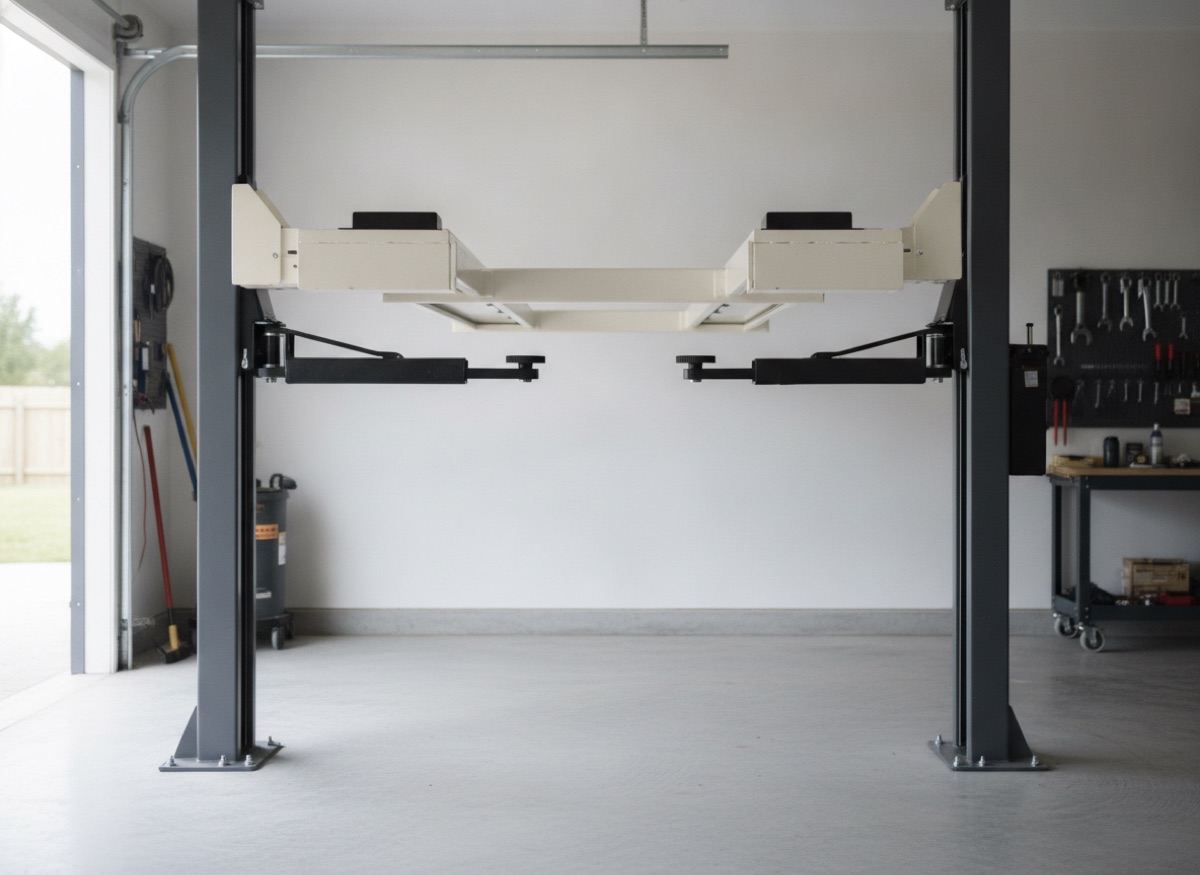
Illustration of a typical 2-post lift — not a photograph of the DMC-FPPS 110V Two Post Lift 9,000 LBS.
DMC-FPPS 110V Two Post Lift 9,000 LBS Review: Plug-and-Play Convenience Meets Serious Capacity
The DMC-FPPS 110V 9,000 lb 2-post is a floor-plate lift built for garages without 220V service: it runs a 2HP motor on a dedicated 20A household circuit, keeps the full 9,000 lb rating, uses asymmetric arms and carries a 3-year warranty, for about $2,550. This review covers what 110V costs in lift speed, what the floor plate costs in workspace, and who should pay $50 more than the 220V version.
Affiliate Disclosure: Car Lift For Garage is a participant in the Amazon Services LLC Associates Program, an affiliate advertising program designed to provide a means for sites to earn advertising fees by advertising and linking to Amazon.com. We may earn a commission from qualifying purchases made through links on this page, at no additional cost to you.
How this review was researched
This is a research-based review built from the manufacturer's specifications and manuals, ALI certification records and the pricing and owner feedback available for this class of lift. We have not installed or operated this unit ourselves, and we do not publish a star rating without at least 10 verified owner ratings. How we evaluate lifts.
Pros
- 110V plug-and-play requires no special electrical work
- Same 9,000 lb capacity as the 220V version without compromise
- Floor plate design adds structural rigidity between columns
- 3-year warranty matches more expensive competitors
- Single-phase power works with any standard household outlet
- Quieter motor operation compared to 220V counterpart
Cons
- Lifting speed is approximately 20% slower than 220V models
- Floor plate reduces under-vehicle workspace access
- Higher amp draw means a dedicated 20-amp circuit is recommended
- Slightly higher price than the 220V version for the same capacity
Why a 110V 2-post exists
Most 2-post lifts run on 220V single phase because a hydraulic pump that lifts 9,000 lb needs more power than a 15A household circuit delivers. The DMC-FPPS 110V gets around that with a 2HP motor drawing on a dedicated 20A circuit, which is a standard wiring job in any garage with a panel nearby and, in many, an outlet that already exists. That makes it a plug-in lift in the practical sense, though not on an ordinary 15A outlet shared with the freezer.
The trade is speed. DMC-FPPS keeps the full 9,000 lb rating, but the pump moves less fluid per second on 110V, and the seller's own comparison puts the rise at roughly 20 percent slower than the 220V version. On a lift that takes about a minute to reach full height, that is an extra twelve seconds or so per cycle. For a home mechanic lifting a car a few times a week it is nothing; for a shop cycling a lift thirty times a day it would add up.
Floor plate versus overhead
The 110V model is a floor-plate design, unlike the 220V DMC-FPPS overhead. The equalization cables and hydraulic line cross the bay in a steel channel at floor level instead of through a beam above the columns. The columns are still 143 in tall, so the ceiling does not drop much, but there is no beam or shut-off bar above them, which matters when a garage door track or an opener motor sits where a beam would go.
The cost is the channel itself. It is an inch or two tall, it runs the width of the bay, and every wheeled thing in the garage has to cross it: transmission jack, oil drain, creeper, the floor jack for the second car. Owner reviews on Amazon are divided on it in the usual way, with people who needed the lower profile glad to have a 2-post at all and people with tall ceilings wishing they had gone overhead. The plate does stiffen the columns against each other, which a light 1,500 lb lift benefits from.
* Affiliate link - we may earn a commission
Capacity, rise and dimensions
The rating is 9,000 lb, the same as the 220V overhead, and the 69 in rise and 112 in inside width are also identical. That covers every sedan, SUV and half-ton pickup and most three-quarter-ton trucks unloaded, and it puts a lifted car at standing height for a mechanic of average build. The asymmetric arms set the vehicle back in the bay so the doors open, which the symmetric APlusLift HW-9KOH and HPDMC 110V do not allow.
Overall height is 143 in, or 11 ft 11 in, so the columns need a ceiling around 12 ft even without a beam. That is taller than a buyer might expect from a floor-plate lift, and it is the number to check first. Shipping weight is 1,500 lb, a little heavier than the overhead version because of the plate. Owner reviews note the 110V motor runs quieter than the 220V unit, which is a pleasant side effect of the lower power.
Installation and the 20A circuit
This is the easiest 2-post install in the DMC-FPPS line, and an easy rating is fair relative to overhead lifts: there is no beam to lift into place, the cable crossover runs at floor level, and the power unit plugs into a 110V receptacle. The circuit should be a dedicated 20A line; sharing it with a compressor or a freezer will trip breakers and can overheat the motor. An electrician can add one in an afternoon if the panel has a slot.
The columns still need a minimum 4 in concrete slab and still weigh enough that two people want an engine hoist or a third helper to stand them. Plan on a long day rather than a weekend. The hardware kit and the manual are the same as the overhead model, adequate with thin coverage of cable tensioning, and support response from DMC-FPPS is the recurring complaint in owner reviews, so ask questions before the crate ships rather than during the install.
Compared with the HPDMC 110V, DMC-FPPS 220V and HW-9KOH
The HPDMC 110V 9,000 lb Heavy Duty at about $2,450 is the direct rival: also 110V on a 20A circuit, also 9,000 lb, but overhead rather than floor-plate, symmetric rather than asymmetric, with a 36-month warranty. It keeps the floor clear and gives up door clearance. The DMC-FPPS 220V overhead at about $2,500 is the same brand with faster lifting and a clear floor, and it is the better lift for any garage that can run a 220V line.
The APlusLift HW-9KOH at about $2,199 is 220V only, symmetric, clear-floor, with a 3-year warranty and the largest body of owner reviews of any 2-post. Against it, the DMC-FPPS 110V trades $350 and a floor plate for a plug-in circuit and asymmetric arms. If 110V is a hard constraint, this lift and the HPDMC 110V are the two choices, and the decision comes down to door clearance versus a clear floor. We would take the DMC-FPPS for interior work and the HPDMC for underbody work.
Who should buy it (and who shouldn't)
Buy the DMC-FPPS 110V if the garage cannot get 220V, has a 12 ft ceiling or close to it, has a sound 4 in slab, and needs door clearance with the vehicle raised. Buy it if a garage door track or opener rules out an overhead beam. The 3-year warranty is reassuring on a lift from a brand still building its record, and the quieter motor is a real benefit in an attached garage.
Skip it if 220V is available or can be added for a few hundred dollars, because the 220V overhead version is cheaper, faster and clear-floor. Skip it if a transmission jack or rolling toolbox will cross the bay daily and the plate will be a nuisance. Skip it for a shop cycling the lift many times a day, where the slower rise adds up and an ALI listing is expected. It solves one specific problem, no 220V, and it should be bought for that problem.
Final Verdict
The DMC-FPPS 110V is the 2-post to buy when adding a 220V circuit is not an option, whether because the panel is full, the garage is detached, or the house is rented. It keeps the same 9,000 lb rating and asymmetric arms as the 220V overhead model and adds a 3-year warranty, and the only real penalty is a rise that takes roughly a fifth longer. The floor plate is the bigger compromise: it keeps the ceiling requirement down but puts a steel channel across the bay. Buy it if 110V is the constraint and door clearance matters. Skip it if the garage has or can get 220V, because the 220V overhead version is $50 cheaper, faster and clear-floor, and that is the better lift.
- 110V plug-and-play requires no special electrical work
- Same 9,000 lb capacity as the 220V version without compromise
- Floor plate design adds structural rigidity between columns
- 3-year warranty matches more expensive competitors
Price incl. tax, excl. shipping. Last updated September 5, 2026.
* Affiliate link - we may earn a commission
Specifications
- Lifting Capacity
- 9,000 lbs
- Lift Type
- Floor Plate, Two Post
- Motor
- 110V Single Phase, 2HP
- Rise Height
- 69 inches
- Overall Height
- 143 inches
- Width Between Posts
- 112 inches
- Power Requirement
- 110V / 20A Dedicated Circuit
- Warranty
- 3-Year Manufacturer
- Weight
- 1,500 lbs
- Arm Type
- Asymmetric Swing Arms
* Affiliate link - we may earn a commission
Wheels off? Check the tires
A lift puts every tire at eye level, so it is an easy time to check pressure. Fanttik makes cordless tire inflators.
See Fanttik tire inflatorsTags
Related Reviews
DMC-FPPS Two Post Car Lift 9,000 LBS Overhead Review: Certified Performance at a Fair Price
$2,499.99
HPDMC 110V Two Post Lift 9,000 LBS Heavy Duty Review: Budget 110V with Solid Fundamentals
$2,449.99

APlusLift HW-9KOH Review: Best Value 9,000 lb Overhead 2-Post Lift
$2,199
Need Help Choosing?
Use our comparison tool to see how the DMC-FPPS 110V Two Post Lift 9,000 LBS stacks up against other lifts, or read our buying guide for expert recommendations.