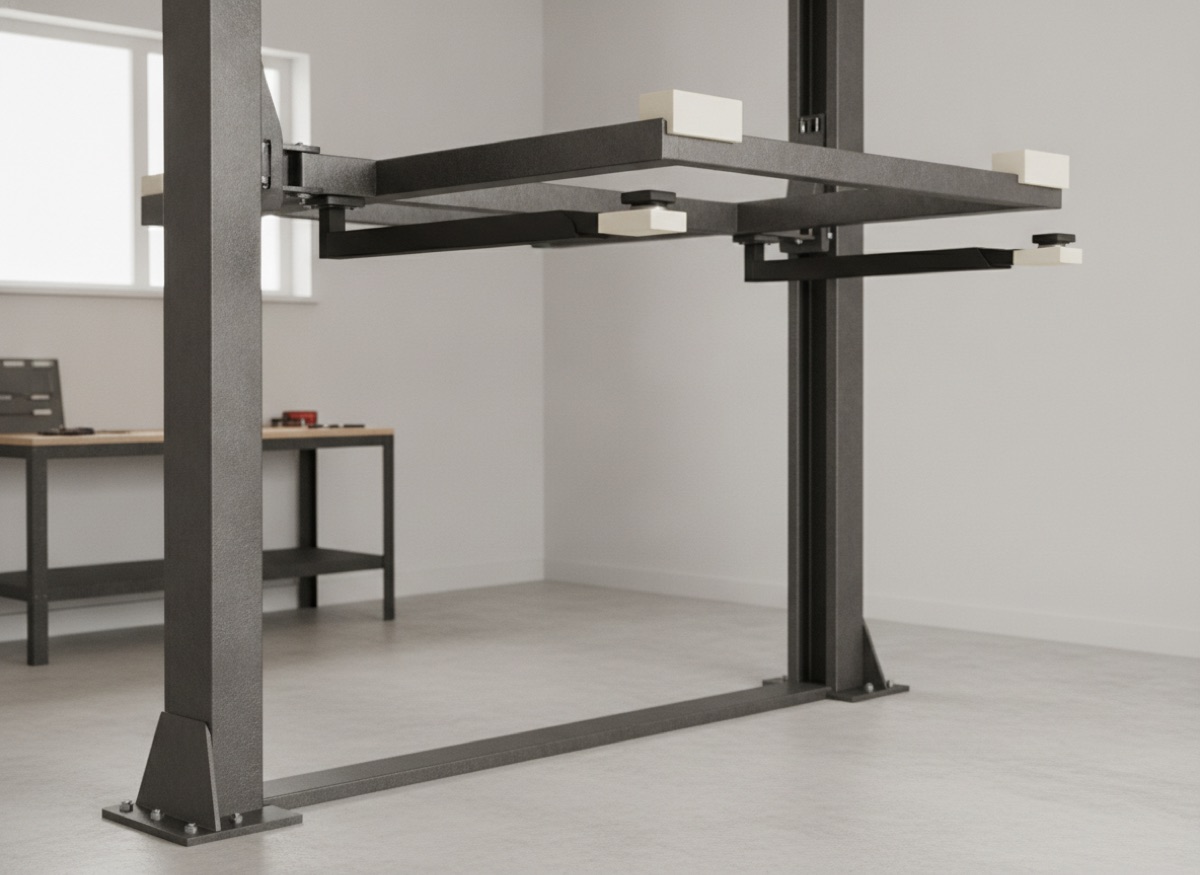
Illustration of a typical 2-post lift — not a photograph of the DMC-FPPS Two Post Car Lift 9,000 LBS Overhead.
DMC-FPPS Two Post Car Lift 9,000 LBS Overhead Review: Certified Performance at a Fair Price
The DMC-FPPS 9,000 lb overhead 2-post sells for about $2,500 with asymmetric swing arms, a 3-year manufacturer warranty and an ALI/ETL certification claim that is unusual at this price. This review covers the 12 ft ceiling it needs, what to verify about that certification, and how it compares to the APlusLift HW-9KOH and Atlas 9KOHX.
Affiliate Disclosure: Car Lift For Garage is a participant in the Amazon Services LLC Associates Program, an affiliate advertising program designed to provide a means for sites to earn advertising fees by advertising and linking to Amazon.com. We may earn a commission from qualifying purchases made through links on this page, at no additional cost to you.
How this review was researched
This is a research-based review built from the manufacturer's specifications and manuals, ALI certification records and the pricing and owner feedback available for this class of lift. We have not installed or operated this unit ourselves, and we do not publish a star rating without at least 10 verified owner ratings. How we evaluate lifts.
Pros
- ALI/ETL certified for verified safety standards
- Overhead design keeps floor area completely clear
- 3-year manufacturer warranty provides peace of mind
- All installation hardware included in shipment
- Solid 9,000 lb capacity handles most passenger vehicles and light trucks
- Smooth hydraulic operation with minimal noise
Cons
- Requires a minimum ceiling height of 12 feet for overhead configuration
- Installation is a two-person job that takes a full weekend
- Powder coat is on the thin side and chips at the arm ends, according to owner reviews
- Customer support response times can be slow during peak periods
What the DMC-FPPS 9,000 lb overhead offers at $2,500
DMC-FPPS is one of the newer names selling 2-post lifts on Amazon, and this 9,000 lb overhead model is its answer to the APlusLift HW-9KOH. It is a clear-floor design with the crossover through an overhead beam, 220V single-phase power, 69 in of rise and a 143 in overall height. What separates it from the HW-9KOH on paper are asymmetric swing arms, which set the vehicle back so the doors open, and a listing as ALI/ETL certified, which is rare on a lift under $3,000.
The warranty is 3 years from the manufacturer, matching APlusLift and beating the 1-year coverage on the Atlas 9KOHX and Triumph NTO-9A. The shipping weight of 1,450 lb is in line with the class. At about $2,500 it costs roughly $300 more than the HW-9KOH and $100 more than the Atlas, and the case for it rests almost entirely on whether the certification and the asymmetric arms are worth that.
Capacity, rise and the 12 ft ceiling
The rating is 9,000 lb, which covers every sedan, SUV and half-ton pickup and most three-quarter-ton trucks unloaded. Rise is 69 in to the pad, enough to stand under a car for a mechanic of average height. The columns are 112 in apart inside, which is a normal drive-through width for full-size trucks, and the overall height is 143 in, or 11 ft 11 in.
Because the beam and shut-off bar sit above the column tops, the seller specifies a 12 ft minimum ceiling, and that number should be taken literally. It is 6 in more than the HW-9KOH needs and 10 in more than the Atlas 9KOHX, which rules this lift out of a lot of standard garages. Measure to the lowest obstruction, including door tracks and opener motors, before ordering. The asymmetric arms also mean the vehicle sits toward the rear of the bay, so leave room behind it for the tailgate and the walkway.
* Affiliate link - we may earn a commission
Installation, power and support
Power is 220V single phase; there is a separate 110V floor-plate version for garages without it. Anchoring is into a minimum 4 in concrete slab with the included hardware, and the seller ships the anchor bolts and the hydraulic fittings in the crate, which owner reviews on Amazon note as a plus compared with lifts that arrive missing small parts. The columns are the heavy items, and two people with an engine hoist or a third helper can stand them; the overhead beam needs a tall ladder and a second set of hands.
Plan on a full weekend. The manual is adequate, with the usual thin coverage of cable tensioning. The most consistent complaint in owner reviews is not the hardware but the support: response times from DMC-FPPS can be slow, and a buyer who needs a replacement part quickly may wait. That is worth weighing against the 3-year warranty, which is only as good as the company answering the email.
The ALI/ETL claim and what to check
The certification listing is the most interesting thing about this lift and the thing that most needs verifying. ALI certification means a third-party lab has verified the design against the ANSI/ALI ALCTV standard and that the specific model appears in the ALI directory; ETL is the testing mark. If the DMC-FPPS model number is in that directory, the buyer is getting a tested lift for the price of an untested one, which is a genuinely good deal. If it is not, the claim is marketing.
The way to check is simple: search the ALI directory for the manufacturer and model before buying, and compare the model number on the certificate to the one in the listing. Several imports sell under multiple brand names, and the certified model is sometimes a sibling rather than the one on the page. Beyond the label, the lift has automatic mechanical safety locks in each column and arm restraints, the standard hardware for the class, and its 1,450 lb shipping weight suggests column steel comparable to the HW-9KOH rather than lighter.
Compared with the HW-9KOH, WEIZE 10,000 and Atlas 9KOHX
The APlusLift HW-9KOH, about $2,199, is symmetric, CE certified, needs 11 ft 6 in, and has the deepest pool of owner reviews of any home 2-post plus the same 3-year warranty. The Atlas 9KOHX, about $2,399, is symmetric with extra-wide columns, needs 11 ft 2 in, and carries a 1-year warranty backed by Greg Smith Equipment's dealer network. The WEIZE 10,000 lb at about $1,899 is the budget option with lighter steel and a 1-year warranty.
Against those three, the DMC-FPPS is the only one with asymmetric arms and the only one listing ALI/ETL certification, and it costs the most and needs the tallest ceiling. If the certification checks out, we would take it over the Atlas for the same money and over the HW-9KOH for a garage that does interior work with the car in the air. If a buyer does not care about door clearance or the label, the HW-9KOH is the better-documented lift for $300 less.
Who should buy it (and who shouldn't)
Buy the DMC-FPPS 9,000 lb overhead if the garage has a full 12 ft ceiling, 220V and a sound 4 in slab, if door clearance for interior work matters, and if the ALI directory confirms the model. That combination at about $2,500 is not available from APlusLift, Atlas or Triumph, and it is the reason to pay the premium. The 3-year warranty is a real plus for a lift from a young brand.
Skip it if the ceiling is under 12 ft; the HW-9KOH fits in 11 ft 6 in and the Atlas 9KOHX in 11 ft 2 in. Skip it if the certification cannot be confirmed, because then the price premium buys only the asymmetric arms. Skip it if fast support matters more than warranty length, and for commercial use verify the listing with the insurer first. It is a promising lift from a brand that still has to earn the track record its warranty implies.
Final Verdict
The DMC-FPPS 9,000 lb overhead is worth a serious look for one reason: it is one of the few 2-posts near $2,500 that lists ALI/ETL certification, and it pairs that with asymmetric arms and a 3-year warranty, three things the APlusLift HW-9KOH and Atlas 9KOHX do not offer together. Before paying for it, look the model up in the ALI directory and confirm the listing matches what ships, because the certification is the reason to choose it over cheaper lifts. It needs a 12 ft ceiling, 220V and a 4 in slab, and it weighs 1,450 lb, so the install is a full weekend for two. Buy it for a home garage that wants door clearance and the label. Skip it if the ceiling is under 12 ft, where the HW-9KOH fits, or if support response time matters, which owner reviews flag as slow.
- ALI/ETL certified for verified safety standards
- Overhead design keeps floor area completely clear
- 3-year manufacturer warranty provides peace of mind
- All installation hardware included in shipment
Price incl. tax, excl. shipping. Last updated September 5, 2026.
* Affiliate link - we may earn a commission
Specifications
- Lifting Capacity
- 9,000 lbs
- Lift Type
- Overhead, Clear Floor
- Motor
- 220V Single Phase
- Rise Height
- 69 inches
- Overall Height
- 143 inches
- Width Between Posts
- 112 inches
- Certification
- ALI/ETL Certified
- Warranty
- 3-Year Manufacturer
- Weight
- 1,450 lbs
- Arm Type
- Asymmetric Swing Arms
* Affiliate link - we may earn a commission
Wheels off? Check the tires
A lift puts every tire at eye level, so it is an easy time to check pressure. Fanttik makes cordless tire inflators.
See Fanttik tire inflatorsTags
Related Reviews


Need Help Choosing?
Use our comparison tool to see how the DMC-FPPS Two Post Car Lift 9,000 LBS Overhead stacks up against other lifts, or read our buying guide for expert recommendations.