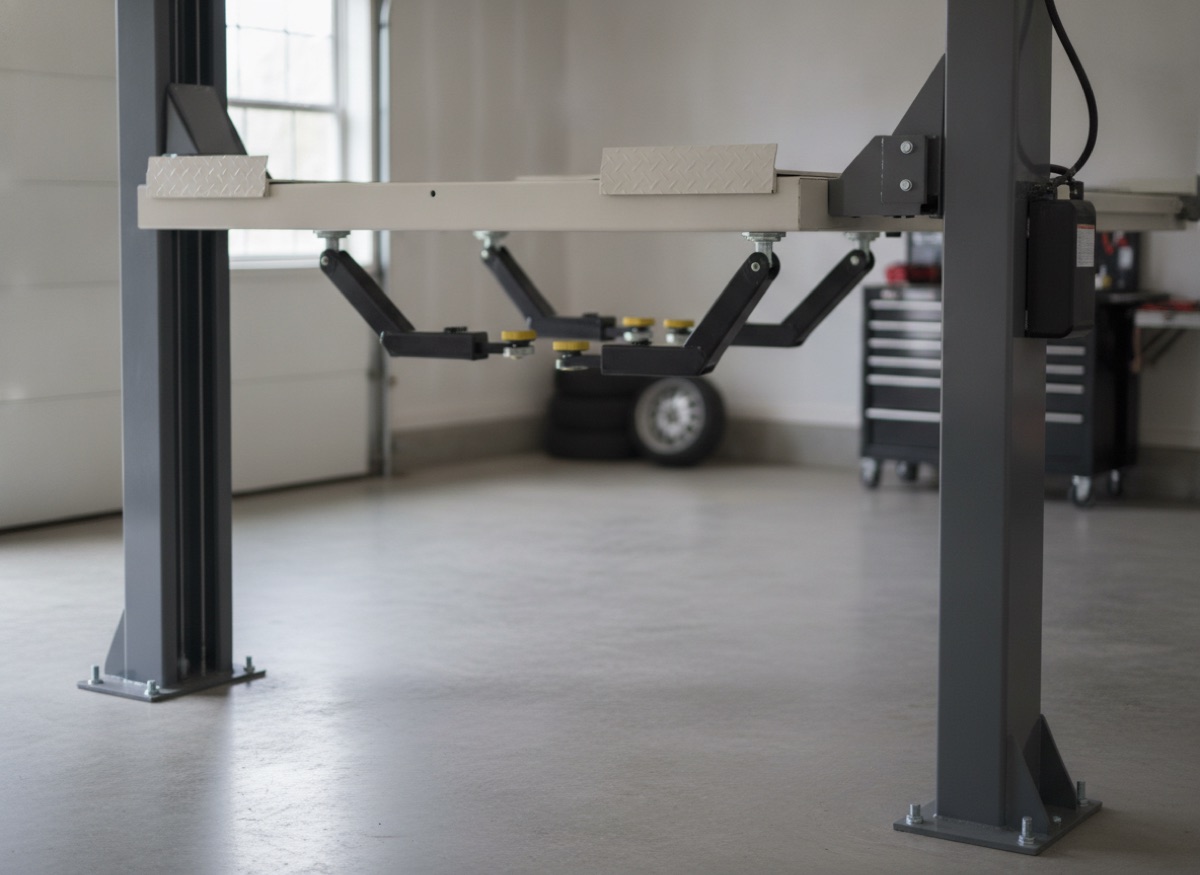
Illustration of a typical 2-post lift — not a photograph of the HPDMC 110V Two Post Lift 9,000 LBS Heavy Duty.
HPDMC 110V Two Post Lift 9,000 LBS Heavy Duty Review: Budget 110V with Solid Fundamentals
The HPDMC 110V 9,000 lb Heavy Duty is a clear-floor overhead 2-post that runs on a dedicated 20A household circuit instead of 220V, with symmetric arms, a 36-month warranty and 141 in columns, for about $2,450. This review covers what 110V costs in lift speed, the ceiling it needs, and how it compares to the DMC-FPPS 110V and the 220V HPDMC.
Affiliate Disclosure: Car Lift For Garage is a participant in the Amazon Services LLC Associates Program, an affiliate advertising program designed to provide a means for sites to earn advertising fees by advertising and linking to Amazon.com. We may earn a commission from qualifying purchases made through links on this page, at no additional cost to you.
How this review was researched
This is a research-based review built from the manufacturer's specifications and manuals, ALI certification records and the pricing and owner feedback available for this class of lift. We have not installed or operated this unit ourselves, and we do not publish a star rating without at least 10 verified owner ratings. How we evaluate lifts.
Pros
- 110V standard power eliminates need for special electrical installation
- 36-month warranty is among the best in this price class
- Heavy-duty construction feels solid and inspires confidence
- Easy maintenance design with accessible grease points and filters
- Competitive pricing for a 110V heavy-duty lift
- Clear installation guide with helpful troubleshooting section
Cons
- Noticeably slower lift speed compared to 220V alternatives
- Owner reviews mention the motor running warm after back-to-back lifts
- Limited color options — only available in standard red
- Arm swing range is slightly restricted compared to premium models
What the 110V Heavy Duty is built for
HPDMC sells this lift for the garage that has a panel with a spare 20A slot and no appetite for running 220V. It is a 9,000 lb clear-floor overhead 2-post, the same layout as the company's 220V model, with a 2HP motor wound for 110V single phase. The rating is not reduced for the lower voltage; what changes is the pump's flow, so the carriage rises more slowly. The Heavy Duty name refers to the columns, which are heavier than HPDMC's lighter 220V 9,000 lb model at 1,400 lb shipping weight.
The arms are symmetric, which centers the vehicle between the columns and limits how far the doors open with the car in the air. That is the main difference from the DMC-FPPS 110V, which uses asymmetric arms on a floor plate. The warranty is 36 months, matching APlusLift and the rest of HPDMC's line, and the price of about $2,450 puts it roughly $250 above the APlusLift HW-9KOH, which needs 220V.
Capacity, rise and ceiling
The 9,000 lb rating covers sedans, SUVs, half-ton pickups and most three-quarter-ton trucks unloaded. Rise is 68 in, an inch less than the HW-9KOH and 4 in less than the 10,000 lb class above it; it is enough to stand under a car for most people. Inside width between posts is 110 in, a normal drive-through for full-size vehicles.
Overall height is 141 in, or 11 ft 9 in. With the shut-off bar above the beam, the practical minimum ceiling is a little under 12 ft, which is more than the HW-9KOH needs and far more than a standard 10 ft garage offers. Buyers sometimes assume a 110V lift is a low-ceiling lift; it is not. This is a full-height overhead 2-post that happens to plug into a smaller circuit, and the tape measure needs to go to the lowest obstruction before ordering.
* Affiliate link - we may earn a commission
The 20A circuit and what it means for speed
The lift needs a dedicated 110V 20A circuit. That is a common wiring job, often an afternoon for an electrician if the panel has a slot, and in many garages a 20A outlet already exists for a compressor. Sharing the circuit with that compressor or a freezer is how breakers trip mid-lift and how motors overheat, so the dedicated line is not optional. Owner reviews on Amazon that describe the motor running warm after several lifts in a row are usually describing exactly that use pattern, or a long extension cord, which drops voltage and heats the motor.
The speed penalty is real and modest: a 110V 2HP pump lifts a car noticeably more slowly than a 220V unit, in the neighborhood of a fifth longer per cycle. For a home garage lifting a car a few times a week it is a non-issue. For a shop cycling the lift many times a day it would be a daily annoyance, and that shop should be on 220V anyway.
Maintenance access and safety hardware
One thing HPDMC did well on this lift is put the maintenance points where a home mechanic can reach them: the arm pivot grease fittings and the hydraulic filter are accessible without pulling covers, and the manual includes a troubleshooting section that owner reviews mention as unusually useful. That matters more on a budget lift than on a BendPak, because the buyer is the service department.
Safety hardware is standard for the class: automatic mechanical locks in each column that engage as the carriage rises, and arm restraints. The lift is CE self-certified, not ALI/ETL listed, which is fine for a home garage and not enough for a commercial shop or most insurers. The arm swing range is a little more restricted than on premium lifts, which occasionally makes it awkward to reach the lift points on a long-wheelbase vehicle. The 36-month warranty covers the motor and pump, the parts most likely to fail on a 110V lift.
Compared with the DMC-FPPS 110V, HPDMC 220V and WEIZE
The DMC-FPPS 110V 9,000 lb at about $2,550 is the other serious 110V 2-post: same capacity, same 20A circuit, a 3-year warranty, but a floor-plate design with asymmetric arms. It wins on door clearance and loses on the steel channel across the bay. The HPDMC 220V 9,000 lb at about $2,400 is the same brand and warranty with a faster pump, asymmetric arms and a lighter 1,380 lb build; for any garage with 220V it is the better lift.
The WEIZE 10,000 lb at about $1,899 needs 220V, so it is not an option for the buyer this lift is aimed at. Between the two 110V lifts, the choice is clear-floor versus door clearance. We would take the HPDMC for a garage that does exhaust, transmission and suspension work, where a transmission jack rolls under the car every week, and the DMC-FPPS for one that does interior work with the doors open.
Who should buy it (and who shouldn't)
Buy the HPDMC 110V Heavy Duty if the garage cannot get 220V, has close to 12 ft of ceiling and a sound 4 in slab, and needs the floor clear for jacks and drains. Buy it if a 36-month warranty and an accessible maintenance layout are worth $250 over the HW-9KOH, which would need the 220V line this buyer does not have anyway.
Skip it if 220V is available or affordable, because the HPDMC 220V is cheaper and faster with asymmetric arms. Skip it if door clearance matters, where the DMC-FPPS 110V is the 110V option. Skip it for a shop cycling the lift daily or needing an ALI listing. And run it on its own 20A circuit with no extension cord, because the warm-motor complaints in owner reviews mostly trace back to not doing that.
Final Verdict
The HPDMC 110V Heavy Duty is the clear-floor answer for a garage that cannot get 220V, and among the two 110V 2-posts worth considering it is the one for underbody work, because the floor stays open. It keeps the full 9,000 lb rating, backs it with a 36-month warranty, and puts the grease points and the hydraulic filter where a home mechanic can reach them. The price is a slower rise than a 220V lift, a motor that owner reviews say runs warm after several lifts in a row, and a 141 in column height that still needs close to 12 ft of ceiling. Buy it if 110V is the constraint and a clear floor matters more than door clearance. Skip it if 220V is available, because the HPDMC 220V 9,000 lb is faster and $50 cheaper, and skip it for a shop that cycles a lift all day.
- 110V standard power eliminates need for special electrical installation
- 36-month warranty is among the best in this price class
- Heavy-duty construction feels solid and inspires confidence
- Easy maintenance design with accessible grease points and filters
Price incl. tax, excl. shipping. Last updated September 5, 2026.
* Affiliate link - we may earn a commission
Specifications
- Lifting Capacity
- 9,000 lbs
- Lift Type
- Overhead, Two Post
- Motor
- 110V Single Phase, 2HP
- Rise Height
- 68 inches
- Overall Height
- 141 inches
- Width Between Posts
- 110 inches
- Power Requirement
- 110V / 20A Dedicated Circuit
- Warranty
- 36-Month Full Coverage
- Weight
- 1,400 lbs
- Arm Type
- Symmetric Swing Arms
* Affiliate link - we may earn a commission
Wheels off? Check the tires
A lift puts every tire at eye level, so it is an easy time to check pressure. Fanttik makes cordless tire inflators.
See Fanttik tire inflatorsTags
Related Reviews

Need Help Choosing?
Use our comparison tool to see how the HPDMC 110V Two Post Lift 9,000 LBS Heavy Duty stacks up against other lifts, or read our buying guide for expert recommendations.