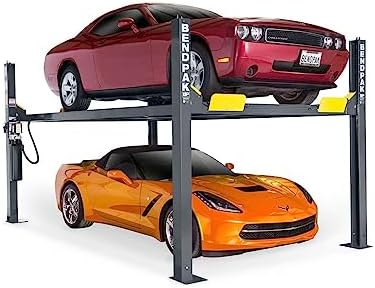
Challenger CL10V3 Review: Versymmetric 10,000-lb Commercial Quality Lift
The CL10V3 is Challenger's 10,000 lb lift with a versymmetric layout, meaning it accepts vehicles positioned either symmetrically or offset rather than forcing one loading pattern. It carries the ALI gold certification label, runs 106 in wide by 210 in long with 80 in of rise, and sells through Challenger's dealer network at roughly $4,599 MSRP rather than on Amazon.
Sold through equipment dealers — not currently listed on Amazon
See Top-Rated 4-Post LiftsAffiliate Disclosure: Car Lift For Garage is a participant in the Amazon Services LLC Associates Program, an affiliate advertising program designed to provide a means for sites to earn advertising fees by advertising and linking to Amazon.com. We may earn a commission from qualifying purchases made through links on this page, at no additional cost to you.
How this review was researched
This is a research-based review built from the manufacturer's specifications and manuals, ALI certification records and the pricing and owner feedback available for this class of lift. We have not installed or operated this unit ourselves, and we do not publish a star rating without at least 10 verified owner ratings. How we evaluate lifts.
Pros
- ALI Gold certification verifies the highest safety and quality standards
- Versymmetric design accommodates both symmetric and asymmetric vehicle types
- Extended runways handle longer vehicles without compromise
- Commercial-quality construction suitable for professional shop environments
- 10,000-lb capacity covers the vast majority of consumer vehicles
- Challenger brand backed by strong parts and service network
Cons
- Versymmetric setup adds complexity to initial installation
- Premium pricing compared to standard symmetric lifts
- Extended runways increase overall floor space requirements
- Heavier than comparable symmetric-only designs
What versymmetric means and why it matters
Versymmetric is Challenger's term for a lift that accommodates both symmetric and asymmetric vehicle positioning rather than committing to one. In practice it means the geometry does not force every vehicle into the same spot, so a long-nosed pickup and a short front-overhang sedan can each sit where their weight balances properly.
The reason this matters is load distribution. A vehicle placed wrong on any lift puts more weight on one end of the structure than the design assumes. A layout that tolerates both positioning schemes takes that decision away from the operator, which is worth more in a busy shop than in a home garage where the same two cars go up every time.
The cost is setup complexity. There are more configuration choices at installation, and getting them right takes reading the manual rather than following intuition. Challenger's documentation is good, which is one of the practical advantages of buying from a company whose customers are professional shops.
The ALI gold certification label
The CL10V3 carries the gold ALI certification label, which means an independent laboratory has verified this model against the ANSI/ALI ALCTV standard and Challenger maintains the ongoing audits the program requires. The lift appears in the Automotive Lift Institute directory, and that directory is what an insurer or an inspector checks.
That listing is rarer in this price band than buyers assume. Dannmar, Atlas, Triumph, Forward and Greg Smith all sell 10,000 to 14,000 lb 4-post lifts without it. Certification does not make the steel thicker or the welds better. What it means is that the 10,000 lb rating was proven with the standard's overload margin by someone other than the manufacturer, and that the safety systems were evaluated rather than described.
For a home garage the practical consequence is usually nothing. For a commercial shop, a lift in a rented building, or anywhere an insurance policy references certified equipment, it is the whole reason to pay Challenger prices instead of import prices.
Available on Amazon in this category:
* Affiliate link - we may earn a commission
Capacity, dimensions and ceiling math
Ten thousand pounds is the right rating for a lift that will hold consumer vehicles. A three-quarter-ton diesel crew cab loaded for towing reaches about 9,500 lb, which is the practical ceiling of what a private owner puts on a lift, and everything lighter has real margin. Going to 14,000 lb buys capacity that only commercial chassis use.
Rise is 80 in, which puts the runway underside above head height for most adults. That is a working lift, not a storage lift, though it does both.
The 210 in runway length is the number that decides whether the CL10V3 fits your building. Add approach ramps and clearance at both ends and you want roughly 20 ft of depth. Width at 106 in needs about 11 ft of bay with a walkway. For ceiling, 80 in of rise plus the height of the vehicle going up gives the requirement: a 76 in tall SUV on the deck needs 156 in, or 13 ft, before margin. Measure to the lowest obstruction, not the joists.
Installation, slab and power
Extended 210 in runways are the hard part of this installation. They are long, heavy, and awkward to place on the carriages without machinery, so plan on three people minimum and preferably a forklift. Column alignment over that span matters more than on a short deck, because small angular errors accumulate along the length.
Slab requirements follow the class, 4 in of 3,000 psi minimum with anchor points clear of cracks and control joints, and Challenger's manual gives the exact anchor pattern and torque values. Follow them rather than approximating; a certified lift installed outside its documented requirements is no longer covered by the certification in any meaningful sense.
Power is 220V single phase. The versymmetric configuration adds decisions at setup that a fixed-geometry lift does not have, which is the single most common reason a first-time installer needs the manual open. Budget a full day plus a second session for cable equalization and the first cycles under load.
How it compares to the HD-9ST, Dannmar D-12 and Challenger CL9
BendPak's HD-9ST is the residential-scale alternative: 9,000 lb, 173 in of deck, 82 in of rise, ALI certified and a rolling jack included, at roughly $3,300. It fits garages the CL10V3 does not, and for a home shop it is the more sensible purchase. The Challenger earns its extra money in a professional setting.
The Dannmar D-12 gives 12,000 lb on a 108 by 203 in frame with a 2-year warranty at around $4,299. More capacity, less money, no certification. That is the trade, and it comes down to whether anyone will ever ask you to produce an ALI listing.
Challenger's own CL9 drops to 9,000 lb on a shorter frame. If the vehicles are cars and half-ton trucks and the bay is tight, the CL9 keeps the certification and the dealer network while fitting a smaller building.
Final Verdict
Buy the CL10V3 if you want ALI certification on a 10,000 lb lift and you value a real parts and service network over the lowest price. Challenger has been building lifts for professional shops for decades and it shows in the hardware and the documentation. Ten thousand pounds covers every consumer vehicle with margin, and 80 in of rise means you work standing. Skip it if the bay cannot give up 210 in of length plus ramps and a walkway, which rules out most residential garages. Skip it too if certification is not a requirement for you, because the Dannmar D-12 gives 2,000 lb more capacity for several hundred dollars less.
The Challenger CL10V3 isn't currently sold on Amazon. Here's our top-rated 4-post lifts pick that is:

Our top-rated 4-post lifts currently available on Amazon.
Price incl. tax, excl. shipping.
* Affiliate link - we may earn a commission
Specifications
- Capacity
- 10,000 lbs
- Overall Width
- 106 inches
- Overall Length
- 210 inches
- Max Rise Height
- 80 inches
- Power Supply
- 220V single phase
- Design
- Versymmetric
- Certification
- ALI Gold certified
- Runways
- Extended length
- Safety Locks
- Multi-position automatic
- Warranty
- 2 year limited
Wheels off? Check the tires
A lift puts every tire at eye level, so it is an easy time to check pressure. Fanttik makes cordless tire inflators.
See Fanttik tire inflatorsTags
Related Reviews
Need Help Choosing?
Use our comparison tool to see how the Challenger CL10V3 stacks up against other lifts, or read our buying guide for expert recommendations.