Best 2-Post Car Lifts for Home Garages
A 2-post lift is the single most capable piece of equipment you can put in a home garage, giving you full undercar access for brakes, suspension, and exhaust work. After two decades installing and servicing these lifts, here are the models I trust and exactly how to choose between them.
Affiliate Disclosure: Car Lift For Garage is a participant in the Amazon Services LLC Associates Program, an affiliate advertising program designed to provide a means for sites to earn advertising fees by advertising and linking to Amazon.com. We may earn a commission from qualifying purchases made through links on this page, at no additional cost to you.

Why a 2-Post Lift Is the Home Mechanic’s First Choice
If you do real mechanical work — brakes, suspension, exhaust, transmission, or restoration — a two-post lift is the tool that changes everything. Unlike a four-post or a portable lift, a two-post raises the vehicle by its frame or pinch-weld points, leaving all four wheels hanging free. That means total, unobstructed access to the entire underside of the car, including the wheels themselves.
I have spent more than 20 years working under vehicles, and I can tell you the difference between a two-post lift and working on jack stands is night and day. A job that takes two hours on the ground takes 30 minutes on a lift, and you do it standing up instead of lying on a creeper. For a dedicated home mechanic, it is the best money you will ever spend on your garage.
The trade-off is that two-post lifts demand more from your garage than other types. You need adequate ceiling height (generally 11 feet 6 inches or more for full rise), a 4-inch concrete slab rated to at least 3,000 PSI, and in most cases a 220-volt circuit. If your garage cannot meet those requirements, a portable or four-post lift may be a better fit — and I cover those in our low-ceiling lift guide. But if you can meet them, nothing else compares for serious work.
Our Top 2-Post Lift Picks at a Glance
Here is how my recommended two-post lifts stack up. Every model below carries either ALI/ETL certification or, at minimum, ETL safety listing, and each one has a real track record in home garages.
| Model | Capacity | Clearance Type | Price Class | Best For |
|---|---|---|---|---|
| BendPak XPR-10AS | 10,000 lb | Asymmetric | ~$4,035 | Best overall |
| APlusLift HW-9KOH | 9,000 lb | Overhead symmetric | ~$2,099 | Best value |
| Atlas 9KOHX | 9,000 lb | Overhead | ~$2,399 | Best mid-range |
| Triumph NTO-9A | 9,000 lb | Asymmetric | ~$2,695 | Best for tight bays |
| WEIZE 10,000 lb | 10,000 lb | Symmetric | ~$1,899 | Best budget |
If you want the short version: buy the BendPak XPR-10AS if your budget allows, because the build quality and support are worth the premium. If you want the best balance of capability and price, the APlusLift HW-9KOH is the one I recommend most often to home mechanics.
Best Overall: BendPak XPR-10AS
The BendPak XPR-10AS is the lift we point most serious enthusiasts toward. BendPak has been building lifts in the United States for decades, and it shows in the details: thicker steel columns, a tested and certified safety lock system, and arm restraints that actually hold up over years of daily use.
The 10,000-pound capacity comfortably handles everything from a compact car to a loaded half-ton truck. The asymmetric arm design rotates the vehicle slightly toward the rear, which gives you the door clearance to step out comfortably even in a two-car garage. That single feature prevents more dinged doors and frustrated owners than any other.
💡Verify Your Ceiling First
The XPR-10AS needs roughly 11 feet 6 inches of ceiling clearance for full rise. Measure to the lowest obstruction — garage door track, opener, or light — not to the drywall.
What sets BendPak apart is the support that comes after the sale. ALI Gold certification, a strong multi-year structural warranty, and a customer service line that actually answers technical questions. When you are trusting a machine to hold 5,000 pounds over your head, that peace of mind matters. Read our full BendPak XPR-10AS review for the complete breakdown.
Best Value: APlusLift HW-9KOH
Not everyone can justify a $4,000 lift, and the APlusLift HW-9KOH is the model I recommend when budget matters but you still want a lift you can trust. At roughly $2,099, it delivers 9,000 pounds of capacity with an overhead symmetric design and a dual-cylinder direct-drive system.
The HW-9KOH is ETL listed and built to the ANSI/ALI ALCTV standard, which is the certification that actually matters for residential use. The fit and finish are not quite BendPak level, but the engineering is sound and thousands of home garages run these without issue. For a home mechanic working on passenger cars and light trucks, this lift does everything you need at roughly half the cost of the premium options.
The overhead design routes the equalization cables and hydraulic lines through the top beam, which keeps the floor between the posts completely clear. The trade-off is that you need the ceiling height to clear the overhead beam — plan for about 12 feet. Our APlusLift HW-9KOH review covers the assembly process and long-term reliability in detail.
Symmetric vs. Asymmetric: Which Design Is Right for You?
This is the single most misunderstood decision in buying a two-post lift, so let me make it simple. The difference comes down to how the posts are oriented and how the arms reach the vehicle.
Symmetric lifts position both posts directly across from each other, and the four arms are equal in length. The vehicle sits centered between the posts. This design balances heavy loads beautifully, which makes it the better choice for trucks, SUVs, and vans. The downside is that the vehicle sits farther forward, so the doors can hit the posts when you open them — annoying if you need to get in and out during a job.
Asymmetric lifts rotate the posts about 30 degrees and use shorter front arms and longer rear arms. This shifts the vehicle rearward so the door openings clear the posts. Asymmetric is the better choice for passenger cars and for anyone who works inside the vehicle while it is raised. The BendPak XPR-10AS and Triumph NTO-9A are both asymmetric.
ℹ️Versymmetric and the Middle Ground
Some lifts (BendPak calls theirs "versymmetric") combine both geometries so you can load a truck symmetrically or a car asymmetrically. If your garage sees a mix of vehicles, that flexibility is genuinely useful.
My rule of thumb: if you mostly work on cars and crossovers, choose asymmetric. If you primarily lift full-size trucks and heavy SUVs, choose symmetric. If it is a true mix, look for a versymmetric or convertible design.
What to Verify Before You Buy
Before you click buy on any two-post lift, walk through this checklist. Too many people order a lift and only then discover their garage cannot support it. A few measurements now save you a painful and expensive return later.
- Ceiling height: Most full-rise two-post lifts need 11 feet 6 inches to 12 feet of clearance. Measure to the lowest obstruction, including garage door tracks and openers.
- Concrete slab: You need a minimum 4-inch-thick slab rated to 3,000 PSI. If you do not know your slab thickness, have it core-tested before installing. Anchoring into thin or weak concrete is dangerous.
- Electrical: Most two-post lifts run on 220-volt single-phase power drawing 20–30 amps. Budget for a dedicated circuit if you do not already have one. (See our 110V vs 220V guide.)
- Bay width: Plan for at least 12 feet of width to comfortably open doors and walk around the vehicle.
- Certification: Insist on ALI/ETL certification or, at minimum, ETL listing to ANSI/ALI ALCTV. This is non-negotiable for overhead equipment.
If any of those requirements is a hard no for your garage, do not force it. A four-post or portable lift may serve you better. Our main car lift buying guide walks through every lift type so you can match the right tool to your space.
Final Recommendation
After installing, servicing, and inspecting these lifts for over two decades, my recommendations come down to your budget and your vehicles.
For most serious home mechanics, the BendPak XPR-10AS is worth every dollar. The build quality, ALI Gold certification, and long-term support make it a 20-year investment that pays for itself in reliability. If your budget is tighter, the APlusLift HW-9KOH delivers genuine capability and proper certification at a price that makes sense for a home garage.
If you lift heavy trucks, lean toward a symmetric design like the WEIZE 10,000-pound or a versymmetric BendPak. If you work on cars and need door clearance, the asymmetric XPR-10AS or Triumph NTO-9A is the better pick.
Whatever you choose, never compromise on the three non-negotiables: proper certification, adequate concrete, and professional installation. Get those right and a two-post lift will transform how you work on vehicles for decades.
Our Top Recommendations
Best overall. 10,000 lb capacity, asymmetric arms for door clearance, ALI Gold certified, and the best manufacturer support in the business.
Price incl. tax, excl. shipping.

Best value. 9,000 lb overhead symmetric design, ETL listed to ANSI/ALI ALCTV, and proven reliability at roughly half the price of premium lifts.
Price incl. tax, excl. shipping.

Best mid-range. Solid 9,000 lb overhead lift with a strong reputation for fit and finish in the value tier.
Price incl. tax, excl. shipping.
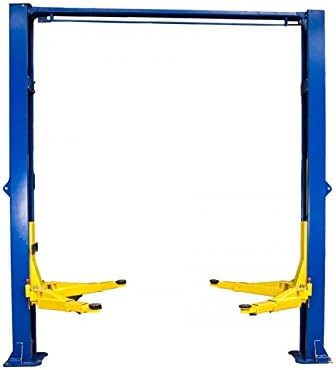
Best for tight bays. Asymmetric arm design maximizes door clearance, making it ideal for a two-car garage where space is at a premium.
Price incl. tax, excl. shipping.
* Affiliate link - we may earn a commission
Frequently Asked Questions
What is the best 2-post car lift for a home garage?▼
How much ceiling height do I need for a 2-post lift?▼
Do 2-post lifts require special concrete?▼
Symmetric or asymmetric — which 2-post lift should I get?▼
Can I install a 2-post lift myself?▼
Related Expert Reviews
BendPak XPR-10AS Review: Professional-Grade Asymmetric 2-Post Lift
APlusLift HW-9KOH Review: Best Value 9,000 lb Overhead 2-Post Lift
Atlas 9KOHX Review: Solid Mid-Range Overhead 2-Post Lift
Triumph NTO-9A Review: Professional Clear Floor 2-Post Design
More Buying Guides
How to Choose the Right Car Lift for Your Garage
Choosing the right car lift is one of the biggest investments you can make for your home garage. This comprehensive guide walks you through every factor you need to consider, from ceiling height and floor thickness to weight capacity and electrical requirements.
12 min readComparison2-Post vs 4-Post Car Lifts: Which is Right for You?
The debate between two-post and four-post car lifts is the most common question I hear from garage owners. Both have distinct advantages and trade-offs, and the right choice depends entirely on how you plan to use the lift.
10 min readGeneralHow Much Does a Car Lift Cost? Full Price Breakdown
A car lift’s sticker price is only part of the story. Once you factor in electrical work, concrete, installation, and permits, the total project usually runs 30–50% more than the lift itself. Here is exactly what to budget, broken down by lift type and real-world example.
12 min readGeneral110V vs. 220V Car Lifts: Which Do You Need?
The power your car lift needs determines whether you can plug it into a wall outlet or have to run a new circuit — a difference of hundreds of dollars. Here is a clear comparison of 110V and 220V lifts, which models use each, and how to decide before you buy.
9 min readReady to Find Your Lift?
Browse our curated selection of top-rated car lifts or use our comparison tool to find the perfect match.