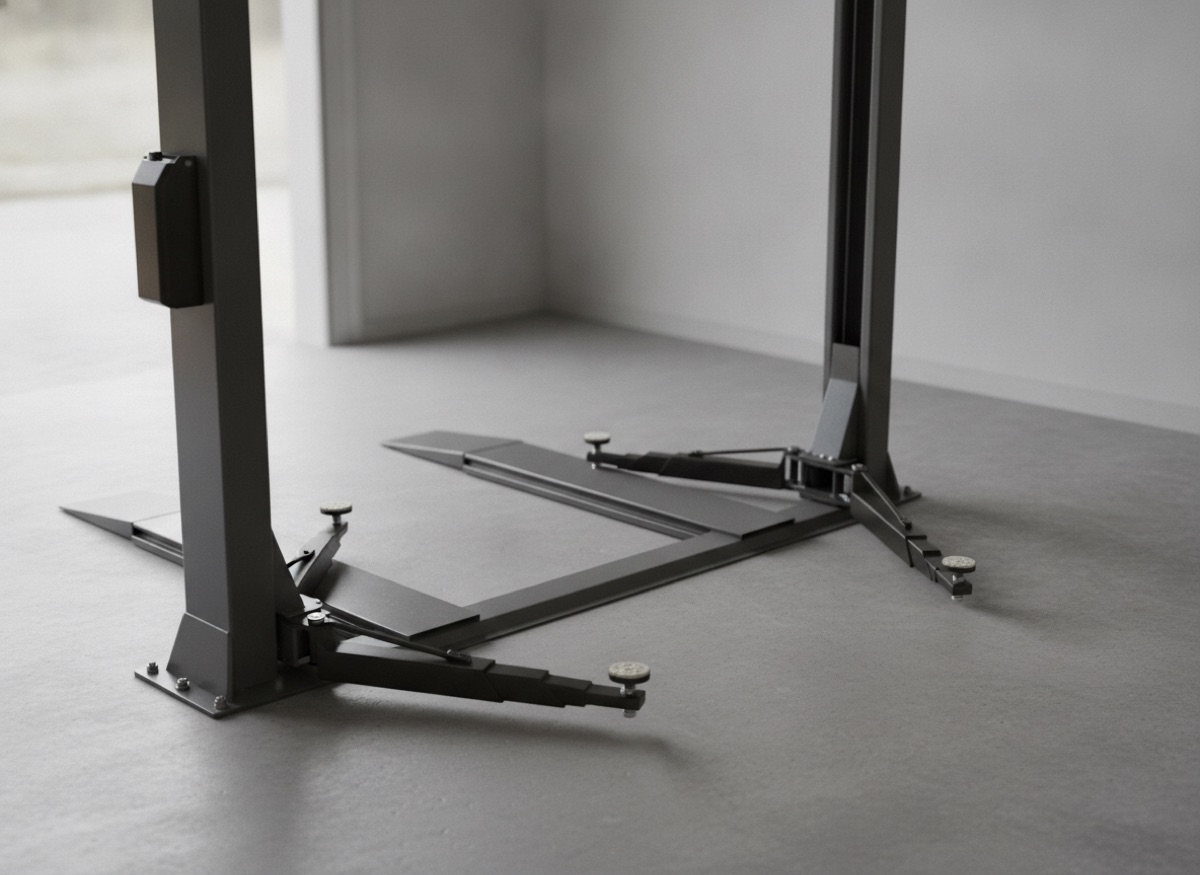
Illustration of a typical 2-post lift — not a photograph of the MOTOOL 4.0HP 12000lbs Two Post Lift.
MOTOOL 4.0HP 12000lbs Two Post Lift Review: Maximum Power for Maximum Capacity
The MOTOOL 4.0HP 12,000 lb is the highest-capacity 2-post sold into the home garage market on Amazon, with a 4HP motor, dual-stage hydraulics, 74 in of rise, a single-point lock release and a 150 in column height, for about $3,500 with a 2-year warranty. This review covers the 220V 40A circuit it needs, the 1,850 lb install, and who actually needs 12,000 lb.
Affiliate Disclosure: Car Lift For Garage is a participant in the Amazon Services LLC Associates Program, an affiliate advertising program designed to provide a means for sites to earn advertising fees by advertising and linking to Amazon.com. We may earn a commission from qualifying purchases made through links on this page, at no additional cost to you.
How this review was researched
This is a research-based review built from the manufacturer's specifications and manuals, ALI certification records and the pricing and owner feedback available for this class of lift. We have not installed or operated this unit ourselves, and we do not publish a star rating without at least 10 verified owner ratings. How we evaluate lifts.
Pros
- Industry-leading 12,000 lb capacity for the home garage market
- 4.0HP motor provides effortless lifting of even the heaviest vehicles
- Premium hydraulic components for smooth, consistent operation
- Single point lock release simplifies the lowering process
- Professional-grade 220V system built for frequent use
- Excellent build quality with heavy-gauge steel throughout
Cons
- Heaviest lift in its class — installation requires significant equipment
- Premium pricing may exceed budget for occasional home use
- Requires 220V 40-amp circuit — higher electrical requirement than most
- Limited availability and longer shipping lead times
What 12,000 lb is for
The step from 10,000 or 11,000 lb to 12,000 lb sounds small and covers a specific set of vehicles: one-ton duallies with a service body or a slide-in camper, ambulances and shuttle buses on a cutaway chassis, heavy-duty trucks with a plow and a salt spreader, and high-roof vans built out as campers. Those vehicles put a 10,000 lb lift at its label. MOTOOL built this lift for them, and for the home garage that has one.
The hardware follows the mission. The 4HP single-phase motor is the largest on any lift in this review series and moves enough fluid to lift a loaded truck without straining. The hydraulic system is dual-stage, which MOTOOL uses to keep the rise speed reasonable under heavy loads. The columns are tall, 150 in, to give 74 in of rise, and the posts are 118 in apart to drive a dually through. At 1,850 lb shipping weight it is the heaviest 2-post here, and at about $3,500 it is priced between the HPDMC 11,000 lb and the BendPak XPR-10AS.
Rise, width and the ceiling it needs
74 in of rise is 2 in more than the HPDMC and WEIZE 11,000 lb lifts and 5 in more than a 9,000 lb lift, and under a truck frame that is the difference between standing straight and ducking. The 118 in inside width is the widest in this group and lets a dually or a wide-body van drive in without folding mirrors. The arms are heavy, and a single-point lock release means one handle drops both column locks for lowering.
The cost of the rise is the column height: 150 in, or 12 ft 6 in, plus the shut-off bar above the beam, which puts the practical minimum ceiling at about 13 ft. That is a shop or a barn, not an attached garage. A high-roof van raised 74 in also has to fit under the ceiling itself, and a 9 ft van at full rise needs more than 15 ft. Buyers should measure both the room and the tallest vehicle before ordering, because this lift is the one most likely to not fit.
* Affiliate link - we may earn a commission
Installation, slab and the 40A circuit
This is the installation that separates the MOTOOL from everything else on the page. The columns are the heaviest single pieces of any home-market 2-post, the beam is long, and the shipping weight of 1,850 lb means a forklift or a rented telehandler rather than two people and an engine hoist. Owner reviews on Amazon describe it as a job that needs equipment, and MOTOOL's own guidance points buyers toward professional installers. Plan on paying for the install unless the garage already has a lifting capability.
The slab needs to be at least 4 in of 3,000 psi concrete, and for a lift carrying 10,000 lb trucks, thicker is better; a test hole before delivery is worth the hour. Power is 220V single phase on a 40A circuit, which is larger than the 20A to 30A circuits most 2-posts use and may require a panel upgrade in an older garage. Budget the electrician into the price, because a 4HP motor on an undersized circuit will trip breakers under load.
Hydraulics, locks and certification
The dual-stage hydraulic system is the technical distinction. Rather than a single pump stage pushing fluid at one rate, it uses a high-flow stage to move the carriages quickly under light load and a high-pressure stage under heavy load, which is how a 12,000 lb lift keeps a reasonable cycle time without a motor larger than 4HP. Owner reviews describe the operation as smooth under load, which is consistent with that design.
The single-point lock release drops both columns' mechanical locks from one lever, so lowering does not mean walking around the vehicle to pull two handles. Automatic locks engage in each column as the carriage rises, and arm restraints hold the arms under load. The lift is CE self-certified and not ALI/ETL listed, which at $3,500 is a fair criticism; the BendPak XPR-12FDL carries the label at about $5,185. For a home garage with a heavy truck and no insurer to satisfy, the MOTOOL does the physical job. For a business, the BendPak is the lift.
Compared with the HPDMC 11,000, WEIZE 11,000 and BendPak XPR-10AS
The HPDMC 220V 11,000 lb at about $3,200 gives up 1,000 lb, 2 in of rise and the dual-stage hydraulics, and adds 1/4 in box-section columns, asymmetric arms with truck extensions and a 36-month warranty, for $300 less. For any truck under 10,000 lb it is the better buy. The WEIZE 11,000 lb 3HP at about $3,000 is the budget option with a 1-year warranty and a thinner finish; it is $500 cheaper and a less finished lift.
The BendPak XPR-10AS at about $4,035 has 2,000 lb less capacity and the ALI/ETL listing, dual-synchro equalization and a dealer network. It is the lift for a shop. The MOTOOL sits in a narrow slot: more capacity than the imports below it, no certification like the BendPak above it. We would buy it only for a vehicle that genuinely needs 12,000 lb, and we would buy the HPDMC for anything lighter.
Who should buy it (and who shouldn't)
Buy the MOTOOL 12,000 lb if the garage has a one-ton dually, a cutaway-chassis vehicle, a heavy plow truck or a built-out high-roof van, plus 13 ft of ceiling, a 40A 220V circuit and a slab that meets spec, and a way to stand up 1,850 lb of steel. Buy it if the extra 2 in of rise and the single-point release are worth $300 over the HPDMC 11,000 lb. For that specific buyer it is the only import that fits the job.
Skip it if the heaviest vehicle is a three-quarter-ton or lighter, which describes nearly every home garage; the HPDMC 11,000 lb is cheaper with a longer warranty. Skip it if the ceiling is under 13 ft. Skip it if a panel upgrade for the 40A circuit is not in the budget. And skip it for commercial use, where the BendPak XPR-12FDL's ALI listing is the reason to pay $1,700 more.
Final Verdict
The MOTOOL 12,000 lb is a truck lift that happens to be sold to home garages, and it should be bought as one. The 4HP motor, dual-stage hydraulics, 74 in of rise, 118 in between posts and single-point lock release are the right hardware for one-ton trucks, heavy vans and lifted diesels, and the 2-year warranty is better than the WEIZE 11,000's 1 year. It costs about $3,500, needs a 220V 40A circuit, a 4 in slab and roughly 13 ft of ceiling, and it weighs 1,850 lb, so professional installation is the sensible route. It is not ALI listed. Buy it if the vehicles exceed 10,000 lb or the extra 2 in of rise matters. Skip it if the heaviest vehicle is a three-quarter-ton, where the HPDMC 11,000 lb costs $300 less with a 36-month warranty, and skip it for commercial use, where the BendPak XPR-12FDL's certification is worth the extra money.
- Industry-leading 12,000 lb capacity for the home garage market
- 4.0HP motor provides effortless lifting of even the heaviest vehicles
- Premium hydraulic components for smooth, consistent operation
- Single point lock release simplifies the lowering process
Price incl. tax, excl. shipping. Last updated September 5, 2026.
* Affiliate link - we may earn a commission
Specifications
- Lifting Capacity
- 12,000 lbs
- Lift Type
- Clear Floor, Overhead
- Motor
- 220V 4.0HP Single Phase
- Rise Height
- 74 inches
- Overall Height
- 150 inches
- Width Between Posts
- 118 inches
- Safety System
- Single Point Lock Release
- Hydraulic System
- Premium Dual-Stage
- Warranty
- 2-Year Limited
- Weight
- 1,850 lbs
* Affiliate link - we may earn a commission
Wheels off? Check the tires
A lift puts every tire at eye level, so it is an easy time to check pressure. Fanttik makes cordless tire inflators.
See Fanttik tire inflatorsTags
Related Reviews

Need Help Choosing?
Use our comparison tool to see how the MOTOOL 4.0HP 12000lbs Two Post Lift stacks up against other lifts, or read our buying guide for expert recommendations.