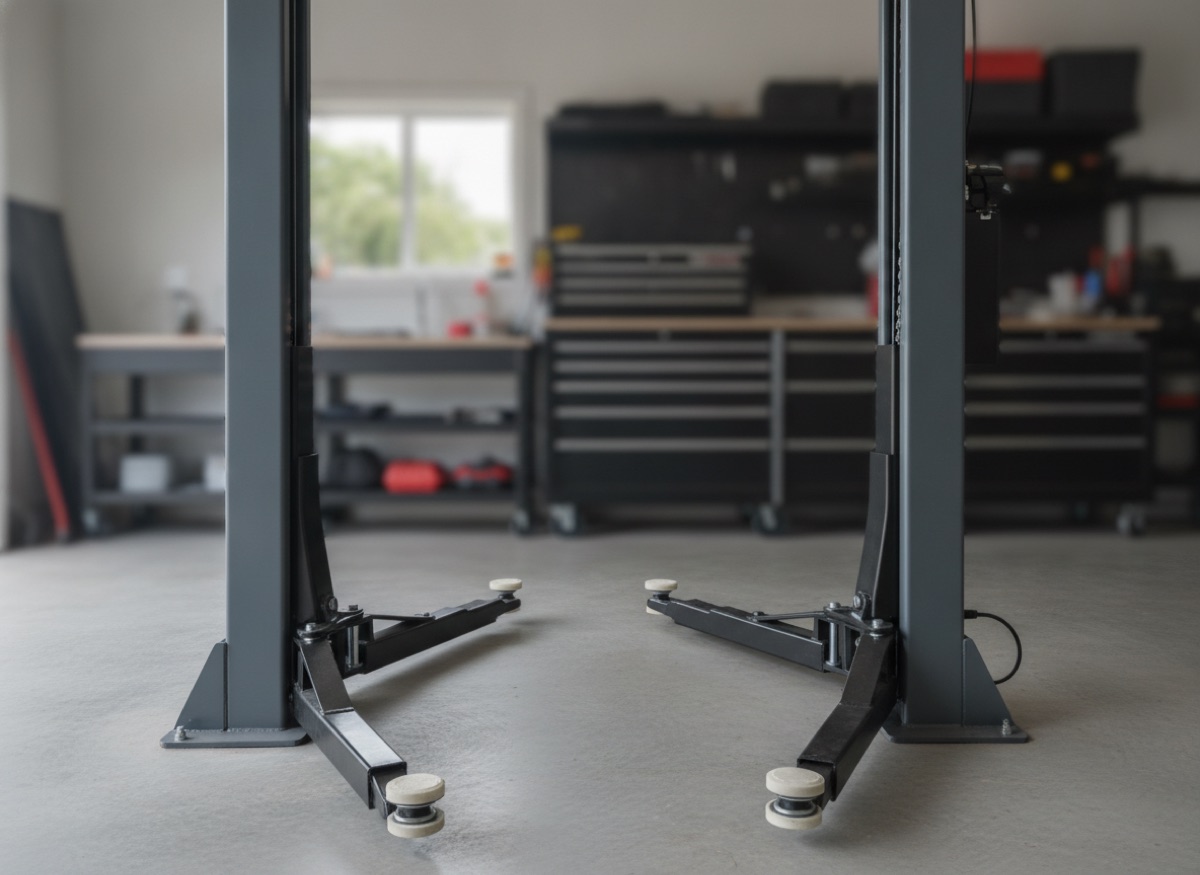
Illustration of a typical 2-post lift — not a photograph of the Triumph NT-9 9,000 lb 2-Post Symmetric Lift.
Triumph NT-9 9,000 lb 2-Post Symmetric Lift Review: ALI Certified Reliability
The Triumph NT-9 is a 9,000 lb symmetric clear-floor 2-post with an ALI/ETL listing, a single-point lock release, a 2HP 220V power unit and 69 in of rise, priced around $3,299 with a 3-year structural, 1-year parts warranty. This review covers what the certification changes, the 12 ft ceiling the 143 in columns imply, and whether it is worth $600 more than Triumph's own NTO-9A.
Sold through equipment dealers — not currently listed on Amazon
See Top-Rated 2-Post LiftsAffiliate Disclosure: Car Lift For Garage is a participant in the Amazon Services LLC Associates Program, an affiliate advertising program designed to provide a means for sites to earn advertising fees by advertising and linking to Amazon.com. We may earn a commission from qualifying purchases made through links on this page, at no additional cost to you.
How this review was researched
This is a research-based review built from the manufacturer's specifications and manuals, ALI certification records and the pricing and owner feedback available for this class of lift. We have not installed or operated this unit ourselves, and we do not publish a star rating without at least 10 verified owner ratings. How we evaluate lifts.
Pros
- ALI certified — independently verified safety standards compliance
- Triumph brand with established track record and support network
- Single-point release simplifies the lowering operation
- Clear floor symmetric design for centered, balanced lifting
- Solid build quality with attention to weld and finish details
- Competitive pricing for an ALI-certified two-post lift
Cons
- 9,000 lb capacity may be limiting for heavy truck owners
- Symmetric design restricts door opening while vehicle is raised
- Motor noise is moderate — not as quiet as premium competitors
- Limited color options available
What the ALI listing changes
Most 2-posts under $3,500 are CE self-certified, which means the manufacturer signed a form. ALI/ETL certification means an independent lab evaluated the design against the ANSI/ALI ALCTV standard, the specific model is listed in the Automotive Lift Institute directory, and the label on the column can be checked against that directory. The NT-9 has it. That is why it costs about $600 more than Triumph's NTO-9A, which is a similar 9,000 lb clear-floor lift without the listing.
For a home garage the label is reassurance and, for some homeowner insurers, a requirement. For a side business, a commercial shop or anyone lifting customer vehicles, it is the difference between a lift an inspector will pass and one they will not. The NT-9 is the least expensive way in this series to get it. The BendPak XPR-9S carries the same certification at around $4,799, and the Forward Lift I10 at around $3,999.
Capacity, rise and ceiling
The 9,000 lb rating covers sedans, SUVs, half-ton pickups and most three-quarter-ton trucks unloaded, and the cons list is right that a loaded three-quarter-ton or a one-ton is outside its range. 69 in of rise puts a car at standing height and a truck frame slightly low for a tall mechanic. The 112 in inside width is a normal drive-through for full-size vehicles. The arms are symmetric, so the vehicle sits centered and the doors barely open with it raised.
Overall height is 143 in, or 11 ft 11 in, and with the shut-off bar above the beam the practical minimum ceiling is about 12 ft. That is 8 in more than the NTO-9A needs and rules out a lot of attached garages. At 1,420 lb shipping weight it is one of the lighter lifts in the certified group, which makes the install easier and is a reminder that certification is about design and testing, not about the thickness of the steel.
Available on Amazon in this category:
* Affiliate link - we may earn a commission
Installation and power
The power unit is 2HP on 220V single phase; there is no 110V version. Anchoring is into a minimum 4 in slab of 3,000 psi concrete, which the ALI standard assumes and Triumph's manual restates. The columns are manageable for two people with an engine hoist, and the beam needs a tall ladder. Triumph's documentation is better than the Amazon-native imports, and the company answers the phone, which is part of what the price buys.
Because it is a clear-floor lift, the two columns are tied together only at the top, and an uneven slab shows up as a beam that will not sit square and cables that will not equalize cleanly. Shimming under the bases is normal; a slab that is out of level by more than the manual allows is not, and no certification covers a lift anchored to bad concrete. Plan on a full weekend, and consider a Triumph dealer install if the garage lacks a hoist.
Single-point release and safety hardware
The single-point lock release is the operational feature that separates the NT-9 from cheaper lifts: one lever releases the mechanical locks in both columns for lowering, so the operator does not walk around the vehicle to pull two handles. It is a convenience on a home lift and a real time saver on a lift cycled many times a day. Automatic locks engage in each column as the carriage rises, and arm restraints hold the arms under load.
Compared with the NTO-9A, the NT-9 trades the dual-point locks and automatic arm restraints for the certification and the single-point release. That is a fair trade for a commercial buyer and a debatable one for a home buyer, since the arm restraints prevent a common mistake and the certification prevents an insurance problem. Motor noise is moderate, in line with the class and louder than a BendPak. The warranty is 3 years structural and 1 year on parts, which is adequate rather than generous.
Compared with the NTO-9A, DMC-FPPS overhead and BendPak XPR-9S
The Triumph NTO-9A at about $2,695 is the same brand, capacity and layout with dual-point locks and automatic arm restraints, a 1-year warranty, an 11 ft 4 in ceiling requirement and no ALI listing. For a home garage that does not need the label, it is the better buy by $600. The DMC-FPPS 9,000 lb overhead at about $2,500 lists ALI/ETL certification with asymmetric arms and a 3-year warranty; if that listing checks out in the ALI directory, it undercuts the NT-9 by $800, and a buyer should verify it before paying Triumph's price.
The BendPak XPR-9S at around $4,799 is the certified symmetric lift with dual-synchro equalization, a 5-year structural warranty and the BendPak dealer network. It is a better lift and $1,500 more. Among the three certified options, the NT-9 is the value pick; among all four, it is the right choice only for the buyer who needs the label and cannot confirm the DMC-FPPS listing.
Who should buy it (and who shouldn't)
Buy the NT-9 if an ALI listing is required, for a homeowner insurer, a side business or a shop, and the budget is closer to $3,300 than to $4,800. Buy it if the garage has 12 ft of ceiling, 220V and a sound slab, and the vehicles stay under 9,000 lb. Buy it if the single-point release will be used often enough to matter. It is the least expensive certified 2-post here, and that is a real position to occupy.
Skip it for a home garage that does not need the label; the NTO-9A has better safety hardware for $600 less. Skip it if the ceiling is under 12 ft. Skip it if door clearance matters, since it is symmetric only, or if the heaviest vehicle is a loaded three-quarter-ton, where the Forward Lift I10's certified rating is $700 more and the right answer.
Final Verdict
The NT-9 is the cheapest ALI/ETL certified 2-post in this review series, and that is its entire argument: a 9,000 lb symmetric clear-floor lift with a third-party listing, a single-point lock release and a 3-year structural warranty for around $3,299, roughly $1,500 less than a BendPak XPR-9S with the same certification. It needs 220V, a 4 in slab and about 12 ft of ceiling, and it is symmetric only. Buy it if the ALI label is required, for insurance or for a side business, and the budget stops short of BendPak. Skip it for a home garage that does not need the label, where Triumph's own NTO-9A offers dual-point locks and automatic arm restraints for $600 less, and skip it if the heaviest vehicle is a loaded three-quarter-ton, where 9,000 lb is the limit.
The Triumph NT-9 9,000 lb 2-Post Symmetric Lift isn't currently sold on Amazon. Here's our top-rated 2-post lifts pick that is:

Our top-rated 2-post lifts currently available on Amazon.
Price incl. tax, excl. shipping.
* Affiliate link - we may earn a commission
Specifications
- Lifting Capacity
- 9,000 lbs
- Lift Type
- Clear Floor, Overhead
- Motor
- 220V Single Phase, 2HP
- Rise Height
- 69 inches
- Overall Height
- 143 inches
- Width Between Posts
- 112 inches
- Arm Type
- Symmetric Swing Arms
- Certification
- ALI/ETL Certified
- Warranty
- 3-Year Structural, 1-Year Parts
- Weight
- 1,420 lbs
Wheels off? Check the tires
A lift puts every tire at eye level, so it is an easy time to check pressure. Fanttik makes cordless tire inflators.
See Fanttik tire inflatorsTags
Related Reviews
DMC-FPPS Two Post Car Lift 9,000 LBS Overhead Review: Certified Performance at a Fair Price
$2,499.99
Atlas 10000 lb Two Post Clear Floor Lift Review: Brand Trust Meets Modern Engineering
Est. $3,899 MSRP
BendPak XPR-9S 9,000-lb Symmetric Lift Review: The Industry Benchmark
Est. $4,799 MSRP
Need Help Choosing?
Use our comparison tool to see how the Triumph NT-9 9,000 lb 2-Post Symmetric Lift stacks up against other lifts, or read our buying guide for expert recommendations.