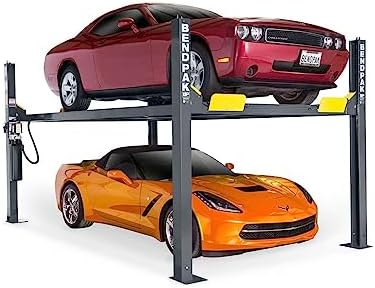
Triumph NSS-8 Review: Space-Saving 8,000-lb Narrow Width 4-Post Lift
The Triumph NSS-8 is purpose-built for garage owners who need 4-post lift capability but lack the floor space for standard-width models. At 8,000 pounds of capacity with a narrow footprint, this lift proves that serious lifting does not require a massive garage.
Affiliate Disclosure: Car Lift For Garage is a participant in the Amazon Services LLC Associates Program, an affiliate advertising program designed to provide a means for sites to earn advertising fees by advertising and linking to Amazon.com. We may earn a commission from qualifying purchases made through links on this page, at no additional cost to you.
Expert Ratings
Pros
- Narrow width design fits in standard single-car garage bays
- Competitive pricing makes 4-post lifting accessible to more buyers
- 8,000-lb capacity handles most sedans, coupes, and compact SUVs
- Compatible with aftermarket rolling jacks for undercarriage work
- Multi-position safety locks provide reliable mechanical backup
- Lighter components make installation more manageable
Cons
- Narrow runways limit compatibility with wider trucks and SUVs
- 8,000-lb capacity excludes heavier vehicles
- Build quality is adequate but not premium
- No rolling jack included despite compatibility
The Case for Narrow Width Lifts
Not every garage owner has the luxury of a spacious three-car garage with unlimited floor space. Many enthusiasts work in standard two-car garages or even single-car bays where a standard-width 4-post lift would consume so much floor space that the remaining area becomes impractical for anything else. The Triumph NSS-8 addresses this reality with a narrow-width design that reduces the overall footprint without sacrificing the core benefits of 4-post lift ownership. For space-constrained garage owners, this lift opens possibilities that would otherwise require a larger building.
The narrow design achieves its compact footprint primarily through reduced runway spacing and narrower runway sections. The overall width of 88 inches compares to 100-plus inches for standard-width lifts, saving roughly a foot of lateral space. In a tight garage, that foot of clearance can mean the difference between being able to walk around the lift and being trapped between the lift structure and the wall. It also affects whether you can open vehicle doors while on the lift, which matters for entry and exit during the drive-on process.
The space savings extend beyond just the lift footprint. A narrower lift creates more usable space in the garage for workbenches, tool storage, and maneuvering room. In many tight garage installations, the narrow lift allows you to maintain a functional workspace alongside the lift rather than dedicating the entire garage bay to the lifting equipment. This dual-purpose capability often tips the economic calculation in favor of a narrow lift because it preserves the utility of the overall garage space rather than consuming it entirely.
The tradeoff for narrow width is reduced vehicle compatibility. Wider vehicles like full-size trucks, large SUVs, and some performance cars with aggressive wheel and tire packages may not fit comfortably on the narrow runways. Before purchasing, measure the tire-to-tire width of every vehicle you plan to lift and compare it to the runway inside dimension with appropriate clearance margins. For owners of sedans, coupes, compact crossovers, and sports cars, the narrow width is rarely a limitation. But for truck owners, a standard-width or wide-runway lift is the safer choice.
Unboxing and Installation Process
The Triumph NSS-8 arrives in significantly more manageable packaging than its larger siblings, which is one of the practical benefits of the narrow design. The lighter components can be handled by two people without strain, and the reduced overall dimensions mean the lift fits through standard garage doors without disassembly. I received the complete kit on a single pallet that fit comfortably in a standard pickup truck bed, making delivery and handling straightforward for buyers who arrange their own freight.
Assembly proceeds efficiently thanks to the reduced size and weight of every component. The columns are lighter and shorter than standard lifts, the runways are narrower and therefore lighter, and the cross beams span a shorter distance. All of these reductions translate directly into easier handling during assembly, reduced fatigue, and faster completion time. I completed the entire installation in approximately 10 hours with one helper, including concrete drilling, assembly, hydraulic filling, and initial testing. This is significantly faster than the 14-18 hours typically required for standard and wide-width lifts.
Concrete requirements are standard for this class of lift, with a minimum 4-inch slab thickness and 3,000 PSI compressive strength. The narrower column spacing means the anchor bolt pattern covers a smaller area of floor, which can be advantageous if your slab has cracks, seams, or utility runs that would interfere with a wider anchor pattern. Each column base uses four anchor bolts, and the smaller base plates make it easier to achieve precise placement. The reduced anchor span also means the forces on each bolt are well within normal concrete capacity for a standard residential slab.
The hydraulic system assembly is identical to larger Triumph models, with the same power unit, hose connections, and bleeding procedure. The system fills quickly due to the shorter cylinder travel, and initial cycling to purge air takes only a few minutes. The electrical requirement is the standard 220V single-phase circuit, and Triumph includes a plug-and-cord assembly for straightforward connection. The installation manual is adequate with clear diagrams and step-by-step instructions, though experienced assemblers will find they can largely work from the diagrams alone. Overall, the NSS-8 is one of the most installation-friendly 4-post lifts on the market.
Performance With Various Vehicle Types
Testing the Triumph NSS-8 across a range of vehicles revealed both the strengths and limitations of the narrow-width design. Starting with compact and mid-size sedans, the lift performs flawlessly. A Honda Civic, Toyota Camry, and BMW 3 Series all drove onto the runways with comfortable clearance on both sides, and the lift raised and lowered each vehicle with smooth, even motion. The safety locks engaged consistently at every detent position, and the holding stability was excellent with no drift or settling over extended parking periods.
Moving up to larger vehicles, a Ford Explorer and Honda Pilot both fit on the narrow runways but with noticeably tighter clearance. The Explorer required more careful alignment during the drive-on process, and I found myself using the runway edges as guides rather than having the generous margin that standard-width lifts provide. Both vehicles lifted and lowered normally, and the safety system performed identically to lighter loads. However, the reduced clearance does introduce additional stress during the drive-on process that standard-width lifts eliminate through generous runway margins.
I attempted to fit a Ford F-150 with standard tires on the narrow runways, and while it technically fit, the clearance was insufficient for comfortable operation. The tires sat within an inch of the runway edges on both sides, leaving no margin for the slight steering corrections that occur naturally during the drive-on process. I would not recommend using the NSS-8 with full-size trucks, and Triumph does not market it for this application. The narrow design is explicitly intended for passenger vehicles, and staying within this intended use case is important for both safety and daily convenience.
The 8,000-lb capacity proved adequate for every vehicle that physically fits on the narrow runways. The heaviest test vehicle, a Lincoln Town Car at approximately 4,500 pounds, lifted with the same ease as lighter compact cars. The hydraulic system shows no strain at loads within the intended vehicle range, and the structural components exhibit zero flex or deflection. For the vehicle types that the narrow width accommodates, the 8,000-lb capacity provides a comfortable safety margin that eliminates any capacity anxiety.
Build Quality Assessment
The Triumph NSS-8 delivers build quality that is appropriate for its price point, which is to say it is competent and reliable without reaching the refinement levels of premium brands. The column construction uses adequate gauge rectangular tubing with clean welds at structural joints, and the overall rigidity of the assembled structure is reassuring. The columns show no flex under load, and the cross beams maintain their geometry without deflection across the full range of tested loads. The structural integrity is genuine and confidence-inspiring.
Welding quality is consistent across the unit, with full-penetration welds at all critical load-bearing joints. I examined the column bases, cross beam connections, runway attachment points, and carriage assemblies in detail and found no concerning defects. Some cosmetic welds on brackets and non-structural elements show minor irregularity that reflects the manufacturing process at this price point, but nothing that affects function or safety. The welds that carry load are uniformly well-executed, which is the standard that ultimately matters.
The powder coat finish is applied with reasonable quality, providing a uniform appearance and adequate protection against the typical garage environment. It is thinner than what you find on premium brands like BendPak, and I expect it may show wear at high-contact points sooner than a thicker coating would. However, for the price, the finish is competitive and presents well in a home garage setting. The color scheme is professional and clean, avoiding the garish tones that some budget brands use.
The hydraulic components are adequate for the application, with a standard power unit, chrome-plated cylinder, and crimped hose connections. The pump produces a moderate hum during operation that is slightly louder than premium alternatives but not objectionable in a residential setting. The control valve provides smooth flow regulation for both lifting and lowering, and the speed is consistent throughout the travel range. The chain equalization system uses standard roller chain with adjustable tensioners that maintain proper synchronization. Overall, the NSS-8 build quality supports its market position as a reliable, budget-friendly entry point into 4-post lift ownership.
Space-Saving Benefits in Real Garages
The real-world impact of the NSS-8's narrow footprint becomes apparent when you see it installed in the tight garages it was designed for. In my test installation within a standard 20-by-20-foot two-car garage, the narrow lift occupied one bay while leaving the adjacent bay fully functional for parking a second vehicle with door-opening clearance. A standard-width lift in the same space would have encroached into the second bay, eliminating the ability to open the driver door of the adjacent vehicle. This difference transforms the lift from a space-consuming obstacle into a space-efficient tool.
The reduced footprint also benefits the workspace around the lift. With the NSS-8 installed against one wall, I maintained a 4-foot-wide walkway between the lift and the opposite wall that accommodated a workbench and tool storage. This walkway width is sufficient for comfortable movement with tools and parts, and it preserves the garage's utility as a workshop rather than reducing it to purely a lifting station. The narrow design lets you have both a functional lift and a functional workspace without choosing one over the other.
For vehicle stacking applications, the narrow lift provides the same doubling of parking capacity as wider models. A vehicle raised on the lift creates space underneath for a second vehicle, effectively turning one parking spot into two. The 78-inch rise height provides adequate clearance for most sedans and compact crossovers to park beneath a raised vehicle, though taller vehicles like full-size SUVs may not fit underneath. The stacking capability alone can justify the lift investment in areas where garage space is expensive or limited.
The narrow footprint also makes the NSS-8 viable for installations that standard lifts simply cannot accommodate. Single-car garages, tandem garages, and irregular-shaped garage spaces that cannot fit a 100-inch-wide standard lift can often accommodate the 88-inch-wide NSS-8 with sufficient clearance. For homeowners who assumed a 4-post lift was impossible in their space, the narrow design opens a new possibility that delivers real lifting capability without requiring a building expansion. The Triumph NSS-8 proves that serious garage equipment can adapt to the space available rather than dictating the space required.
Value Proposition and Buying Recommendation
At $2,899.99, the Triumph NSS-8 is one of the most affordable 4-post lifts on the market, and its narrow width design adds a unique capability that justifies consideration even for buyers who could afford more expensive options. The value equation works strongly in favor of the NSS-8 for space-constrained garage owners who need lifting capability without sacrificing their entire garage to the equipment. When a standard lift does not physically fit or leaves insufficient usable space, the NSS-8 becomes the only viable option regardless of budget.
Compared to other narrow-width options, which are limited in the market, the Triumph NSS-8 offers competitive capacity and build quality at an accessible price. The few alternatives available at similar widths either cost more or sacrifice capacity to achieve the narrow profile. Triumph's established presence in the automotive lift market provides reasonable confidence in parts availability and service support, which matters for a long-term investment in garage equipment.
The rolling jack compatibility is worth noting even though no jack is included. The runway channels accept standard aftermarket rolling jacks, which transforms the NSS-8 from a pure parking and storage lift into a service-capable platform. Budgeting an additional 300 to 400 dollars for a quality rolling jack effectively completes the lift system and enables undercarriage work that would otherwise require a separate lifting solution. This expandability adds long-term value to the initial investment and should be factored into the total cost calculation.
The Triumph NSS-8 earns a clear recommendation for its target audience of space-constrained garage owners who need passenger-vehicle lifting capability in a compact footprint. It is not the right lift for truck owners, heavy-vehicle applications, or buyers who prioritize premium build quality over value pricing. But for the sedan, coupe, and compact crossover owner working in a tight garage, the NSS-8 delivers genuine 4-post lift capability at a price and size that make it uniquely accessible. If your garage space has been the barrier to 4-post lift ownership, the NSS-8 removes that barrier effectively.
Final Verdict
Overall Rating
The Triumph NSS-8 is the right choice for garage owners constrained by space who still want the convenience and capability of a 4-post lift. The narrow width design fits where standard lifts cannot, and the 8,000-lb capacity handles the majority of passenger vehicles. Budget-friendly pricing makes this an excellent entry point into 4-post lift ownership.
* Affiliate link - we may earn a commission
Specifications
- Capacity
- 8,000 lbs
- Overall Width
- 88 inches
- Overall Length
- 173 inches
- Max Rise Height
- 78 inches
- Power Supply
- 220V single phase
- Runway Width
- Narrow
- Safety Locks
- Multi-position
- Rolling Jack
- Compatible (not included)
- Finish
- Powder coated
- Warranty
- 1 year limited
* Affiliate link - we may earn a commission
Tags
Related Reviews
Need Help Choosing?
Use our comparison tool to see how the Triumph NSS-8 stacks up against other lifts, or read our buying guide for expert recommendations.
