
TRIUMPH NSS-8 Review: Best Budget 4-Post Lift for Storage
The NSS-8 is the 4-post lift we now point most home buyers at, and the reason is the owner record. It has more than 145 ratings on Amazon averaging 4.4 stars, which is deeper feedback than any other 4-post lift in this category has accumulated. Triumph rates it at 8,000 lb with 72 in of rise on an 11 ft ceiling, and it ships with rolling jacks, a caster kit and drip trays included.
Affiliate Disclosure: Car Lift For Garage is a participant in the Amazon Services LLC Associates Program, an affiliate advertising program designed to provide a means for sites to earn advertising fees by advertising and linking to Amazon.com. We may earn a commission from qualifying purchases made through links on this page, at no additional cost to you.
Our Rating
This score weighs the published specifications, the certification status and 145 Amazon owner ratings (averaging 4.4/5 at our last check). We have not installed or operated this unit ourselves. How we evaluate lifts.
Pros
- Excellent value at under $3,000 for 8,000 lb capacity
- Storage-optimized design perfect for vehicle collectors
- Easier installation than premium alternatives
- Includes rolling jacks and caster kit as standard equipment
- Good build quality considering the budget price point
- Adequate for most passenger cars and light trucks
Cons
- Build quality doesn't match premium brands like BendPak
- Limited to 8,000 lb capacity insufficient for heavy trucks
- Shorter 72-inch rise height than higher-end alternatives
- Thinner gauge steel more susceptible to long-term wear
- No ALI/ETL certification may affect insurance
What the NSS-8 is built for
Triumph designed the NSS-8 around storage rather than service, and every spec reflects that. Capacity is 8,000 lb, which covers sedans, coupes, crossovers and half-ton pickups with margin. An F-150 at roughly 5,000 lb and a Grand Cherokee at 4,800 lb both sit comfortably inside it. A three-quarter-ton diesel at 8,500 lb does not, and that is the ceiling on this lift.
The frame is 96 in wide and 176 in long, which is narrower and shorter than most 9,000 lb lifts. In a standard two-car garage that means the NSS-8 takes one bay and leaves a usable walkway, and in a single-bay garage it fits where a wider lift will not.
Rise is 72 in. That is a parking height, not a working height. It gets a car high enough to park another underneath and high enough for a seated adult to work at wheel level, but a six-footer will not stand upright under the runways.
Ceiling height math and garage fit
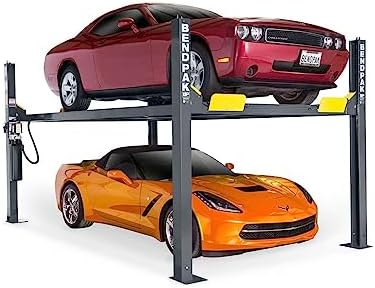
Triumph lists an 11 ft minimum ceiling. Against 72 in of rise, a 132 in ceiling leaves roughly 60 in for the vehicle parked on top, minus the runway steel. A Miata at 49 in, a Corvette at 49 in and a Camry at 57 in all clear that. A RAV4 at 67 in does not, and neither does a pickup.
That is the real constraint on a storage 4-post in a residential garage: the car on top has to be short. Owners who buy these to stack two SUVs discover the geometry after delivery. If the vehicle going up is tall, the answer is a taller building or the 83 in NOS9000XLT with a 12 ft ceiling, not a different pair of ramps.
At 176 in of overall length the NSS-8 also fits garages that are shallow front to back, which is where a lot of 200 in commercial lifts fail. Measure from the closed garage door to the back wall, and leave 24 in behind the lift for the approach ramps when they are stowed.
* Affiliate link - we may earn a commission
What comes in the box, and what that saves
The NSS-8 ships with rolling jacks, a caster kit and drip trays as standard. That package matters more than it sounds. On most competing lifts a rolling jack is a $400 to $700 accessory, the caster kit is another $200 to $300, and drip trays are extra again. BendPak's HD-9 includes jack trays; the Triumph includes the jacks themselves.
The rolling jacks are what turn a parking lift into a service lift. They ride on the runways, pick the vehicle up off them, and free the wheels for brake and suspension work. Without them a 4-post lift can only do oil changes, exhaust and anything else reachable with the tires loaded.
The caster kit lets one or two people reposition the lift when it is empty, which is the standard answer for a garage that also has to hold a workbench and a boat. Owner reviews on Amazon regularly mention the included accessories as the reason the lift undercut the alternatives they were considering.
Owner feedback and where the complaints cluster
With more than 145 ratings averaging 4.4 stars, the NSS-8 has the deepest owner record of any 4-post lift covered here, which is worth as much as any spec. The consistent themes in that feedback are that the lift arrives complete, that a competent pair of people get it standing in a day, and that it holds cars for years without drama.
The complaints cluster in two places. The first is freight damage and paint: crates arrive scuffed and the powder coat is thinner than what BendPak applies, so scratches show up early. The second is documentation, which owner reviews describe as adequate rather than good. Cable equalization in particular is a step where owners tend to work it out by feel.
Nothing in that pattern suggests a structural problem, which is the important part. The recurring notes are about finish and paperwork, not about locks, cables or columns. For a lift at this price that is close to the best outcome available.
How it compares to the HD-9, NOS9000 and QuickJack 7000TL
The BendPak HD-9 is the better-built lift, with 9,000 lb of capacity, 82 in of rise and an ALI/ETL listing. Bought from a dealer at around $3,000 it is a fair fight. Bought from its Amazon listing at roughly $6,095 it is not, and that pricing gap is a large part of why the NSS-8 takes our top pick.
Triumph's own NOS9000 adds 1,000 lb of capacity and 1 in of rise for a few hundred dollars more, and it is aimed more squarely at double-stacking. If storage is the only goal and the budget stretches, it is the more capable version of the same idea.
The QuickJack 7000TL is not a real alternative unless portability is the point. It runs on 110V, needs no anchors and stores against a wall, but it lifts about 21 in and cannot park a car above another one. Buy it for a rented garage, not for storage.
Final Verdict
Overall Rating
The NSS-8 is our best overall 4-post pick for a home garage, and the case is not that it is the best-built lift here. It is that it does the storage job well, includes the rolling jacks and caster kit that other brands charge extra for, and has more consistent owner feedback than anything else in the class. Buy it if you want a second parking space and occasional service access for cars and half-ton trucks in a garage with 11 ft of ceiling. Skip it if you need to lift more than 8,000 lb, if you want to stand fully upright underneath (72 in of rise means stooping), or if a permit office or insurer has asked for an ALI listing, which this lift does not carry.
- Excellent value at under $3,000 for 8,000 lb capacity
- Storage-optimized design perfect for vehicle collectors
- Easier installation than premium alternatives
- Includes rolling jacks and caster kit as standard equipment
Price incl. tax, excl. shipping. Last updated September 5, 2026.
* Affiliate link - we may earn a commission
Specifications
- Capacity
- 8,000 lbs
- Overall Width
- 96 inches
- Overall Length
- 176 inches
- Max Rise Height
- 72 inches
- Min Ceiling Height
- 11 feet
- Power Supply
- 220V single phase
- Included Accessories
- Rolling jacks, caster kit, drip trays
- Runway Surface
- Diamond plate
- Finish
- Powder coat
- Warranty
- 1 year limited
* Affiliate link - we may earn a commission
Wheels off? Check the tires
A lift puts every tire at eye level, so it is an easy time to check pressure. Fanttik makes cordless tire inflators.
See Fanttik tire inflatorsTags
Related Reviews


Need Help Choosing?
Use our comparison tool to see how the TRIUMPH NSS-8 stacks up against other lifts, or read our buying guide for expert recommendations.