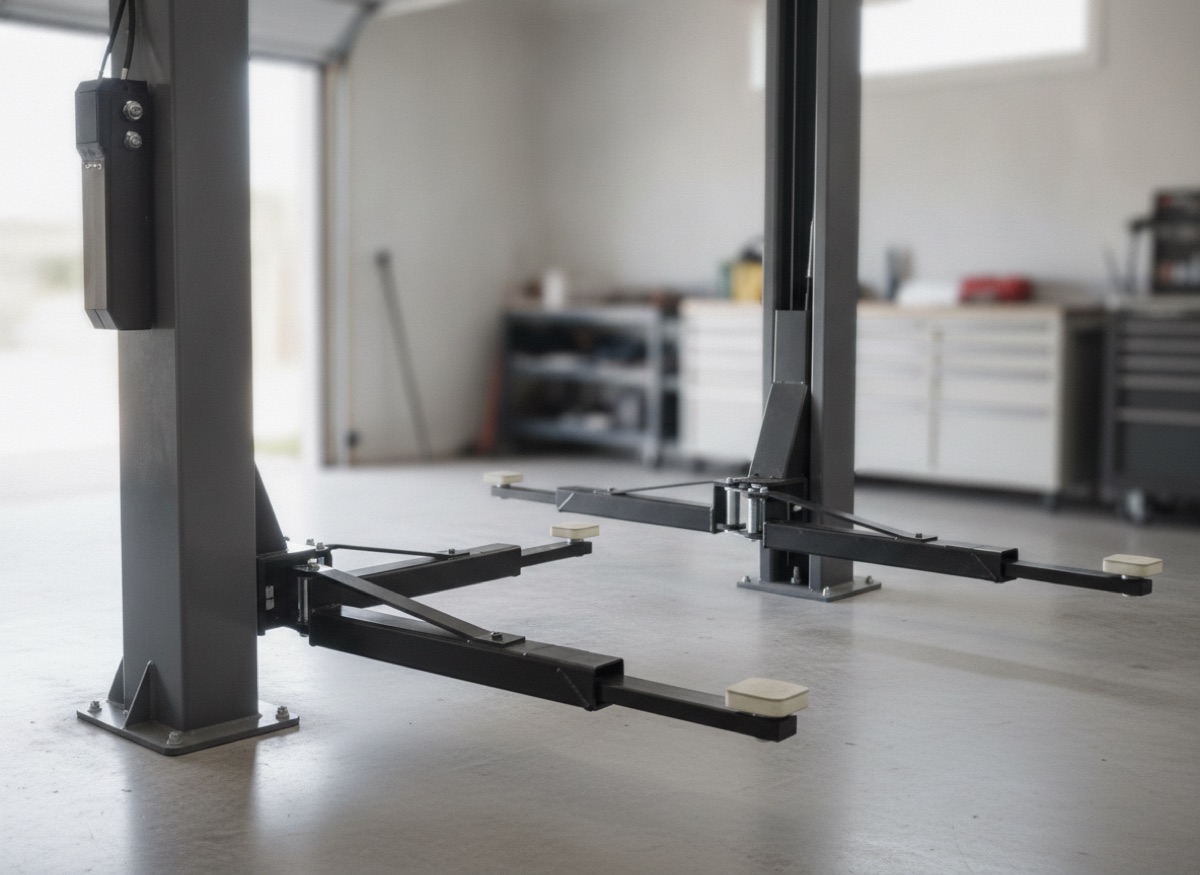
Illustration of a typical 2-post lift — not a photograph of the MaxJax M6K 6,000-lb Portable Two-Post.
MaxJax M6K 6,000-lb Portable Two-Post Review: Lift Freedom Without Floor Anchors
The MaxJax M6K is a 6,000 lb portable 2-post that runs on a standard 110V 15A outlet, rises 49.5 in and stores against a wall when the job is done, at around $2,199 with an ALI and ETL listing and a 2-year limited warranty. This review covers what portable really means here, the anchors it still needs, and where 6,000 lb and 49.5 in of rise stop being enough.
Sold through equipment dealers — not currently listed on Amazon
See Top-Rated 2-Post LiftsAffiliate Disclosure: Car Lift For Garage is a participant in the Amazon Services LLC Associates Program, an affiliate advertising program designed to provide a means for sites to earn advertising fees by advertising and linking to Amazon.com. We may earn a commission from qualifying purchases made through links on this page, at no additional cost to you.
How this review was researched
This is a research-based review built from the manufacturer's specifications and manuals, ALI certification records and the pricing and owner feedback available for this class of lift. We have not installed or operated this unit ourselves, and we do not publish a star rating without at least 10 verified owner ratings. How we evaluate lifts.
Pros
- No permanent floor anchoring required — truly portable and removable
- 110V plug-in power works with any standard household outlet
- Compact storage when not in use — columns can be moved against walls
- ALI/ETL certified despite the portable design
- Perfect for renters who cannot modify their garage permanently
- Setup and teardown can be completed in under 30 minutes
Cons
- 6,000 lb capacity limits use to passenger cars and light SUVs
- Lower rise height than permanent two-post lifts
- Requires flat, level concrete floor for safe operation
- Cannot be used for very heavy or wide vehicles
What portable means on the M6K
The M6K is not anchor free. Each column bolts into the slab, and MaxJax specifies a minimum 4 in of cured 3,000 psi concrete for those anchors, the same as a full-height lift. What is different is what happens afterwards: the columns lift off the anchors, the anchor sleeves sit flush with the floor, and the two columns and the power unit roll away and store against a wall.
That is the whole design. The bay is a normal garage most of the time and a lift bay when there is work to do. For a renter, the floor change is a set of flush anchors rather than a permanent installation. For a two car garage, the second car parks where the lift was.
Total system weight is 580 lb split across two columns and a pump, so one person can move a column with a hand truck. Setup and teardown are a job of minutes once the anchors are in, not a job of hours.
Capacity, rise and how the work gets done
6,000 lb covers sedans, coupes, wagons and light crossovers. It does not cover a half-ton pickup with any load in it, a three-quarter-ton, or a full-size SUV, and buyers who talk themselves into believing otherwise are the ones who get hurt. Check the curb weight before ordering, not after.
49.5 in of rise is the other limit and it is the more consequential one. A full-height 2-post gives 69 to 73 in and lets an adult stand under the car. 49.5 in gives a comfortable seated working height on a stool or a creeper seat, with the exhaust and the subframe at chest level while sitting. Brakes, suspension, exhaust, fluid changes and wheel work are all easy. Overhead transmission work is not.
The compensating benefit is that a car raised 49.5 in fits under an 8 ft ceiling with room to spare, which is the height a normal attached garage actually has.
Available on Amazon in this category:
* Affiliate link - we may earn a commission
Power, slab and setup
The power unit runs on a standard 110V 15A household outlet, so there is no electrician, no dedicated 220V circuit and no panel work. That alone saves several hundred dollars against every full-height lift here, and it is the reason the M6K can move to another garage without an electrical project.
The slab is the part that still needs attention. Four inches of cured 3,000 psi concrete is the requirement, level enough that the columns stand plumb, with the anchors set the distance apart the manual specifies. Because the columns are independent, with no overhead beam or floor plate tying them together, plumb and spacing are not details, they are the structure.
Column spacing is adjustable, which is how the M6K handles different vehicle widths, and it means the anchor pattern has to suit the range of cars the garage sees. Set that out on paper before drilling, because the anchors are the one part of this lift that is permanent.
Certification and safety hardware
The M6K carries an ALI and ETL listing, which is unusual at $2,199 and unusual for a portable design. An independent lab evaluated it against the ANSI/ALI ALCTV standard and the model appears in the ALI directory. A lot of low-cost lifts, including several full-height 9,000 lb models that cost more than this, have nothing but a CE self-declaration.
Mechanical locks engage as each carriage rises and hold the load without hydraulic pressure. The arms carry restraints. Because the columns are free standing, the lift depends on correct anchoring and level ground far more than a beam-tied lift does, and the MaxJax manual is direct about that.
The 2-year limited warranty is shorter than the 3-year coverage several imports offer, which is a fair criticism. The offsetting factor is that MaxJax sits inside the BendPak group, so parts and support come from an established company rather than a marketplace seller.
Compared with the 110V full-height lifts and a cheap 10,000 lb
The DMC FPPS 110V 9,000 lb at around $2,550 and the HPDMC 110V 9,000 lb at around $2,450 are the alternatives for a garage with no 220V. Both are full-height lifts giving around 69 in of rise on a 110V 20A dedicated circuit, both are permanent, and both want roughly 12 ft of ceiling. They cost $250 to $350 more and neither carries an ALI listing. If the ceiling and the permanence are available, they are more lift for the money.
The Weize 10,000 lb at around $1,899 is $300 less than the M6K with 10,000 lb of capacity, but it is a permanent 220V overhead lift that needs a tall garage, and it is CE certified only.
The M6K is not competing on capacity or rise. It competes on the two things none of these can offer: an 8 ft ceiling and a floor that goes back to normal.
Who the M6K is right for
Buy the M6K if the garage ceiling is 8 or 9 ft, if the slab is sound but the lease or the household says nothing permanent, if there is no 220V and no budget to add it, and if the cars are sedans and light crossovers. In that situation it is close to the only honest answer, and the ALI listing at this price makes it a better one than the cheap portable jacks it competes with.
Skip it if a pickup, a three-quarter-ton or a full-size SUV is part of the fleet, because 6,000 lb is a real ceiling and not a conservative rating. Skip it if the plan is to stand up under the car. And skip it if the garage already has 12 ft of clearance and a 220V circuit, because a full-height lift is a categorically better tool and the price gap is only a few hundred dollars.
Final Verdict
The M6K solves a problem no full-height lift can. It gives a garage with an 8 ft ceiling, a 15A outlet and no appetite for permanent hardware a real 2-post lift that picks a car up by its frame instead of jacking one corner at a time. The columns anchor to the slab, but they come off those anchors and store flat, which is what makes it workable for renters and for garages that still have to hold cars at night. It is ALI and ETL listed, which is rare at this price. The limits are hard ones: 6,000 lb and 49.5 in of rise mean passenger cars and light crossovers, worked on sitting rather than standing. Buy it for a car garage with a low ceiling or a floor that cannot be permanently committed. Skip it if a pickup is in the fleet, or if the goal is to walk upright under the vehicle, because no portable lift does that.
The MaxJax M6K 6,000-lb Portable Two-Post isn't currently sold on Amazon. Here's our top-rated 2-post lifts pick that is:

Our top-rated 2-post lifts currently available on Amazon.
Price incl. tax, excl. shipping.
* Affiliate link - we may earn a commission
Specifications
- Lifting Capacity
- 6,000 lbs
- Lift Type
- Portable, Two Post
- Motor
- 110V Single Phase
- Rise Height
- 49.5 inches
- Overall Height
- 95 inches (stored)
- Width Between Posts
- Adjustable
- Power Requirement
- 110V / 15A Standard Outlet
- Certification
- ALI/ETL Certified
- Warranty
- 2-Year Limited
- Weight
- 580 lbs (total system)
Wheels off? Check the tires
A lift puts every tire at eye level, so it is an easy time to check pressure. Fanttik makes cordless tire inflators.
See Fanttik tire inflatorsTags
Related Reviews
DMC-FPPS 110V Two Post Lift 9,000 LBS Review: Plug-and-Play Convenience Meets Serious Capacity
$2,549.99
HPDMC 110V Two Post Lift 9,000 LBS Heavy Duty Review: Budget 110V with Solid Fundamentals
$2,449.99

WEIZE 10,000 lb Review: Budget Champion Overhead 2-Post Lift
$1,899
Need Help Choosing?
Use our comparison tool to see how the MaxJax M6K 6,000-lb Portable Two-Post stacks up against other lifts, or read our buying guide for expert recommendations.