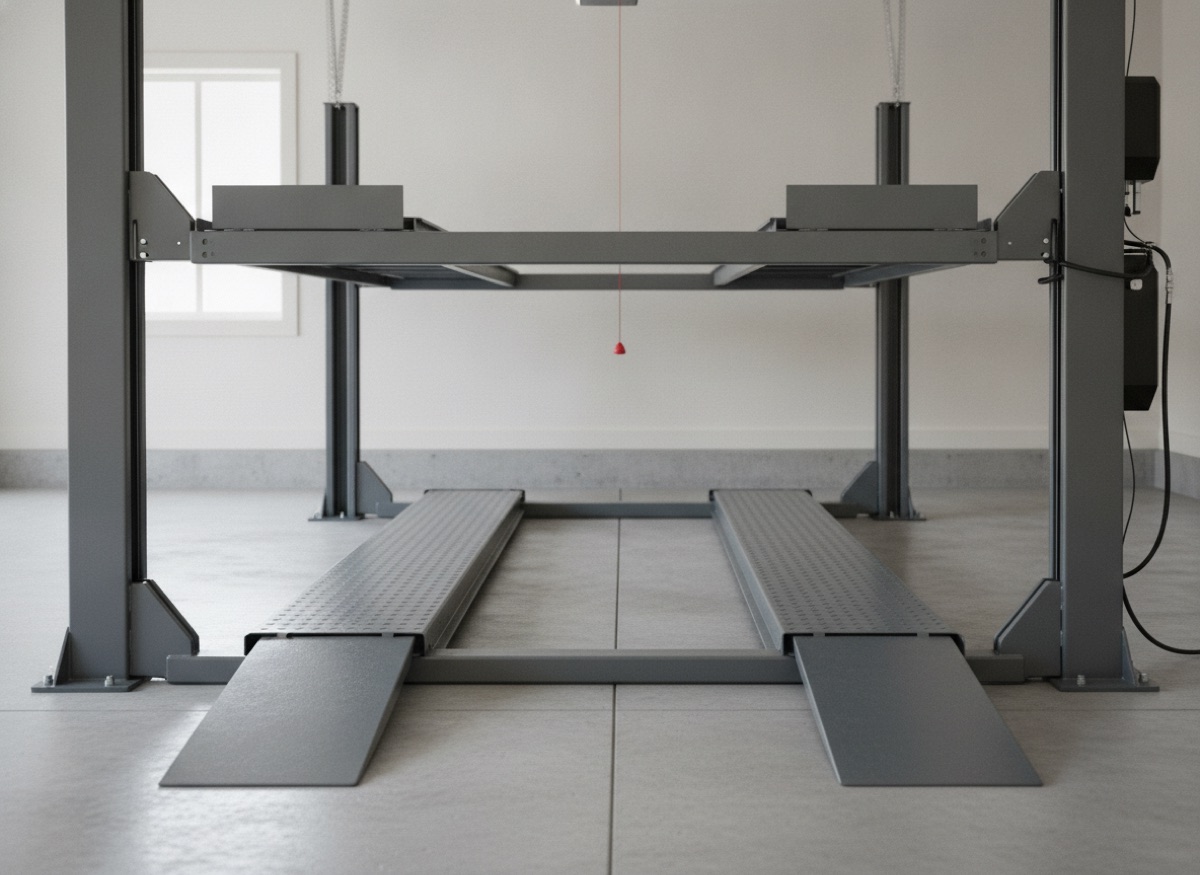
Illustration of a typical parking lift — not a photograph of the Greg Smith GS-PL7.
Greg Smith GS-PL7 Review: Commercial-Grade 7,000-lb Parking Lift
The Greg Smith GS-PL7 is a 7,000 lb parking lift from the Indianapolis equipment distributor that also sells the Atlas line, priced around $3,999. It weighs 2,300 lb, 100 lb more than the Atlas AP-7 with the same capacity, and that extra steel is the product's argument. This review works through the 11 ft 10 in ceiling math, why the install is listed as difficult, and whether the heavier frame is worth $300 over the AP-7 or $100 under the Rotary SPL-7.
Sold through equipment dealers — not currently listed on Amazon
See Top-Rated Parking LiftsAffiliate Disclosure: Car Lift For Garage is a participant in the Amazon Services LLC Associates Program, an affiliate advertising program designed to provide a means for sites to earn advertising fees by advertising and linking to Amazon.com. We may earn a commission from qualifying purchases made through links on this page, at no additional cost to you.
How this review was researched
This is a research-based review built from the manufacturer's specifications and manuals, ALI certification records and the pricing and owner feedback available for this class of lift. We have not installed or operated this unit ourselves, and we do not publish a star rating without at least 10 verified owner ratings. How we evaluate lifts.
Pros
- Commercial-grade heavy-duty frame construction
- Reliable safety lock system with solid engagement
- Smooth hydraulic operation with quality components
- 7,000-lb capacity suits most passenger vehicles
- Professional powder coat finish with good durability
- Strong dealer network for parts and support
Cons
- No ALI certification despite commercial-grade build
- Heavier than necessary for some residential applications
- Installation requires experienced professionals
- Slightly louder hydraulic operation than premium competitors
Heavier steel, same capacity
Greg Smith Equipment is an Indianapolis distributor that sells imported lifts direct, both under the Atlas name and under its own. The GS-PL7 is its 7,000 lb parking lift, and the spec that separates it from the Atlas AP-7 is not capacity, rise or platform size, all of which are within an inch. It is weight: 2,300 lb crated against 2,200 lb for the AP-7. The extra steel is in the columns and the platform cross-members, and it is why the marketing calls it commercial-grade.
Whether that matters depends on how the lift will be used. A parking lift that raises a 3,500 lb sedan once a day is not stressing a 7,000 lb frame either way. One that carries a 5,500 lb Grand Cherokee or Tahoe up and down twice a day, year after year, is closer to its rating and benefits from the heavier structure.
The rest of the numbers: 110 in by 98 in platform, 86 in of drive-on width, 73 in of rise, 8 in lowered height, 220V single phase power, automatic mechanical locks, around $3,999.
Ceiling height and clearance
The minimum ceiling is listed at 11 ft 10 in, or 142 in, with a 73 in rise. That leaves 69 in for the upper vehicle at the minimum ceiling, before deducting for an opener or light. Every sedan, coupe and sports car fits; a CR-V at 66 in fits; an Explorer at 70 in does not fit at the minimum and needs about 12 ft. A Tahoe at 76 in needs roughly 12 ft 7 in.
The 8 in lowered height is the highest in the 7,000 lb group, an inch above the Atlas AP-7 and Rotary SPL-7. It comes from the heavier platform section and it makes the approach ramps a touch steeper. A car with 4 in of ground clearance, which is most modern sports cars, needs to be driven up slowly and squarely. It also means the deck underside at full rise is about 65 in off the floor, enough for any sedan and most compact crossovers below.
Compared with the AP-7, the GS-PL7 asks for 2 in more ceiling and gives 1 in more rise. In a garage that measures 11 ft 8 in to the lowest obstruction, that puts the Atlas in spec and the Greg Smith out of it, and a spec is not something to shave.
Available on Amazon in this category:

* Affiliate link - we may earn a commission
Why the install is rated difficult
The GS-PL7 is listed as a difficult install, and the reasons are weight and support. At 2,300 lb, the platform sections need a pallet jack or engine hoist to move and hang, and the columns are heavy enough that plumbing them is a two-person job with a third to run the level. Greg Smith Equipment does not have a dealer installer network, so the buyer hires a local lift installer or a mechanically capable crew and works from the manual, which is functional but assumes experience. Budget two days for a crew of two.
Concrete is the class requirement, 4 in of 3,000 psi slab that is sound at every anchor. The heavier lift does not change the slab requirement but it does raise the cost of getting an anchor wrong.
Power is 220V single phase on a dedicated circuit. With freight, an electrician and two days of hired labor, the realistic project total is around $5,300 to $5,800. That is more than the Atlas AP-7 project costs by roughly the $300 difference in sticker price plus the extra install day, which is the true cost of the heavier frame.
Locks, hydraulics and the certification gap
The GS-PL7 holds its parked load on automatic mechanical locks in both columns that engage as the platform rises, and the hydraulic circuit has a check valve against pump failure, a flow control on descent and a manual lowering valve for a power outage. This is the standard parking-lift layout, and the heavier columns give the lock pawls a thicker section to bear against, which is the one safety-adjacent benefit of the extra steel.
The cons list notes that the hydraulic unit runs louder than the premium competitors, and that is consistent with a distributor-sourced power unit rather than a name-brand one. In a garage shared with living space it is a real consideration; in a detached garage it is not.
There is no ALI/ETL certification. The 7,000 lb rating is the distributor's figure, not one verified by an independent lab to the ANSI/ALI ALCTV standard, and the commercial-grade language on the frame does not change that. Buyers who need a certified 7,000 lb lift have one option in this group, the BendPak PL-7000XR at around $4,499, and the $500 gap is the price of the listing.
Against the Atlas AP-7, Rotary SPL-7 and Greg Smith GS-PL9
The Atlas AP-7 is the same distributor's lighter 7,000 lb lift: 110 in by 98 in platform, 86 in drive-on width, 72 in rise, 11 ft 8 in ceiling, 2,200 lb, around $3,699. It needs 2 in less ceiling, costs $300 less and is a shorter install. For a sedan-and-crossover household it is the better buy from the same catalog.
The Rotary SPL-7 is around $4,099: a slightly smaller 108 in by 96 in platform with 84 in of drive-on width, 72 in of rise, dual mechanical locks, 2,250 lb, and Rotary's dealer network with dealer installation tied to the warranty. It gives up 2 in of deck width to the GS-PL7 and gains a second lock position per column, a thicker finish and a dealer who will install it. For $100 more, that is a strong case.
The GS-PL9 is the step up: 9,000 lb, 116 in by 104 in platform, 92 in of width, 2,900 lb and an extended warranty for around $4,999. It is the truck lift; the GS-PL7 is not, and an 86 in deck should not be asked to take an 80 in truck body.
Final Verdict
The GS-PL7 is the 7,000 lb parking lift to buy if you want the heaviest frame in the mid-capacity class without a name-brand price, and you are comfortable with distributor support rather than a local dealer. Its 86 in deck and 73 in rise match the Atlas AP-7 while the frame carries 100 lb more steel, and at around $3,999 it is $100 under the Rotary SPL-7. We would choose it over the AP-7 for a household that will load the lift near its rating every day. We would choose the Rotary SPL-7 over it for the dealer network and dual locks, and the Atlas AP-7 for a lighter-duty household that would rather keep the $300. Skip the GS-PL7 if you need an ALI listed lift, or if your ceiling is under 11 ft 10 in, which is 2 in more than the AP-7 asks for.
The Greg Smith GS-PL7 isn't currently sold on Amazon. Here's our top-rated parking lifts pick that is:
Our top-rated parking lifts currently available on Amazon.
Price incl. tax, excl. shipping.
* Affiliate link - we may earn a commission
Specifications
- Capacity
- 7,000 lbs
- Platform Length
- 110 inches
- Platform Width
- 98 inches
- Lift Height
- 73 inches
- Lowered Height
- 8 inches
- Minimum Ceiling Height
- 11 feet 10 inches
- Power Requirements
- 220V single phase
- Safety Locks
- Automatic mechanical
- Drive-On Width
- 86 inches
- Weight
- 2,300 lbs
Tags
Related Reviews
Need Help Choosing?
Use our comparison tool to see how the Greg Smith GS-PL7 stacks up against other lifts, or read our buying guide for expert recommendations.