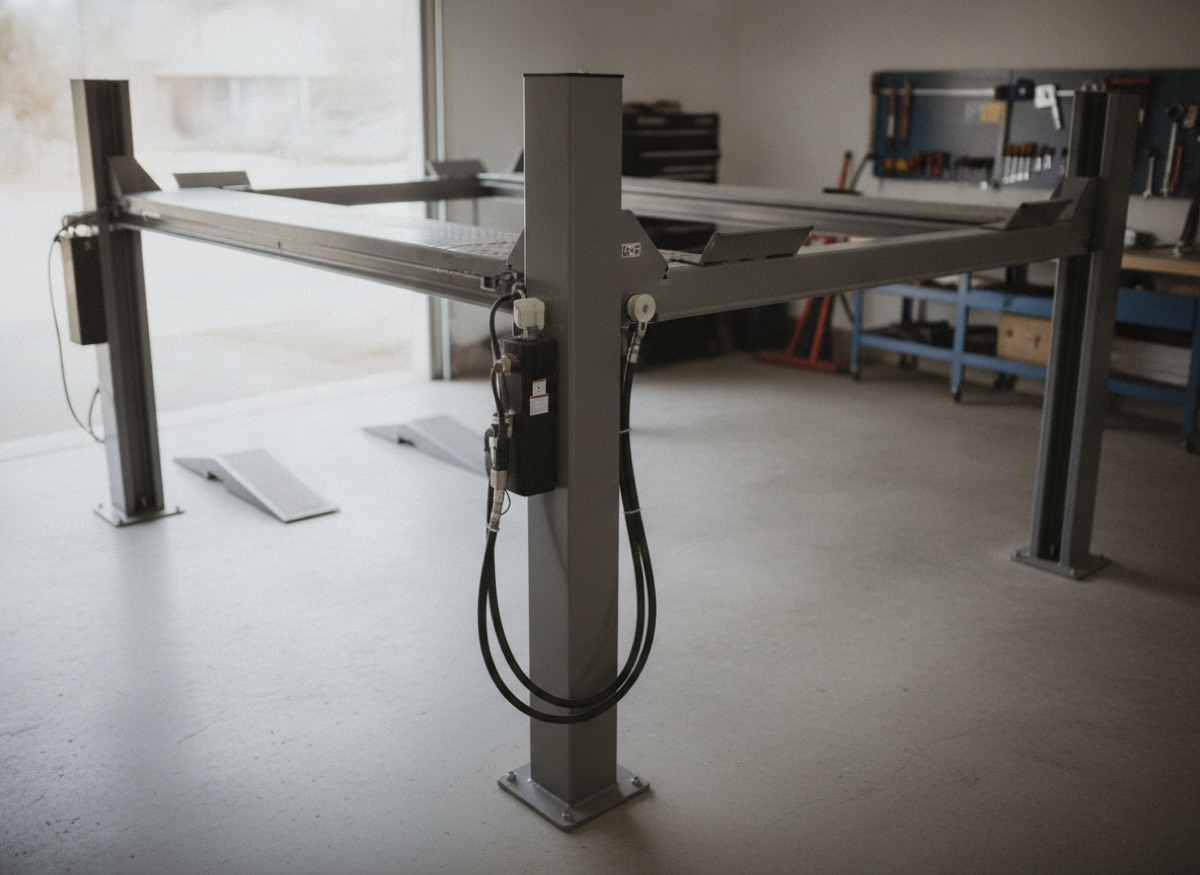
Illustration of a typical parking lift — not a photograph of the Atlas AP-7.
Atlas AP-7 Review: 7,000-lb Auto Park Lift for Residential Garages
The Atlas AP-7 is a 7,000 lb single-platform parking lift priced around $3,699, which lands it $200 under the ALI certified BendPak PL-6000 while offering 1,000 lb more capacity and 2 in more drive-on width. Atlas is the house brand of Greg Smith Equipment, and the AP-7 follows the brand pattern: sound steel, competitive numbers, no certification and a thinner finish. This review covers the ceiling math, the garage requirements and where it wins and loses against the PL-6000, the Forward FPL-6 and the bigger AP-9XL.
Sold through equipment dealers — not currently listed on Amazon
See Top-Rated Parking LiftsAffiliate Disclosure: Car Lift For Garage is a participant in the Amazon Services LLC Associates Program, an affiliate advertising program designed to provide a means for sites to earn advertising fees by advertising and linking to Amazon.com. We may earn a commission from qualifying purchases made through links on this page, at no additional cost to you.
How this review was researched
This is a research-based review built from the manufacturer's specifications and manuals, ALI certification records and the pricing and owner feedback available for this class of lift. We have not installed or operated this unit ourselves, and we do not publish a star rating without at least 10 verified owner ratings. How we evaluate lifts.
Pros
- Compact footprint designed specifically for residential garages
- Easy drive-on platform with generous approach ramps
- Solid 7,000-lb capacity covers most passenger vehicles
- Competitive pricing for a quality parking lift
- Smooth hydraulic operation with minimal noise
- Well-organized installation hardware and clear manual
Cons
- Lacks ALI certification found on premium brands
- Powder coat could be thicker for long-term corrosion protection
- Customer support response times can be slow
- Limited dealer network for in-person support
Where the AP-7 sits in the Atlas line
Atlas is the equipment brand of Greg Smith Equipment Sales in Indianapolis, an importer that sells direct online and by phone rather than through a dealer network. That business model explains the AP-7's pricing and its main weakness in one sentence. You get a 7,000 lb parking lift for around $3,699, and you get support from a call center rather than a local installer who knows the unit.
The AP-7 is the middle of three Atlas parking lifts. Below it is the AP-6XR, a 6,000 lb lift with a longer 112 in platform for around $3,899. Above it is the AP-9XL, a 9,000 lb, 120 in by 106 in platform for around $4,799 that is built for full-size trucks. The AP-7 is the general-purpose one: 110 in by 98 in platform, 86 in of drive-on width, 72 in of rise, 2,200 lb shipping weight.
The 7,000 lb rating is the reason to pick it over a 6,000 lb lift. It covers a Grand Cherokee at 4,800 lb, a Model Y at 4,400 lb or an Explorer at 4,500 lb with more than 2,000 lb of margin, where a 6,000 lb lift is closer to its limit on the same vehicles.
Ceiling height and what fits on top
Atlas lists a minimum ceiling of 11 ft 8 in, which is 140 in. With a 72 in rise that leaves 68 in for the upper vehicle before subtracting for a door opener or a light. That is enough for any sedan, every sports car and most compact crossovers: a CR-V is 66 in tall, a RAV4 about 67 in. An Explorer at 70 in does not fit at the minimum ceiling and needs about 12 ft. A Tahoe at 76 in needs 12 ft 6 in.
So the pairing that works at 11 ft 8 in is a crossover or sedan up top and a taller vehicle below. Below the platform, lowered height is 7.5 in, so the deck underside at full rise is about 65 in off the floor, which takes any car and a compact crossover.
The 4 in of extra minimum ceiling over the BendPak PL-6000 is worth noting. Both lifts rise 72 in, but Atlas asks for 11 ft 8 in against BendPak's 11 ft 6 in. If your garage measures exactly 11 ft 6 in, the AP-7 is out of spec and the PL-6000 is not, and 2 in is not a gap you should wish away.
Available on Amazon in this category:

* Affiliate link - we may earn a commission
Installation and power requirements
At 2,200 lb crated, the AP-7 arrives on a liftgate truck in several crates, with the platform sections carrying most of the weight. Atlas rates the job as a professional install, and the realistic figure for an experienced two-person crew is a full day, with the columns anchored plumb, the platform assembled on the floor and hung on the carriages, and the equalizer cables adjusted until the deck travels level.
Concrete is the class standard, 4 in of 3,000 psi slab, sound at the anchor points. Atlas supplies an anchor template and the column base plates have adjustment slots that forgive small drilling errors, which is a small but useful design choice for anyone doing it without a dealer crew.
Power is 220V single phase on a dedicated circuit. Between an electrician, freight and a day of install labor, the total project runs around $4,800 to $5,200. Note that the installation manual is decent on hardware organization but light on explanation in places; installers who have done a BendPak will find the Atlas book thinner, and first-timers should watch the dealer install videos Greg Smith Equipment posts before starting.
Safety features, and the certification it does not have
The AP-7 holds a parked vehicle on automatic mechanical locks that engage in both columns at intervals as the platform rises. That is the load path when the car is stored, and it is independent of hydraulic pressure. A check valve in the hydraulic circuit keeps the platform from settling if the pump loses pressure, a flow control governs descent speed, and a manual lowering valve covers a power outage.
What it does not have is an ALI/ETL certification. The 7,000 lb rating is Atlas's own figure, not one proven by an independent lab to the ANSI/ALI ALCTV standard. The BendPak PL-6000, PL-7000XR and Challenger CP-8 all carry that listing; the Atlas, Forward and Triumph lifts in this class do not. For a private garage this is usually a paper distinction. It stops being paper when a municipality requires a certified lift on the permit or an insurer asks after a claim, so check both before choosing an uncertified lift on price.
Maintenance is the same as any parking lift: cable inspection, lock engagement check on every rise, anchor torque and hydraulic seals yearly.
Against the BendPak PL-6000, Forward FPL-6 and Atlas AP-9XL
The BendPak PL-6000 is the direct rival. It costs about $200 more, is rated at 6,000 lb rather than 7,000, has a 2 in narrower deck, needs 2 in less ceiling, carries ALI certification and has the thicker powder coat and the better manual. Sedan household with a permit office to satisfy: BendPak. Crossover household on a budget: Atlas.
The Forward FPL-6 is the budget alternative at around $3,499. It is 6,000 lb, 70 in of rise, 82 in of drive-on width and 1,950 lb of steel. The AP-7 costs $200 more for 1,000 lb of capacity, 4 in of width and 2 in of rise, which we consider an easy upgrade.
The AP-9XL is the answer if a full-size truck is going up. It adds 2,000 lb of capacity, an 8 in wider deck and a 76 in rise for about $1,100 more, and it needs 12 ft of ceiling and a bigger footprint. Buying the AP-7 and hoping a Silverado fits later is the mistake to avoid; a 5,000 lb truck is inside the rating but 81 in of body on an 86 in deck is tight.
Who the AP-7 is right for
The AP-7 makes sense for a household with a crossover or mid-size SUV and a car, a ceiling of 11 ft 8 in or taller, and no requirement for a certified lift. It is the least expensive way in this group to get 7,000 lb of capacity and an 86 in deck, and that combination fits most two-vehicle suburban garages.
It also suits the buyer who is comfortable managing an install: hiring a local crew, sourcing an electrician, and calling Greg Smith Equipment when a part is needed rather than expecting a dealer to show up. If that describes you, the $200 to $800 saved against BendPak and Rotary is real money.
Skip it if a certified lift is a permit or insurance condition, since the Challenger CP-8 and BendPak PL-6000 exist. Skip it if your ceiling is 11 ft 6 in or less; the BendPak PL-6SR at 9 ft 6 in is the low-ceiling answer. And skip it if the upper vehicle is a full-size pickup, where the AP-9XL or the Triumph NSP-8 gives you the width and weight margin the AP-7 does not.
Final Verdict
The AP-7 is the value pick for a two-vehicle household where one vehicle is a mid-size SUV or crossover in the 4,000 to 5,500 lb range and the ceiling is at least 11 ft 8 in. It gives you 1,000 lb of headroom over a 6,000 lb lift for less money than the BendPak PL-6000, and its 86 in drive-on width fits everything short of a full-size truck. We would buy it over the Forward FPL-6 for the capacity and over the PL-6000 only when certification does not matter. Skip it if you need an ALI listed lift for a permit or insurer, if your ceiling is under 11 ft 8 in, or if you value fast dealer support, because Greg Smith Equipment's service is by phone and email rather than through a local dealer network.
The Atlas AP-7 isn't currently sold on Amazon. Here's our top-rated parking lifts pick that is:
Our top-rated parking lifts currently available on Amazon.
Price incl. tax, excl. shipping.
* Affiliate link - we may earn a commission
Specifications
- Capacity
- 7,000 lbs
- Platform Length
- 110 inches
- Platform Width
- 98 inches
- Lift Height
- 72 inches
- Lowered Height
- 7.5 inches
- Minimum Ceiling Height
- 11 feet 8 inches
- Power Requirements
- 220V single phase
- Safety Locks
- Automatic mechanical
- Drive-On Width
- 86 inches
- Weight
- 2,200 lbs
Tags
Related Reviews
Need Help Choosing?
Use our comparison tool to see how the Atlas AP-7 stacks up against other lifts, or read our buying guide for expert recommendations.