Best Motorcycle Lifts for Home Garages (2026)
A motorcycle lift is either a full table that raises the whole bike to bench height or a scissor jack that gets the wheels off the floor for a tenth of the price. This guide sorts the two families by what your bike weighs, how long it is, and how much garage you can give up, with the specific Amazon-listed models we track in each class.
Affiliate Disclosure: Car Lift For Garage is a participant in the Amazon Services LLC Associates Program, an affiliate advertising program designed to provide a means for sites to earn advertising fees by advertising and linking to Amazon.com. We may earn a commission from qualifying purchases made through links on this page, at no additional cost to you.

Two kinds of motorcycle lift, and why that choice comes first
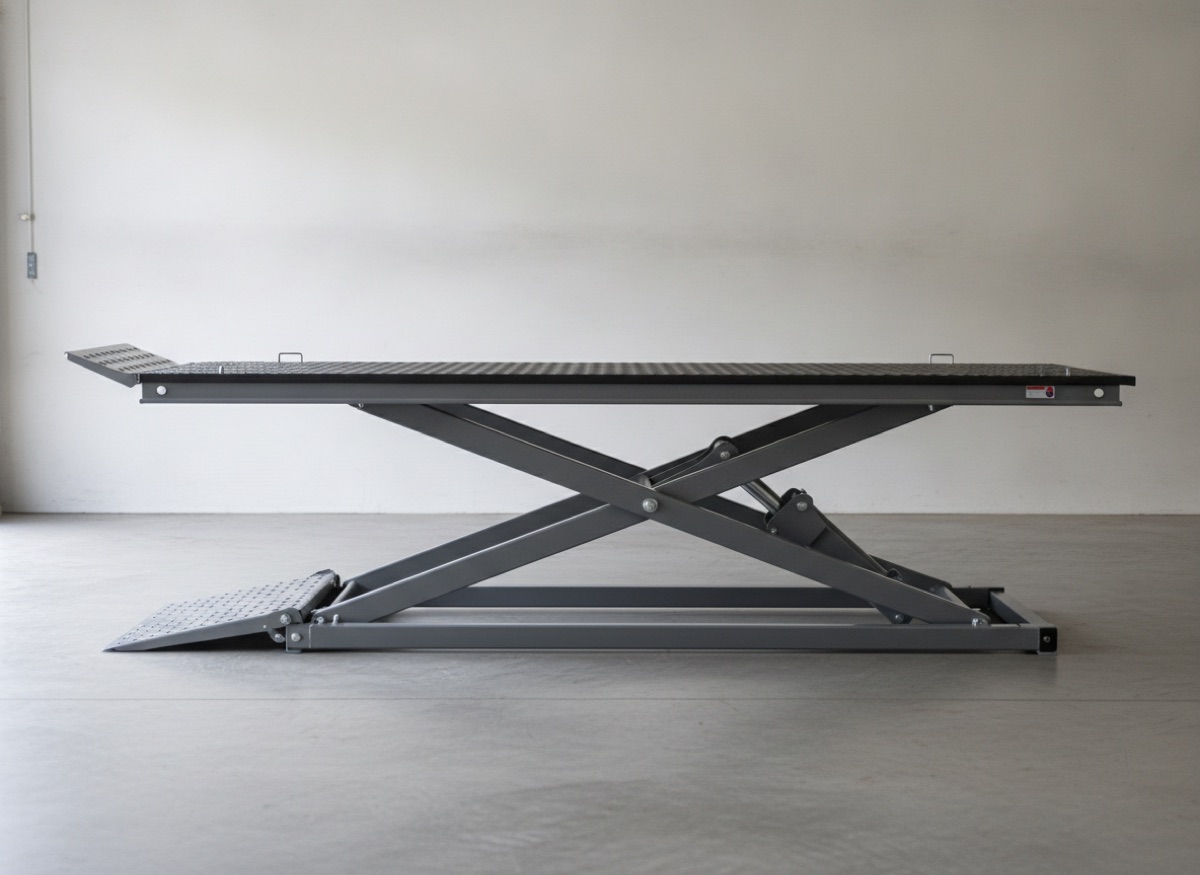
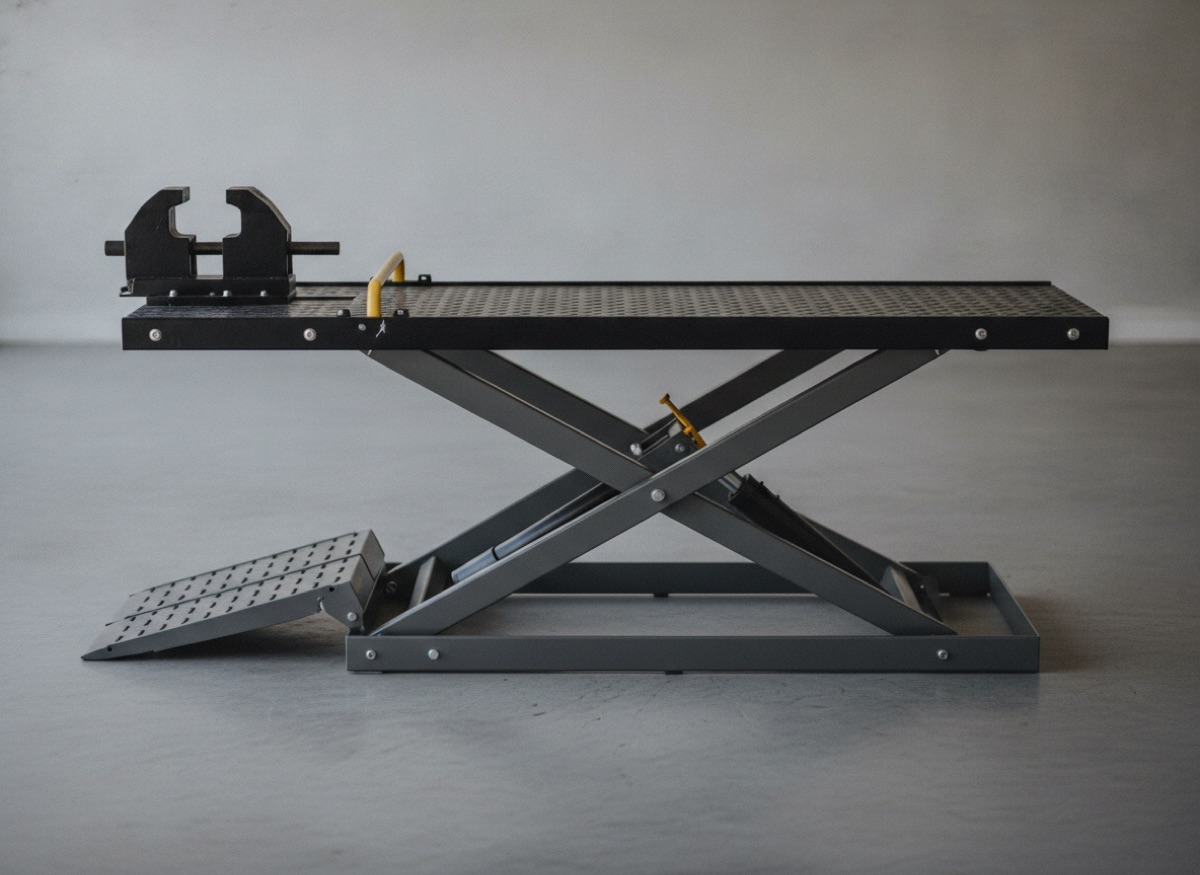
The search phrase "best motorcycle lift" covers two products that have almost nothing in common except the word lift. A lift table is a steel deck roughly 7 ft long on a scissor frame. You roll the bike up a ramp, clamp the front tire in a vise, strap it down, and raise the whole machine, wheels and all, to bench height. A scissor jack is a platform about the size of a sheet of paper that slides under the frame rails, lifts the bike a little over a foot, and gets one or both wheels off the floor.
They are priced about ten to one. A capable 1,100 lb scissor jack is about $70 on Amazon. The cheapest 1,000 lb table we track is about $870, and the pneumatic ProLift table is about $1,575. They take up garage floor in roughly the same ratio: a jack hangs on a wall hook, a table occupies a 7 ft by 3 ft rectangle whether you are using it or not.
The honest way to choose is not by budget. It is by how often you do wheel-off work and whether you can give up that rectangle. A table is the better tool for nearly every job. A jack is the better purchase for most owners, because most owners change oil, lube a chain, swap tires once a season, and otherwise ride. A $1,500 table bought for three oil changes a year is how tables end up on the used market a year later.
One ground rule: none of the motorcycle lifts on Amazon has enough owner reviews yet for us to quote a rating, so we do not. We compare capacity, deck size, lift range, drive type and price, then match those to what motorcycles actually weigh. Every model named here is validated in our motorcycle lift category. If you are weighing a Harbor Freight table or jack against these, the Harbor Freight motorcycle lift review compares all three Pittsburgh lifts with the Amazon units spec for spec.
Capacity versus what your bike actually weighs
Lift capacity is the first spec everyone checks and the one most often checked wrong. Manufacturers publish wet or running-order weight for the bike alone. Add fuel (a 6 gal bagger tank holds about 36 lb), loaded hard bags, a windshield, and crash bars. We suggest keeping 25 percent of margin between the loaded bike and the lift's rating.
| Motorcycle | Approx. running-order weight | 1,100 lb jack | 1,500 lb jack or 1,000 lb table |
|---|---|---|---|
| Honda Grom | ~227 lb | Yes | Yes |
| Kawasaki Ninja 400 | ~366 lb | Yes | Yes |
| Yamaha MT-07 | ~406 lb | Yes | Yes |
| Honda Rebel 500 | ~408 lb | Yes | Yes |
| Harley-Davidson Sportster S | ~502 lb | Yes | Yes |
| BMW R 1250 GS | ~549 lb | Yes | Yes |
| Harley-Davidson Softail Standard | ~630 lb | Yes | Yes |
| Harley-Davidson Street Glide | ~810 lb | Marginal | Yes |
| Honda Gold Wing Tour | ~845 lb | No | Yes |
| Harley-Davidson Ultra Limited | ~917 lb | No | 1,500 lb only |
| Indian Roadmaster | ~930 lb | No | 1,500 lb only |
The weights above are approximate factory figures for recent model years; check your own owner's manual. The pattern is what matters. An 1,100 lb jack covers every sport bike, naked bike, adventure bike, and mid-size cruiser with room to spare. Baggers and touring bikes push past 800 lb before you load them, and that is where the 1,500 lb jacks and the tables earn their price.
A 1,000 lb table holding a 917 lb Ultra Limited is at 92 percent of its rating before fuel and bags. A rider stepping onto the deck to steady the bike adds another 200 lb for a few seconds. That is the practical reason the ProLift Black Widow is rated at 1,500 lb and why we would put a big touring bike on it rather than on either 1,000 lb table.
Lift tables: ProLift, DNA Motoring and VEVOR compared
Three tables are on Amazon and in our database right now, and they split cleanly into a pneumatic tier and a hydraulic tier.
| Table | Capacity | Listed max height / deck | Power | Price (Amazon) |
|---|---|---|---|---|
| ProLift Black Widow (B00OBDJHPG) | 1,500 lb | 31.25 in high | Pneumatic (air over hydraulic) | about $1,575 |
| DNA Motoring lift table (B0F5Q6SD3P) | 1,000 lb | 86.2 in deck length | Hydraulic foot pump | about $870 |
| VEVOR lift table (B0F78SB4W3) | 1,000 lb | 360-degree casters listed | Hydraulic foot pump | about $878 |
The ProLift Black Widow is the one to buy if you own a bagger and a compressor. The listing rates it at 1,500 lb and 31.25 in of height, and the air-over-hydraulic cylinder means the deck goes up with a foot on a pedal rather than forty pumps on a lever. A compressor is the hidden cost. At about $1,575 it is the most expensive motorcycle lift in this guide by a wide margin.
The DNA Motoring table is the value pick for touring bikes on a budget. Its listing gives an 86.2 in deck, which is long enough for any production bagger (more on wheelbase below), at a 1,000 lb rating. The VEVOR table is priced within ten dollars of it and its listing leads with 360-degree swivel casters, which matters if the table has to move out of the way to park a car. Neither 1,000 lb table has the margin we want for a loaded Ultra Limited or Roadmaster; for a Street Glide or Gold Wing they are fine.
What every table needs that the listing photo hides: a floor spot about 8 ft by 4 ft including the ramp, a lowered height of roughly 7 to 8 in (so the bike rolls up a ramp, not onto a flat), a front wheel vise, and ideally a removable rear panel so the rear wheel can drop out with the bike strapped.
Scissor jacks: the $55 to $140 answer for most garages
A scissor jack is the right motorcycle lift for the majority of people reading this, and the whole class costs less than a set of tires. The pattern across the models we track: a collapsed height a little under 4 in, a raised height around 16 in, a deck close to 16 in by 9 in with a rubber pad, and a lock pin or lock bar that holds the platform mechanically once it is up.
| Scissor jack | Capacity | Drive | Price (Amazon) |
|---|---|---|---|
| VEVOR hydraulic ATV/motorcycle jack (B0C4KQH4SC) | 1,500 lb | Foot-pumped hydraulic | about $110 |
| VEVOR hydraulic lift jack (B0GRYBG9H1) | 1,500 lb | Foot-pumped hydraulic | about $130 |
| VIVOHOME hydraulic lift jack (B0BP22SQCZ) | 1,500 lb | Foot-pumped hydraulic | about $137 |
| OMT scissor jack stand (B0B3X85X4Q) | 1,100 lb | Hand crank screw | about $70 |
| VEVOR scissor jack with dolly (B0C4KS7PJR) | 1,100 lb | Hand crank screw | about $67 |
| VEVOR wide-deck scissor jack (B0GXYL815Q) | 1,100 lb | Hand crank screw | about $56 |
The 1,100 lb crank jacks are the ones we point most riders at. A screw drive is slow but cannot bleed down and has no seal to weep after a winter in an unheated garage. The OMT and the VEVOR wide-deck are the same idea at about $56 to $70; the VEVOR with dolly adds wheels and a handle, worth the ten dollars if the jack stores against a far wall.
Step up to a 1,500 lb hydraulic jack for a bagger, or for any bike where you want the platform to rise in ten pedal strokes instead of sixty turns. The three hydraulic models here list the same layout: foot pedal up, release valve down, mechanical lock. The VEVOR B0C4KQH4SC is sold as an ATV jack as well, which in practice means it ships with wider support arms. Whichever you pick, the descent is the moment that matters. Crack the release valve a quarter turn and let the bike settle; opening it fully drops 800 lb the last few inches.
Nine jacks are compared spec for spec, with clearance and strap advice, in the best motorcycle jacks guide.
Air, hydraulic or manual: how each one goes up
Three drive types show up across both families, and the drive determines how the lift feels to use more than any other spec.
A screw drive (the hand-crank jacks) is the simplest. A threaded rod pulls the scissor arms together as you turn the handle. It is slow, it needs a clear path for the crank handle, and it is essentially leak-proof. For a jack that gets used six times a year, slow does not matter and leak-proof does.
A hydraulic foot pump (the 1,500 lb jacks and both 1,000 lb tables) moves a small cylinder with each pedal stroke. Twenty to forty strokes takes a jack to full height; a table takes more because the deck travels farther. Hydraulic lifts have a release valve for descent, which is convenient and also the part that can drift over time. Expect to top up or bleed the cylinder at some point in the lift's life, and store it fully lowered.
A pneumatic system (the ProLift table) uses shop air to drive the hydraulic cylinder. The deck rises while you stand on a pedal, with no pumping. The same pedal controls descent. This is the closest a home garage gets to the feel of a dealership table, and it is the right choice if the table will be used weekly.
💡Air is a hidden line item
If you do not already own a compressor, budget for one before choosing a pneumatic table. A hydraulic table at about $870 plus the cost of pumping it is cheaper than a $1,575 pneumatic table plus a $300 compressor, unless you wanted the compressor anyway.
Deck length for baggers and touring bikes
Table length trips up more touring-bike owners than capacity does. A Harley Street Glide is about 96 in long overall; a Gold Wing Tour is about 98 in. Both DNA Motoring and VEVOR sell tables around 86 in of deck, so on paper the bike hangs off the end.
In practice, the number to measure is wheelbase, not overall length. The front tire sits in the wheel vise at the very front edge of the deck and the rear tire lands near the back. A Street Glide's wheelbase is 64.0 in and a Gold Wing's is 66.7 in, so both tires land on an 86 in deck with 15 to 20 in to spare.
What a long bike does need is a deck wide enough for the floorboards and hard bags to clear the side rails, and a rear panel that drops out so the rear wheel can come off with the bike still strapped at the front. Check the listing for a drop-out panel and for side extensions; the tables in this guide list the deck dimension but not all of them list the panel.
For scissor jacks, length is not the issue. The jack contacts the frame rails under the engine, and a bagger's rails are as accessible as a Sportster's. The issue on a bagger is the exhaust: dual pipes running low on both sides can block the jack's path in. Measure the gap between the pipes at the frame before buying, and expect to use a jack adapter or a pair of wood blocks to clear them.
Tie-downs, wheel vises and the ways bikes fall off lifts
Motorcycles fall off lifts for three reasons, and none of them is a lift failing under load. They tip, they roll, or the jack was lifting the wrong part of the bike.
On a table, tipping is prevented by four straps, not the wheel vise. The vise stops the front tire rolling; it does not hold a 900 lb bike upright. Run two straps from the handlebars or triple tree forward and down to the deck's anchor loops, and two more from the rear of the frame or the passenger grab rail back and down. Compress the front suspension about a third with the front straps and the bike cannot rock. Then engage the table's lock bar before anyone stands on the deck.
On a scissor jack, the failure is lifting the wrong thing. The platform has to sit on both frame rails, not on the exhaust, the oil pan, the center-stand tabs, or a belly pan. Bikes with a flat cradle frame (most cruisers, most Harleys, many Japanese standards) lift easily. Bikes with no flat rails under the engine, which includes a lot of sport bikes and every trellis-framed Ducati, need a model-specific adapter or a different lift entirely. Lift 1 in and rock the bike by the bars before going higher; if it moves on the pad, lower and reposition.
Rolling is the third failure. A bike on a scissor jack with both wheels off the ground cannot roll, but a bike with one wheel down can pivot on that tire. Put a strap or a wheel chock on the wheel that stays down, and always set the lock pin the moment the platform reaches height. Hydraulic jacks hold on the pin, not on the pump.
⚠️Never lift with a rider aboard
Every jack and table in this guide is rated for the machine, not for the machine plus a person sitting on it. Get the bike up, strap it, lock it, and then climb on the deck if the job needs you there.
ATVs, UTVs and our recommendations
Most 1,500 lb scissor jacks are marketed as motorcycle/ATV jacks, and for ATVs that is true with one condition. A quad has to be lifted by the frame at four points, not by the platform under the middle, so the jack needs the wide support arms that ATV-labeled models ship with. Weights are manageable: a Honda Rancher is around 600 lb, a Yamaha Grizzly 700 around 700 lb, a Polaris Sportsman 850 around 850 lb. Any of the 1,500 lb jacks here handles them.
UTVs are a different problem. A Polaris RZR or Ranger weighs 1,400 to 1,900 lb dry, which exceeds every motorcycle lift sold on Amazon. Use a floor jack and stands, or a portable car lift; the low-capacity portable lifts in our portable lift category are the closest fit.
Our recommendations, by owner:
- Sport, naked, adventure, or mid-size cruiser under 650 lb, occasional maintenance: an 1,100 lb crank jack. The OMT (B0B3X85X4Q) at about $70 or the VEVOR wide-deck (B0GXYL815Q) at about $56.
- Bagger or touring bike, or any bike plus an ATV: a 1,500 lb hydraulic jack. The VEVOR B0C4KQH4SC at about $110.
- Weekly wrenching on a touring bike, or a garage that does tires and forks for friends: the DNA Motoring 1,000 lb table (B0F5Q6SD3P) at about $870 if you have no compressor, the ProLift Black Widow 1,500 lb pneumatic (B00OBDJHPG) at about $1,575 if you do.
- Dirt bikes under 250 lb: the VEVOR 350 lb hydraulic mini table (B0CQ2DMK86) at about $153 raises a dirt bike to stand height without a full-size table.
Skip the table if the bike gets serviced a few times a year; skip the crank jack if the bike weighs more than 800 lb loaded. See our VEVOR 1,100 lb jack review for the scissor-jack class and the BendPak ML-1500 review for what a dealer-grade table costs.
Our Top Recommendations
Foot-pumped hydraulic scissor jack rated at 1,500 lb with ATV support arms. The pick for baggers, touring bikes, and anyone who also owns a quad.
Price incl. tax, excl. shipping.

Crank-driven screw jack that cannot bleed down. Enough capacity for every bike under about 800 lb loaded, at the price of an oil change.
Price incl. tax, excl. shipping.
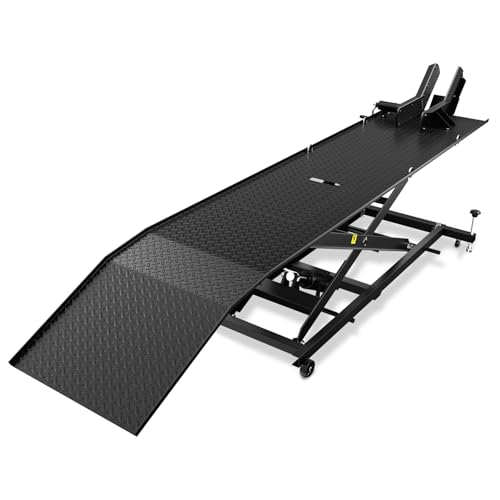
The lowest-priced full table we track, with an 86.2 in deck that fits any production bagger by wheelbase. Hydraulic foot pump, no compressor needed.
Price incl. tax, excl. shipping.
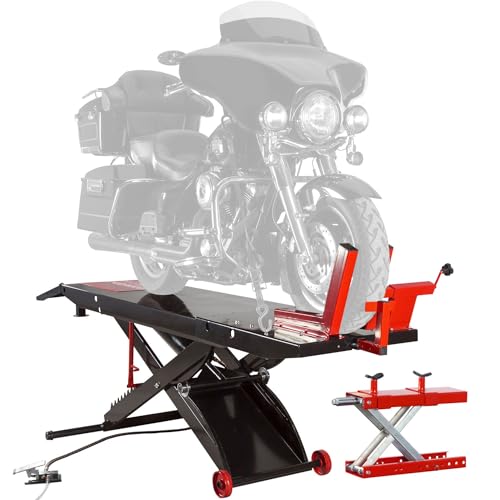
Air-over-hydraulic table rated at 1,500 lb with 31.25 in of height. The right table for a loaded Ultra Limited or Roadmaster, if you already own a compressor.
Price incl. tax, excl. shipping.
* Affiliate link - we may earn a commission
Frequently Asked Questions
What size motorcycle lift do I need for a Harley Street Glide?▼
Is a motorcycle lift table worth it for a home garage?▼
Can a motorcycle scissor jack lift an ATV?▼
Do I need an air compressor for a motorcycle lift table?▼
How do you keep a motorcycle from tipping on a lift?▼
Related Expert Reviews
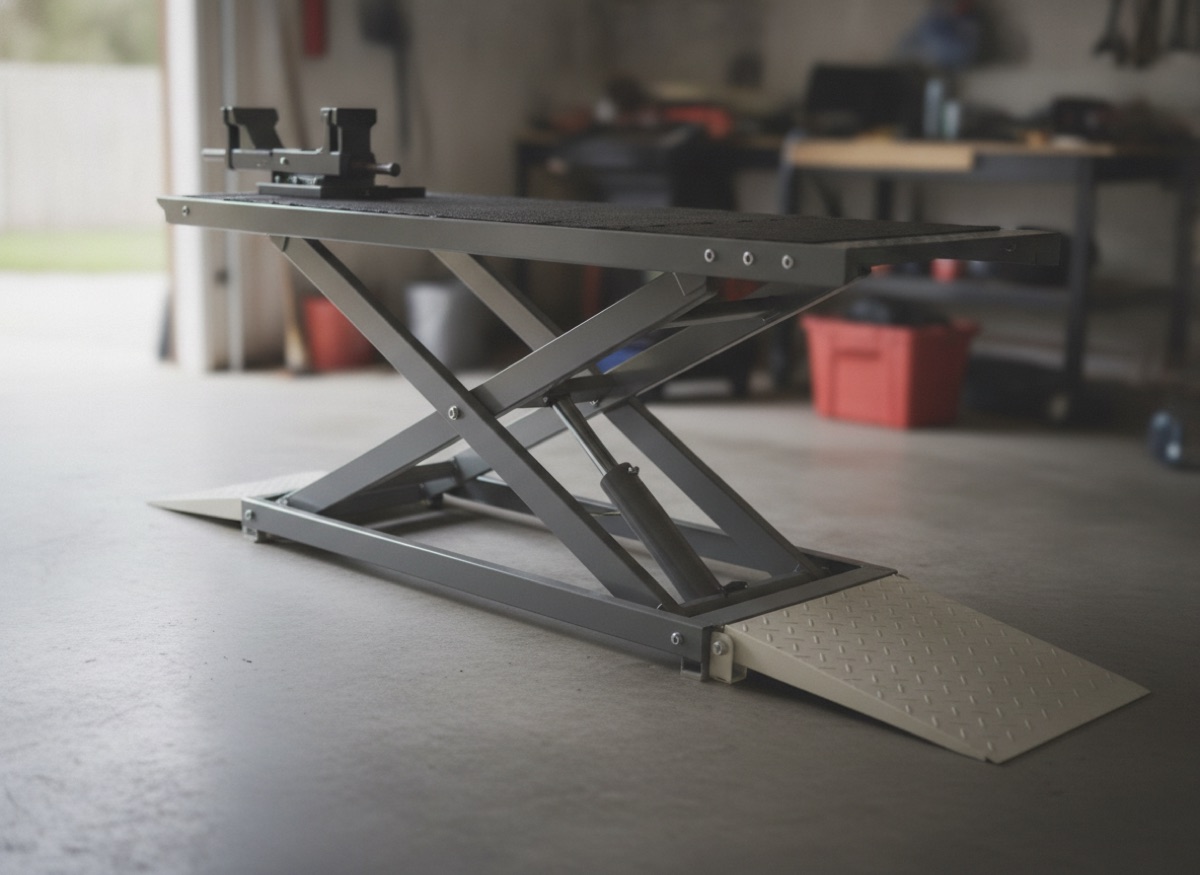
VEVOR Motorcycle Lift 1100 LBS Review: Best Budget Hydraulic Table
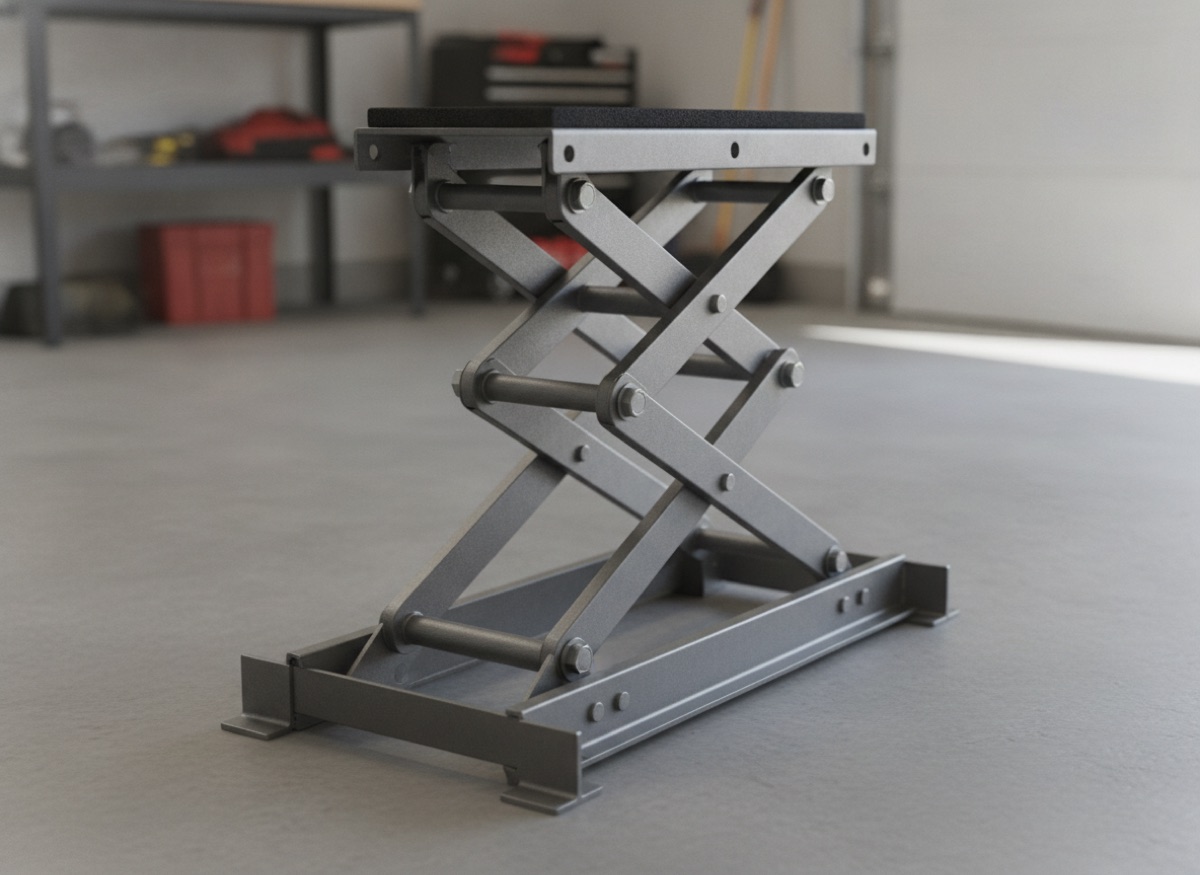
Black Widow Steel Motorcycle Jack 1000 lbs Review: Compact and Affordable
Titan 1500 lb Motorcycle ATV Lift Table Review: Versatile Heavy-Duty Option
BendPak ML-1500 Pro Motorcycle Lift Review: The Commercial Gold Standard
More Buying Guides
How to Choose the Right Car Lift for Your Garage
Choosing the right car lift is one of the biggest investments you can make for your home garage. This comprehensive guide walks you through every factor you need to consider, from ceiling height and floor thickness to weight capacity and electrical requirements.
12 min readGeneralBest Car Lifts for Low Ceiling Garages Under 10 Feet
A low ceiling doesn't mean you have to give up on having a car lift. With the right equipment and careful planning, you can safely lift your vehicle for maintenance even in garages with 8 to 10-foot ceilings.
10 min readGeneralHow Much Does a Car Lift Cost? Full Price Breakdown
A car lift’s sticker price is only part of the story. Once you factor in electrical work, concrete, installation, and permits, the total project usually runs 30–50% more than the lift itself. Here is exactly what to budget, broken down by lift type and real-world example.
12 min readReady to Find Your Lift?
Browse our curated selection of top-rated car lifts or use our comparison tool to find the perfect match.