
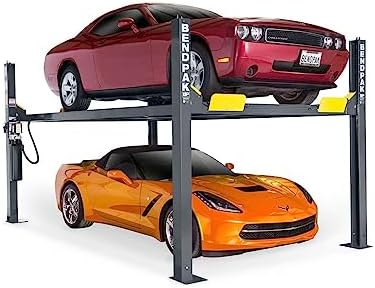
Illustration of a typical scissor lift — not a photograph of the Triumph NSS-6 6,000-lb Portable Scissor.
Triumph NSS-6 Review: Portable Scissor Lift That Defies Expectations
The Triumph NSS-6 is a 6,000 lb scissor platform that needs no anchors and runs on a 110V outlet, with 36 in of rise. It sits between a QuickJack frame lift and a fixed mid-rise: more height than the first, less than the second, and at 620 lb it is movable with a helper rather than portable. It costs around $2,199.
Sold through equipment dealers — not currently listed on Amazon
See Top-Rated Scissor LiftsAffiliate Disclosure: Car Lift For Garage is a participant in the Amazon Services LLC Associates Program, an affiliate advertising program designed to provide a means for sites to earn advertising fees by advertising and linking to Amazon.com. We may earn a commission from qualifying purchases made through links on this page, at no additional cost to you.
How this review was researched
This is a research-based review built from the manufacturer's specifications and manuals, ALI certification records and the pricing and owner feedback available for this class of lift. We have not installed or operated this unit ourselves, and we do not publish a star rating without at least 10 verified owner ratings. How we evaluate lifts.
Pros
- No anchoring or permanent installation needed — place it and start lifting
- 6,000-lb capacity provides generous margin for trucks and large SUVs
- 110V standard power eliminates need for dedicated electrical circuits
- Compact storage profile when collapsed makes multi-use garages practical
- Scissor design offers inherent lateral stability during heavy work
- Straightforward controls with intuitive up/down operation
Cons
- Rise height could be taller for more comfortable standing work on larger vehicles
- Unit weight makes repositioning a two-person job
- Hydraulic pump is noticeably louder than premium competitors like BendPak
- Paint finish on base plates shows wear marks quickly on rough concrete
Where the NSS-6 sits between a frame lift and a mid-rise
Portable scissor platforms are a small class, and the Triumph NSS-6 is the clearest example of it. It is a single 68 in by 60 in scissor platform, 5 in tall when collapsed, that raises 6,000 lb to 36 in on a 110V power unit. Nothing is bolted to the floor. That puts it a foot above the 24 in a QuickJack BL-7000SLX reaches and a foot below the 48 in a BendPak MD-6XP reaches, at a price of around $2,199 that lands between them too.
The reason to want the middle is ergonomic. At 24 in a person works on their back on a creeper. At 36 in a person can sit upright on a low stool under a truck, or kneel comfortably under a car, and there is room for a drain pan, a transmission jack on its lowest setting and a light. It is not standing height, and the NSS-6 should not be bought expecting that.
Triumph sells through discount lift dealers rather than a factory network, which is part of why the price undercuts the BendPak and Dannmar mid-rises by several hundred dollars.
Capacity, dimensions and what parks over it
The 6,000 lb rating is the useful number. It covers every sedan and crossover and the common half-ton pickups at their curb weight: an F-150 crew cab near 5,000 lb, a RAM 1500 around 5,400, a Tahoe around 5,600. That is more margin than the QuickJack 7000 offers on the same trucks, and the platform design means the load sits on four adjustable rubber pads rather than on frame contact blocks that must be placed per vehicle.
The footprint is 68 in long and 60 in wide, so it fits inside a standard bay with walking room on both sides. Collapsed height is 5 in, which a stock sedan or SUV will drive over and park on. A car lowered on aftermarket springs will need Triumph's ramps or a pair of boards. The pads are adjustable along the platform, so the lift reaches short-wheelbase cars and long-wheelbase trucks without extensions, though a coupe with widely spaced pinch welds should be checked against the pad travel before ordering.
Weight is 620 lb. That is light for a scissor platform and heavy for anything called portable. Two people and a pallet jack or furniture dolly can reposition it; one person cannot.
Available on Amazon in this category:

* Affiliate link - we may earn a commission
Power, floor and setup requirements
The NSS-6 runs on a standard 110V household circuit, and Triumph specifies a dedicated 20-amp outlet rather than a shared one, because the pump draws its full current at the start of every lift. There is no 220V option listed, which is a difference from the BendPak MD-6XP and Dannmar DMR-6 and makes the NSS-6 slower to rise with a heavy vehicle on it. For a home garage doing a few lifts a week that is a non-issue. For a shop cycling it all day it is the reason to look at the 220V mid-rises.
Setup is placement, not installation. The platform comes on a pallet, gets moved to its spot, the power unit connects to the hydraulic port, the reservoir is filled and the lift is cycled unloaded to bleed air. Triumph's manual asks for a flat, level concrete floor and no anchoring, and the platform's own weight keeps it in place under load.
The floor requirement is the one that trips up garages with a pitched slab. A scissor platform that is out of level loads one side of its locks first, so shimming to level is part of setup, not an optional step.
Safety locks, warranty and the certification question
The NSS-6 uses mechanical safety locks that engage as the platform rises, plus a pressure relief valve in the hydraulic circuit and a flow control on the descent. With the locks set the vehicle sits on steel, and lowering requires a short raise to unload the locks before they release. That is the standard scissor arrangement and it works the same way on the BendPak and Dannmar platforms.
What the NSS-6 does not have is an ALI certification listing. Triumph's spec sheet does not claim one, and the model does not appear in the ALI directory. That does not make the lift unsafe, and Triumph has sold this class of lift for years, but it means no third-party lab has tested a production unit to the ANSI/ALI ALCTV standard. For a home garage that is a judgment call. For a commercial shop that answers to an insurer, it is usually a deal-breaker, and it is the main thing the extra $700 for the MD-6XP buys.
The warranty is 3 years limited, which is a year longer than QuickJack's cover and two years shorter than BendPak's structural warranty.
How it compares to the QuickJack BL-7000SLX, Atlas MR6K and BendPak MD-6XP
The QuickJack BL-7000SLX (around $1,899) is the alternative for a garage that parks a truck every night. It carries 7,000 lb, stores on a wall, and stops at 24 in. The NSS-6 gives a foot more rise and skips the per-vehicle frame positioning, at the cost of 620 lb that stays on the floor. Choose by whether the bay is free most of the time.
The Atlas MR6K (around $1,799) is a rolling air-hydraulic jack that lifts one end of a car to 28 in and rolls away. It needs a compressor and, for a whole-vehicle lift, two units. It suits a shop with air and several cars more than a home garage with one.
The BendPak MD-6XP (around $2,899) is the upgrade: 48 in of rise, ALI/ETL certification, a 5-year structural warranty, and 110V or 220V power. The NSS-6 saves about $700 and 230 lb against it and gives up a foot of height and the certification. In our view the height matters more than the sticker for a home user, and the sticker matters more than the height for a shop.
Who should buy it (and who shouldn't)
The NSS-6 makes sense for the owner with a two-car garage where one bay can be given to a lift most of the year, who wants more than creeper height, and who is not ready to spend mid-rise money. It is also the sensible pick for someone who expects to move house in a few years and does not want anchors in the slab. The 6,000 lb rating, 110V power and 36 in rise cover a half-ton truck and every car under it for brakes, fluids, suspension and exhaust.
It is the wrong lift for a garage that must be cleared nightly, because 620 lb does not go on a wall. It is the wrong lift for a shop that needs certification or 220V cycle speed. And it is the wrong lift for anyone who will spend real time on transmission or fuel tank work, where 48 in of rise is worth every dollar of the mid-rise premium.
For the buyer in the first group, the NSS-6 is a good value and we would buy it over a second-tier frame lift. We would not buy it over the MD-6XP if the bay is permanent.
Final Verdict
The NSS-6 is the lift for a garage that has a spare bay most of the time but occasionally needs it back, and for anyone who wants a foot more rise than a QuickJack without paying mid-rise money. The 6,000 lb rating covers half-ton trucks at the curb. Skip it if the lift has to store on a wall every night (the QuickJack BL-7000SLX does that, this does not) or if you want standing-height access, where the BendPak MD-6XP's 48 in and ALI listing are worth the extra $700.
The Triumph NSS-6 6,000-lb Portable Scissor isn't currently sold on Amazon. Here's our top-rated scissor lifts pick that is:
Our top-rated scissor lifts currently available on Amazon.
Price incl. tax, excl. shipping.
* Affiliate link - we may earn a commission
Specifications
- Lift Capacity
- 6,000 lbs
- Maximum Rise Height
- 36 inches
- Lowered Height
- 5 inches
- Power Requirements
- 110V standard household
- Safety Features
- Mechanical safety locks, pressure relief valve
- Overall Length
- 68 inches
- Overall Width
- 60 inches
- Weight
- Approximately 620 lbs
- Warranty
- 3-year limited warranty
- Installation
- No anchoring required
Wheels off? Check the tires
A lift puts every tire at eye level, so it is an easy time to check pressure. Fanttik makes cordless tire inflators.
See Fanttik tire inflatorsTags
Related Reviews
Need Help Choosing?
Use our comparison tool to see how the Triumph NSS-6 6,000-lb Portable Scissor stacks up against other lifts, or read our buying guide for expert recommendations.