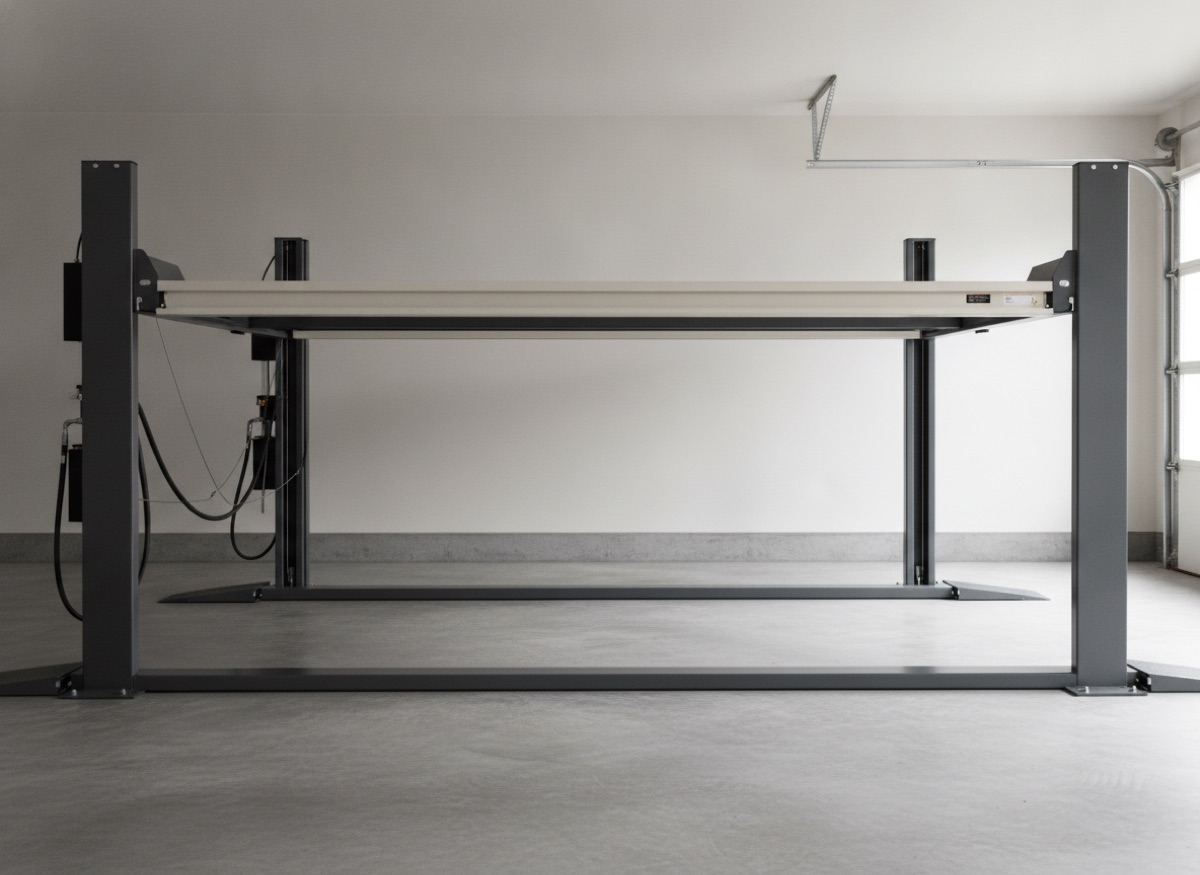
Illustration of a typical parking lift — not a photograph of the Triumph NSP-8.
Triumph NSP-8 Review: 8,000-lb Storage Lift for Serious Car Collectors
The Triumph NSP-8 is an 8,000 lb parking lift priced around $4,299, which puts it about $400 above the ALI certified BendPak PL-6000 while offering 2,000 lb more capacity and 4 in more drive-on width. That trade, capacity for certification, is the whole decision. This review works through the published numbers, what a 2,450 lb lift demands at install time, and which trucks and SUVs actually fit on the upper deck at the 12 ft minimum ceiling.
Sold through equipment dealers — not currently listed on Amazon
See Top-Rated Parking LiftsAffiliate Disclosure: Car Lift For Garage is a participant in the Amazon Services LLC Associates Program, an affiliate advertising program designed to provide a means for sites to earn advertising fees by advertising and linking to Amazon.com. We may earn a commission from qualifying purchases made through links on this page, at no additional cost to you.
How this review was researched
This is a research-based review built from the manufacturer's specifications and manuals, ALI certification records and the pricing and owner feedback available for this class of lift. We have not installed or operated this unit ourselves, and we do not publish a star rating without at least 10 verified owner ratings. How we evaluate lifts.
Pros
- Impressive 8,000 lbs capacity handles trucks and SUVs
- Heavy-duty construction with reinforced platform
- Reliable safety lock system with multiple engagement points
- Space-efficient footprint for the capacity offered
- Competitive pricing for an 8,000-lb class lift
- Smooth hydraulic operation with controlled descent
Cons
- Requires minimum 12-foot ceiling for full-size vehicles
- Heavier than 6,000-lb models making installation more complex
- Powder coat finish is thinner than premium brands
- Instructions could be more detailed for DIY installers
What the NSP-8 is for
Triumph builds the NSP-8 for one job: parking a heavy vehicle over a lighter one in a single bay. The 8,000 lb rating is the point. A 6,000 lb lift is fine for a sedan but leaves no margin for an F-150 crew cab at 5,000 to 5,700 lb, a Tahoe at 5,600 lb or a Rivian R1T at 7,000 lb. The NSP-8 carries all of those with at least 500 lb in hand, and it does so for around $4,299, which is less than most 7,000 lb lifts from the name brands.
The platform is listed at 114 in long by 100 in wide with an 88 in drive-on width. That width matters more than it sounds. A Silverado 1500 is about 81 in across the body and an F-150 about 80 in, so an 84 in deck like the BendPak PL-6000 leaves 2 in per side and an 88 in deck leaves 4 in. Anyone who has parked a truck on a lift knows the difference.
Triumph is an import brand sold through online equipment dealers rather than a factory-direct manufacturer. That is how the price gets to where it is, and it is also why the manual and the finish trail the BendPak and Rotary products in this category.
Ceiling, headroom and which vehicles fit
The minimum ceiling is listed at 12 ft, or 144 in, with a full rise of 74 in. That leaves 70 in for the upper vehicle at the minimum ceiling, before deducting for a door opener or overhead lighting. A Tahoe at 76 in tall does not fit at 12 ft; it needs about 12 ft 8 in. An F-150 is 77 in and similar. A Grand Cherokee at 71 in is marginal, and anything 66 in or under, which includes most crossovers and every sedan, fits with room.
So the honest reading is this: at a 12 ft ceiling the NSP-8 stores a heavy crossover or a low truck on top and a taller vehicle below. At 13 ft it stores almost any half-ton on top. Measure to the lowest obstruction, not the drywall.
Below the platform, lowered height is 8 in, so the deck underside at full rise is roughly 66 in off the floor. That takes any sedan or sports car and a compact SUV like a CR-V. If both of your vehicles are trucks, no residential parking lift in this range works; you need a taller garage than most houses have.
Available on Amazon in this category:

* Affiliate link - we may earn a commission
Installation demands of a 2,450 lb lift
The NSP-8 weighs 2,450 lb crated, about 350 lb more than a 6,000 lb lift, and the difference is in the platform sections and columns. That pushes the install from a long day into a two-day job for a crew of two or three, with a pallet jack or engine hoist for positioning the platform. Triumph's own literature assumes professional installation and the manual is thin on the steps a first-time installer needs most, which is one of the listed cons and a fair one.
Concrete requirements follow the class: 4 in of 3,000 psi slab, sound and uncracked at the anchor points. The column loads on an 8,000 lb lift are higher than on a 6,000 lb unit, so this is not the place to gamble on an unknown floor. A core sample or a builder's pour record settles it.
Power is 220V single phase on a dedicated circuit. Between the electrician, freight and a two-day install, the realistic all-in number is around $5,500 to $6,000. That still undercuts a comparable 8,000 lb lift from Rotary or BendPak once their higher sticker prices go through the same math.
Safety locks and what certification it lacks
The NSP-8 holds its load on automatic mechanical locks in both columns that engage as the platform rises, so a parked vehicle rests on steel, not on hydraulic pressure. Lowering requires raising off the locks, releasing them and descending through a flow-controlled valve, and a manual lowering path covers power outages. Those are the right features and they are the same features BendPak and Challenger use.
What the NSP-8 does not have is an ALI/ETL certification. The 8,000 lb rating is Triumph's own number, not a figure proven by an independent lab to the ANSI/ALI ALCTV standard. For most homeowners that is a paper difference, but it is a real one in two cases: when a local permit office requires a certified lift, and when an insurer asks after a claim. The Challenger CP-8 offers the same capacity with certification for about $100 less, which makes it the obvious cross-shop if the ALI sticker matters to you.
The practical safety work is the same on any of these lifts: inspect cables, verify the locks click in on every rise, check anchor torque yearly.
Against the BendPak PL-6000, Atlas AP-9XL and Triumph NSP-10
The BendPak PL-6000 costs about $400 less, is ALI certified, has the better finish and the better documentation, and is rated at 6,000 lb. If the vehicle going up is a sedan or a compact SUV, buy the BendPak. If it is a Tahoe or a half-ton, the BendPak is out of its rating and the Triumph is in.
The Atlas AP-9XL is the step up: 9,000 lb, a 120 in by 106 in platform, 94 in of drive-on width and a 76 in rise for around $4,799. It is the better truck lift, especially for a long-bed or a three-quarter ton, and it costs about $500 more and weighs 350 lb more. Within Triumph's own line, the NSP-10 goes to 10,000 lb and a 78 in rise for around $5,299 but needs 12 ft 6 in of ceiling and weighs 3,100 lb.
The NSP-8 sits in the middle of that ladder on purpose. It is the least expensive way to get a half-ton off the floor, and that is a real niche, since most parking lifts under $4,000 top out at 6,000 or 7,000 lb.
Who should buy it
The NSP-8 fits a household with a full-size truck or three-row SUV and a car, a garage with 12 ft or more to the lowest obstruction, and a budget that stops before the certified 8,000 lb lifts. Collectors with one heavy vehicle and one light one are the classic case; so is the family with a pickup that needs to live indoors over a commuter car.
It is also a reasonable pick for someone who plans to trade into a heavier vehicle later. An 8,000 lb rating means the lift does not need replacing when the next truck arrives.
Pass on it if certification is required where you live, because the Challenger CP-8 covers the same capacity with an ALI listing for similar money. Pass on it if your ceiling is under 12 ft, since there is no short-rise variant. And pass on it if your heaviest vehicle is under 4,500 lb, because you would be paying for capacity and shipping weight you will never use, and the BendPak PL-6000 does that job better for less.
Final Verdict
The NSP-8 is the lift to buy when the vehicle going up weighs between 5,000 and 7,500 lb, which covers a Tahoe, an F-150 or a Model X, and you have 12 ft of ceiling and a budget of about $4,300 before install. It is the cheapest 8,000 lb platform in this group and its 88 in drive-on width takes a full-size truck without drama. We would pick it over the BendPak PL-6000 for a truck household and pick the BendPak for a sedan household, because the Triumph gives up ALI certification, a thicker finish and a better manual to get its price. Skip it if a certified lift is a permit or insurance condition, or if your upper vehicle is under 4,500 lb, where the extra capacity is money spent on nothing.
The Triumph NSP-8 isn't currently sold on Amazon. Here's our top-rated parking lifts pick that is:
Our top-rated parking lifts currently available on Amazon.
Price incl. tax, excl. shipping.
* Affiliate link - we may earn a commission
Specifications
- Capacity
- 8,000 lbs
- Platform Length
- 114 inches
- Platform Width
- 100 inches
- Lift Height
- 74 inches
- Lowered Height
- 8 inches
- Minimum Ceiling Height
- 12 feet
- Power Requirements
- 220V single phase
- Safety Locks
- Automatic mechanical
- Drive-On Width
- 88 inches
- Weight
- 2,450 lbs
Tags
Related Reviews
Need Help Choosing?
Use our comparison tool to see how the Triumph NSP-8 stacks up against other lifts, or read our buying guide for expert recommendations.