
TRIUMPH NOS9000 Review: 9,000 lb Parking Lift with Stacking Capability
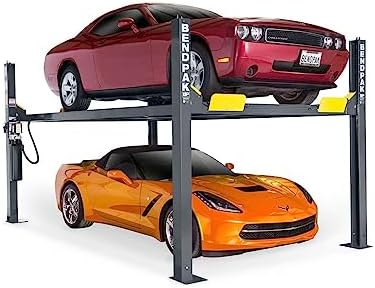
The NOS9000 is Triumph's 9,000 lb parking lift, built to put one car above another rather than to be worked under. It rises 73 in on an 11 ft ceiling, spans 100 by 176 in, and includes a caster kit, aluminum ramps and rolling jack trays at around $3,295. The design choices all point the same direction: storage first, service second.
Affiliate Disclosure: Car Lift For Garage is a participant in the Amazon Services LLC Associates Program, an affiliate advertising program designed to provide a means for sites to earn advertising fees by advertising and linking to Amazon.com. We may earn a commission from qualifying purchases made through links on this page, at no additional cost to you.
Our Rating
This score weighs the published specifications, the certification status and 12 Amazon owner ratings (averaging 4/5 at our last check). We have not installed or operated this unit ourselves. How we evaluate lifts.
Pros
- Optimized design for double-stacking vehicles efficiently
- Good value for 9,000 lb capacity parking lift
- Included caster kit allows repositioning when empty
- Aluminum ramps are lightweight yet durable
- Rolling jack trays included for occasional working access
- Straightforward installation for budget equipment
Cons
- Parking focus means less optimized for intensive work use
- Build quality adequate but not exceptional
- Requires careful planning for stacking configurations
- Lower rise height limits some undercarriage work
- No certification may affect insurance coverage
A parking lift that happens to lift 9,000 lb
Triumph sells this as a storage lift and the specification bears that out. The 73 in rise is enough to slide a second car underneath and not enough to work upright under the runways. The runway surface is continuous rather than open, so it holds drips and dirt off the car below. The included accessories are a caster kit and aluminum ramps, which are storage tools, not service tools.
Capacity is 9,000 lb, which is more than a parking lift strictly needs and gives useful margin. A loaded half-ton pickup at 6,000 lb parked on top for a winter is well inside the rating, and that margin matters more for a lift that holds weight for months than for one that cycles daily.
At 100 in wide and 176 in long the frame fits a single bay in a standard garage. It is the same width as BendPak's HD-9 and 1 in shorter, so if a HD-9 fits the space, this does too.
Ceiling height math for double-stacking
This is where most NOS9000 plans succeed or fail. Triumph lists an 11 ft minimum, which is 132 in. Subtract the 73 in rise and about 59 in remain for the vehicle on the upper deck, minus the runway steel itself. That accepts a Miata at 49 in, a Corvette at 49 in, a Mustang at 55 in and a Camry at 57 in. It does not accept a CR-V at 66 in or any pickup.
Turn the math around if the goal is a car underneath. The runway underside at full rise sits roughly 66 in off the floor, which clears most sedans and sports cars and nothing taller.
A 12 ft ceiling changes the answer considerably, opening up 71 in of clearance on top. If the building is going up new or the ceiling is drywall over trusses with room above, an extra foot buys far more than any accessory. Measure to the lowest obstruction, since door tracks and lights live in exactly that space.
* Affiliate link - we may earn a commission
Installation, anchors and power
A 4-post lift puts its load into four columns rather than two, which makes anchoring less demanding than a 2-post but not optional. Plan on the usual 4 in of 3,000 psi slab, columns plumb, and diagonals measured before the anchors go in. Two people and a full day gets most of these standing; cable equalization and the first cycles take a second session.
Power is 220V single phase, which for most homes means an electrician and a dedicated circuit. Price that in. A 4-post lift that needs a $400 electrical run is not really a $3,295 lift.
The included caster kit is genuinely useful here and worth setting up during installation rather than later. It lets two people roll the empty lift out of the way, which is how a lot of owners keep a garage flexible. Note that a lift on casters is not anchored, so it should be rolled empty and only parked under load once it is sitting where it belongs.
What owners report, and the certification gap
Owner reviews of the NOS9000 on Amazon are generally positive about the value and the completeness of the package, with the caster kit and aluminum ramps mentioned often as things buyers expected to pay extra for. The recurring criticisms are finish quality, with powder coat thinner than the premium brands apply, and instructions that owners describe as workable rather than clear.
The bigger structural point is that the NOS9000 carries no ALI or ETL listing. Triumph states the 9,000 lb rating; no independent lab has verified it against the ANSI/ALI ALCTV standard. In practice most homeowners never encounter a consequence. Where it does matter is with insurers who ask about certified equipment, permit offices in some jurisdictions, and anyone using a lift in a commercial setting.
If that listing matters to you, BendPak's HD-9 is the certified alternative at roughly $3,000 from a dealer, and it lifts 9 in higher into the bargain.
How it compares to the NSS-8, NOS9000XLT and HD-9
Against Triumph's own NSS-8 the NOS9000 adds 1,000 lb of capacity, 1 in of rise and 4 in of width for a few hundred dollars. The NSS-8 has far more owner feedback behind it, more than 145 Amazon ratings at 4.4 stars, and includes rolling jacks rather than jack trays. For a buyer who wants occasional service access, the NSS-8 is the better buy. For pure parking with margin, the NOS9000.
The NOS9000XLT is this lift stretched: 196 in of runway and 83 in of rise for a 12 ft ceiling. If the vehicle going on top is a full-size truck, that is the version to order, and the extra length matters as much as the height.
The BendPak HD-9 costs more from a dealer, rises 82 in and carries the ALI listing. It is the better service lift. The Triumph is the better storage value, and most buyers of a 4-post are really buying storage.
Final Verdict
Overall Rating
Buy the NOS9000 if the goal is a second parking space for a low car in a garage with 11 ft of ceiling, and you want the caster kit and ramps in the box rather than on the invoice. At its price it does that job as well as anything, and the 9,000 lb rating covers full-size trucks going up top if your ceiling can take the height. Skip it if you plan to spend real time underneath, because 73 in of rise puts the runways below standing height for most adults and the lift has no ALI listing to satisfy an insurer. Skip it too if the vehicle going on top is a tall SUV, which the ceiling math simply will not allow in a residential garage.
- Optimized design for double-stacking vehicles efficiently
- Good value for 9,000 lb capacity parking lift
- Included caster kit allows repositioning when empty
- Aluminum ramps are lightweight yet durable
Price incl. tax, excl. shipping. Last updated September 5, 2026.
* Affiliate link - we may earn a commission
Specifications
- Capacity
- 9,000 lbs
- Overall Width
- 100 inches
- Overall Length
- 176 inches
- Max Rise Height
- 73 inches
- Min Ceiling Height
- 11 feet
- Power Supply
- 220V single phase
- Design Type
- Parking/storage optimized
- Included Accessories
- Caster kit, rolling jack trays, aluminum ramps
- Finish
- Powder coat
- Warranty
- 1 year limited
* Affiliate link - we may earn a commission
Wheels off? Check the tires
A lift puts every tire at eye level, so it is an easy time to check pressure. Fanttik makes cordless tire inflators.
See Fanttik tire inflatorsTags
Related Reviews


Need Help Choosing?
Use our comparison tool to see how the TRIUMPH NOS9000 stacks up against other lifts, or read our buying guide for expert recommendations.