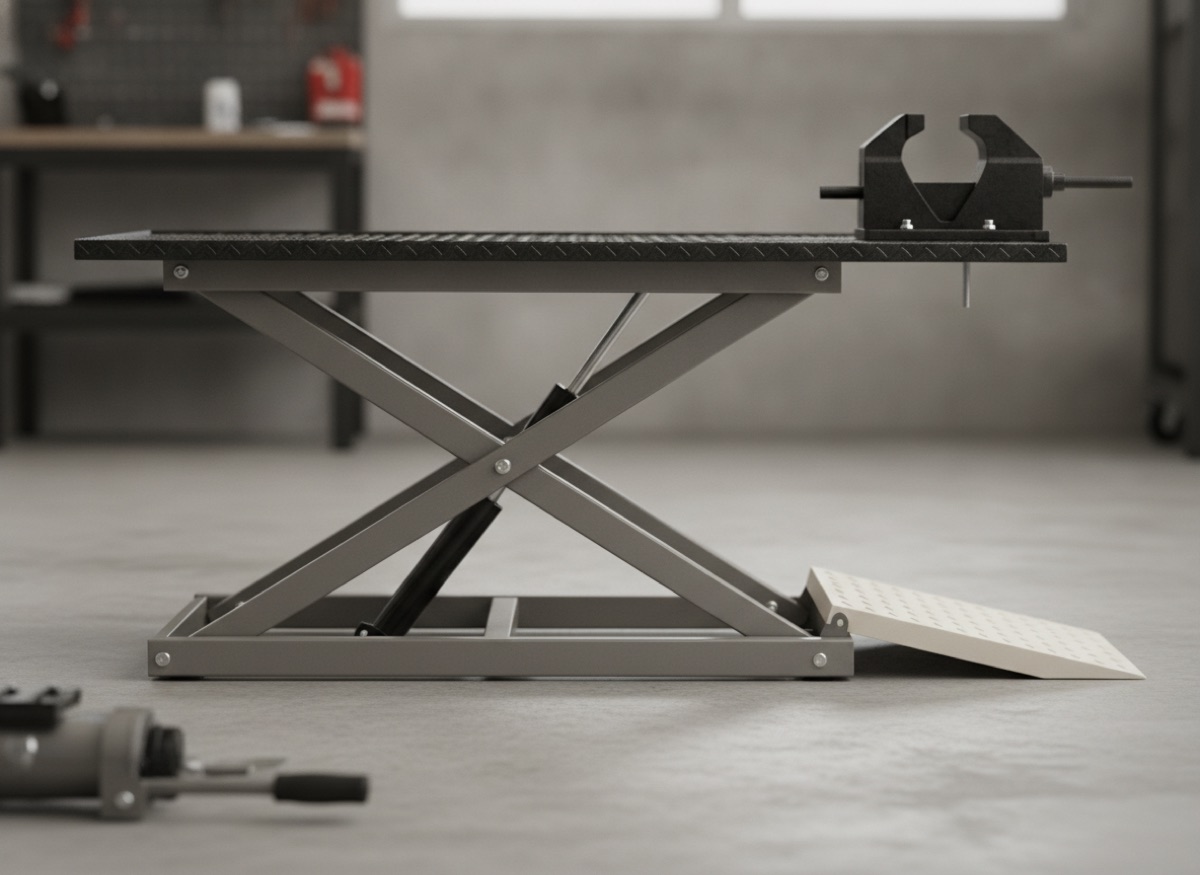
Illustration of a typical motorcycle lift — not a photograph of the Challenger CML-1000 1,000-lb Value.
Challenger CML-1000 Value Motorcycle Lift Review: Premium Brand at Entry Pricing
The Challenger CML-1000 is a 1,000 lb foot-pump table from a Louisville automotive lift maker: a 47 by 22 inch deck, an 8 to 33 inch range, a lock bar and check valve, and a two-year warranty for around $449. This review covers which bikes the rating suits, what it shares with the CML-1500, and how it holds up against the Atlas AML-1000 and the 1,500 lb value tables.
Sold through equipment dealers — not currently listed on Amazon
See Top-Rated Motorcycle LiftsAffiliate Disclosure: Car Lift For Garage is a participant in the Amazon Services LLC Associates Program, an affiliate advertising program designed to provide a means for sites to earn advertising fees by advertising and linking to Amazon.com. We may earn a commission from qualifying purchases made through links on this page, at no additional cost to you.
How this review was researched
This is a research-based review built from the manufacturer's specifications and manuals, ALI certification records and the pricing and owner feedback available for this class of lift. We have not installed or operated this unit ourselves, and we do not publish a star rating without at least 10 verified owner ratings. How we evaluate lifts.
Pros
- Challenger premium construction quality at a more accessible price point
- Reliable hydraulic operation with smooth consistent lifting performance
- Professional-grade safety features including lock bar and check valve
- Excellent powder coat finish that resists chemicals and shop wear
- Strong brand support with parts availability and customer service
- Clean professional appearance that looks great in any garage
Cons
- 1,000 lb capacity limits use with heavier touring motorcycles over 700 lbs
- around $450 price faces stiff competition from 1,500-lb lifts at similar or lower pricing
- Foot pump only with no air-hydraulic option at this model level
- Brand premium means you pay more per pound of capacity than value brands
Challenger's entry model
Challenger Lifts of Louisville, Kentucky builds two-post and four-post automotive lifts for dealerships and independent shops. Its motorcycle line is two tables: the air-hydraulic CML-1500 at around $699 and this one, the foot-pump CML-1000. Published specs: a 1,000 lb capacity, a 47 by 22 inch professional-grade steel deck, a hydraulic foot pump, an 8 to 33 inch height range, a lock bar and hydraulic check valve, a premium powder coat, 155 lb assembled weight and a two-year limited warranty.
At around $449 the CML-1000 sits at the same price as the Atlas AML-1000, $30 under the Triumph NML-1000S and $100 under the Rotary RML-1000, all 1,000 lb tables from automotive lift brands. It is also $100 to $150 above the JEGS 80081 and Titan 1500, both rated 1,500 lb.
That is the whole story of this table. It is a good 1,000 lb table in a market where 1,000 lb is becoming a hard sell at $449, and what Challenger offers for the money is construction, finish, a check valve and a support network rather than capacity. Whether that is enough depends on the bike.
Capacity and bike fit
A 1,000 lb rating is comfortable to about 650 lb of bike, leaving a third of the rating for the side loads that come with real work. That takes in every sport bike and naked bike, dual sports, adventure bikes like the BMW R 1250 GS at about 549 lb or the KTM 1290 Super Adventure at about 540 lb, and middleweight cruisers like the Sportster Iron 883 at about 564 lb or the Indian Scout at about 560 lb.
It does not take in the big cruisers. A Harley Street Bob at about 650 lb is at the line, a Fat Boy at about 700 lb is past it, and anything with saddlebags and a fairing belongs on the CML-1500 or a 1,500 lb table from another brand. The cons list on this page puts the practical cutoff at 700 lb, which is generous; 650 is the safer number.
The 47 by 22 inch deck matches the rating. A bike with a wheelbase under about 59 inches sits with both contact patches on the main deck, and 22 inches holds floorboards with room beside the tire. The 33 inch maximum rise is 1 inch under the Atlas and Triumph tables, which for most riders does not matter.
Available on Amazon in this category:

* Affiliate link - we may earn a commission
Deck, height range and assembly
The 8 inch minimum is standard for the class and works with a short ramp for most bikes. At 155 lb the CML-1000 is a two-person build of about 90 minutes and a permanent installation on level concrete, with a footprint of about 4 by 2 feet plus working room on three sides. There are no casters.
The finish is a real difference from the direct-import tables. Challenger's powder coat is the same process used on its automotive lifts, and it holds up to brake cleaner and chain lube in a way that a painted VEVOR deck does not. That is a maintenance advantage over ten years rather than a performance one.
The foot pump is appropriate for the bikes this table suits. Lifting a 550 lb bike to 33 inches is a couple of dozen strokes with moderate effort, and the release is a proportional valve so lowering speed follows how far it is opened. It is the same pump family as the CML-1500 without the air motor.
Safety hardware compared with the CML-1500
The CML-1000 has a lock bar and a hydraulic check valve. The lock bar seats into stops along the rise and carries the load once the release is opened; the check valve holds cylinder pressure if a seal or hose fails. That is the same pairing as the CML-1500 and the Triumph NML-1000S, and it is one item more than the Atlas AML-1000, which lists a positive-lock bar without a separate check valve.
Against the tables below $350 it is a step up. The Titan and JEGS list a safety lock with a hydraulic hold rather than a check valve, and the VEVOR and Black Widow list a latch. For a rider working alone under the bike, the check valve is worth having.
The routine is standard: pump past the stop, seat the bar, open the release until the load transfers. Before lowering, pump to unload the bar, retract it, and open the release from beside the bike. Challenger does not list ALI or ETL certification for the CML-1000; no motorcycle table in this category carries ALI certification, because the program covers automotive lifts. The two-year warranty matches Atlas and Triumph and is a year short of the CML-1500.
CML-1000 vs Atlas AML-1000, Forward FML-1000 and the 1,500 lb value tables
The Atlas AML-1000 at around $449: 1,000 lb, a 46 by 22 inch deck, 8 to 34 inches, a positive-lock bar, industrial powder coat, 155 lb, two-year warranty. Same price, 1 inch less deck, 1 inch more rise, and no check valve listed. The two are close enough that brand preference decides; the Challenger has the check valve, the Atlas has the extra inch of rise.
The Forward FML-1000 at around $399: 1,000 lb, a 45 by 20 inch deck, 7 to 32 inches, a lock bar and check valve, locking swivel casters, 140 lb, one-year warranty. For $50 less it moves and has a lower entry height; it gives up deck size, steel and a year of warranty. Riders who need the table to roll should buy the Forward.
The Titan 1500 at around $299 and JEGS 80081 at around $349: 1,500 lb, 48 by 24 inch decks, foot pumps, safety locks, one-year warranties. For $100 to $150 less they carry 500 lb more on a bigger deck, with lighter finish, a hydraulic hold instead of a check valve and half the warranty. For a rider with a 750 lb bike, one of these is the only option at this price.
Verdict
Buy the CML-1000 if the bike is under about 650 lb, the table will stay in one spot, and a lift-company finish, a check valve and a two-year warranty are worth $100 to $150 over a Titan or JEGS. It is also the natural choice for a shop that already runs Challenger automotive lifts and wants one parts and service relationship.
Skip it if the bike is over 650 lb; the rating runs out and the CML-1500 at $250 more or the Titan 1500 at $150 less are the tables for that bike. Skip it if the budget is the constraint and the bike is light; the Titan does the job for $150 less and the difference is finish and warranty rather than function. And skip it if the table has to move, which is the Forward FML-1000's job.
Our recommendation: the CML-1000 is a sensible 1,000 lb table at a price where the buyer should be sure 1,000 lb is enough. If it is, it is as good as the Atlas and Triumph alternatives. If it is not, no amount of finish fixes that.
Final Verdict
The CML-1000 is a well-finished 1,000 lb table with the right safety hardware and a two-year warranty, and for a rider with a sub-650 lb bike who wants a lift-company product it is a fair buy at $449. Its problem is arithmetic: the Titan 1500 and JEGS 80081 carry 500 lb more for $100 to $150 less, and the Atlas AML-1000 matches it for the same money. Buy it if Challenger support and finish are worth the premium. Skip it for any bike over 650 lb.
The Challenger CML-1000 1,000-lb Value isn't currently sold on Amazon. Here's our top-rated motorcycle lifts pick that is:
Our top-rated motorcycle lifts currently available on Amazon.
Price incl. tax, excl. shipping.
* Affiliate link - we may earn a commission
Specifications
- Lift Capacity
- 1,000 lbs
- Lift Type
- Hydraulic Table
- Pump Type
- Hydraulic Foot Pump
- Table Dimensions
- 47" x 22"
- Height Range
- 8" to 33"
- Weight
- 155 lbs
- Material
- Professional-Grade Steel
- Safety Features
- Lock Bar, Hydraulic Check Valve
- Finish
- Premium Powder Coat
- Warranty
- 2 Year Limited
Wheels off? Check the tires
A lift puts every tire at eye level, so it is an easy time to check pressure. Fanttik makes cordless tire inflators.
See Fanttik tire inflatorsTags
Related Reviews
Challenger CML-1500 Heavy Duty Motorcycle Lift Review: Premium Air-Hydraulic Power
Est. $699 MSRP
Atlas AML-1000 Bike Lift Table Review: Reliable Mid-Range Performer
Est. $449 MSRP
Forward FML-1000 Bike Lift Review: Simple and Effective for Home Mechanics
Est. $399 MSRP
Need Help Choosing?
Use our comparison tool to see how the Challenger CML-1000 1,000-lb Value stacks up against other lifts, or read our buying guide for expert recommendations.