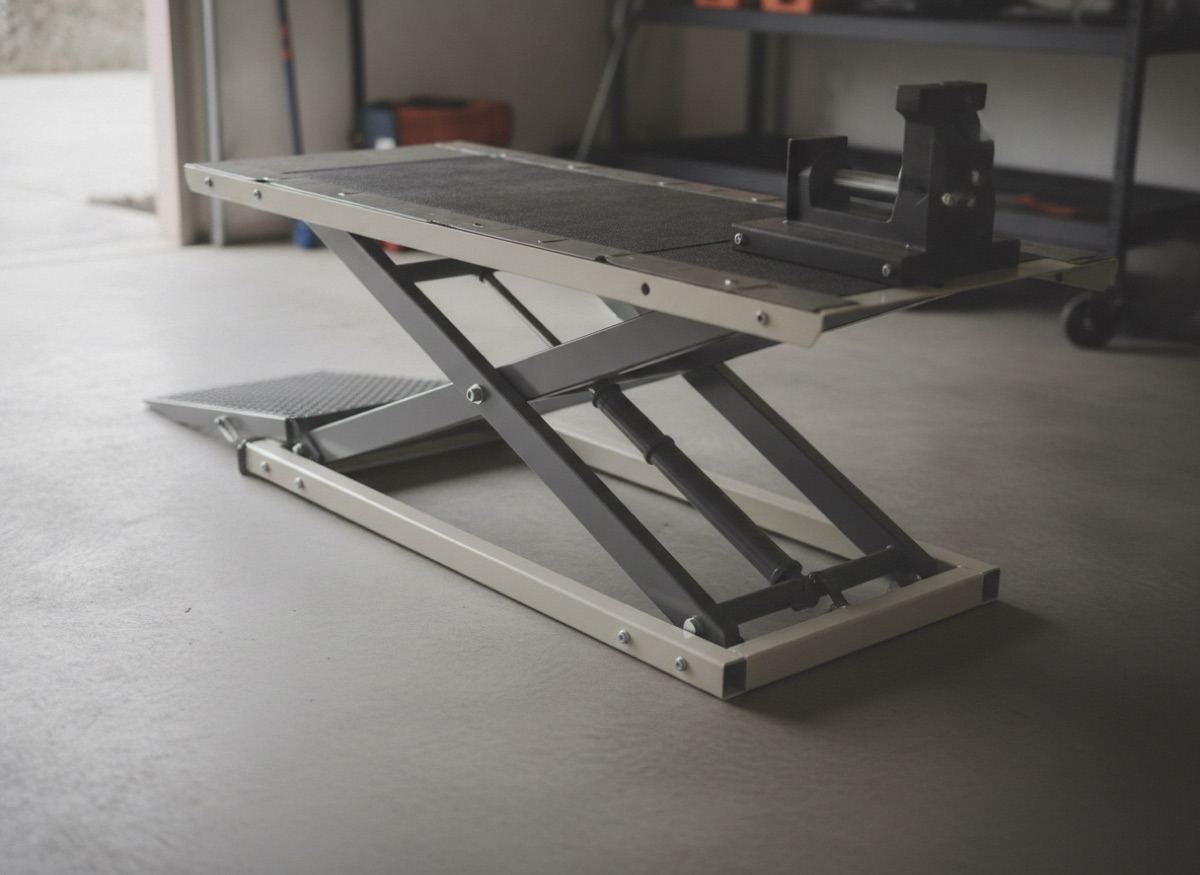
Illustration of a typical motorcycle lift — not a photograph of the Rotary RML-1000 1,000-lb Moto Lift.
Rotary RML-1000 Moto Lift Review: Industrial Heritage Meets Motorcycle Service
The Rotary RML-1000 is a 1,000 lb foot-pump table from the largest name in automotive lifts: a 48 by 22 inch anti-skid deck, an 8 to 34 inch range, a lock bar and check valve, and Rotary's dealer network for around $549. This review looks at what the Rotary name buys at a price where 1,500 lb tables are common.
Sold through equipment dealers — not currently listed on Amazon
See Top-Rated Motorcycle LiftsAffiliate Disclosure: Car Lift For Garage is a participant in the Amazon Services LLC Associates Program, an affiliate advertising program designed to provide a means for sites to earn advertising fees by advertising and linking to Amazon.com. We may earn a commission from qualifying purchases made through links on this page, at no additional cost to you.
How this review was researched
This is a research-based review built from the manufacturer's specifications and manuals, ALI certification records and the pricing and owner feedback available for this class of lift. We have not installed or operated this unit ourselves, and we do not publish a star rating without at least 10 verified owner ratings. How we evaluate lifts.
Pros
- Backed by Rotary legendary reputation in the professional automotive lift industry
- Exceptional build quality with industrial-grade steel and superior welds
- Durable hydraulic system engineered for sustained professional use cycles
- Comprehensive safety features meeting commercial equipment standards
- Professional-grade powder coat finish with outstanding chemical resistance
- Strong parts availability and customer support infrastructure
Cons
- 1,000 lb capacity is limiting at the around $550 price point where 1,500 lb options exist
- Premium pricing does not include air-hydraulic pump system
- Heavy weight of 175 lbs requires permanent or semi-permanent placement
- Brand premium adds cost that some buyers may find difficult to justify
Rotary's name on a motorcycle table
Rotary Lift, part of Dover's Vehicle Service Group, is the largest automotive lift manufacturer in North America and the brand most dealership service bays are built around. The RML-1000 is its 1,000 lb motorcycle table. Published specs: a 1,000 lb capacity, a 48 by 22 inch industrial-grade steel deck with an anti-skid surface, a hydraulic foot pump, an 8 to 34 inch height range, a lock bar and hydraulic check valve, an industrial powder coat, 175 lb assembled weight and a two-year limited warranty.
Price is around $549, which is the problem this review has to work through. At that money the Triumph NML-1500 offers 1,500 lb and an air-hydraulic pump for $50 more, the Dannmar DML-1200 offers 1,200 lb and dual locks for $20 less, and the Atlas AML-1000 offers the same 1,000 lb for $100 less.
What Rotary sells for the difference is the anti-skid deck, 20 lb more steel than the Atlas, and a dealer and service network that no other brand in this category can match. For a commercial shop that is worth paying for. For a home garage it usually is not, and the sections below say why.
1,000 lb at $549: the capacity problem
A 1,000 lb rating covers bikes to about 650 lb with a working margin. That is every sport bike, naked bike, dual sport and adventure bike, and middleweight cruisers like the Sportster Iron 883 at about 564 lb or the Indian Scout at about 560 lb. It is not the big cruisers: a Road King at about 800 lb, a Street Glide at about 800 lb or a Gold Wing at about 840 lb all belong on a 1,200 lb table at least.
The issue is not that 1,000 lb is too little for the bikes it suits. The issue is that at $549 the buyer is paying heavy-duty money for a middleweight rating. The Titan 1500 at around $299 and the JEGS 80081 at around $349 both carry 1,500 lb. A rider with a 500 lb bike who buys the RML-1000 is paying $250 over the Titan for steel gauge, finish and a name; a rider with an 800 lb bike cannot buy it at all.
Rotary's own RML-1500 Pro Moto at around $729 fixes the rating and adds an air pump. For heavy bikes that is the Rotary to buy.
Available on Amazon in this category:

* Affiliate link - we may earn a commission
Deck, anti-skid surface and height range
The 48 by 22 inch deck is the same length as the Titan and JEGS decks and 2 inches narrower. It holds any bike with a wheelbase under about 60 inches with both contact patches on the main surface, and 22 inches is enough for floorboards. The anti-skid surface is the deck's distinguishing feature: rather than a bare textured plate or a rubber mat that wears, the deck is finished with a grit coating that keeps tires from sliding during loading. It is a shop feature carried over from Rotary's automotive runways, and it is one of the few things on this table that no competitor at any price offers.
The 8 to 34 inch range is standard for the class. Roll-on at 8 inches works with a short ramp, and 34 inches is a comfortable working height for a standing rider on a middleweight bike.
At 175 lb with no casters the RML-1000 is a two-person build of about 90 minutes and a permanent installation on level concrete, with a footprint of roughly 4 by 2 feet plus working room on three sides.
Safety hardware and the Rotary network
The RML-1000 has a lock bar and a hydraulic check valve, the same pairing as the Atlas AML-1000 and one lock short of the Dannmar DML-1200. The bar is solid steel and seats into stops along the rise; the check valve holds pressure if a seal or hose fails. The anti-skid deck is listed as a safety feature by Rotary, and fairly: most table incidents happen during loading, when a tire slips on a smooth deck.
Rotary does not list ALI certification for the RML-1000. Rotary's automotive lifts are ALI certified almost without exception, so the absence here says something about the category rather than the company: ALI's program is written for automotive lifts, and no motorcycle table in this group carries the sticker.
What Rotary does offer that no one else does is the service network. Rotary authorized installers and parts distributors are in every metropolitan market, and a shop that already has a Rotary two-post lift serviced on contract can put the RML-1000 on the same schedule. That is the real product here, and it explains the price in a way the spec sheet does not.
RML-1000 vs Atlas AML-1000, Dannmar DML-1200 and Triumph NML-1500
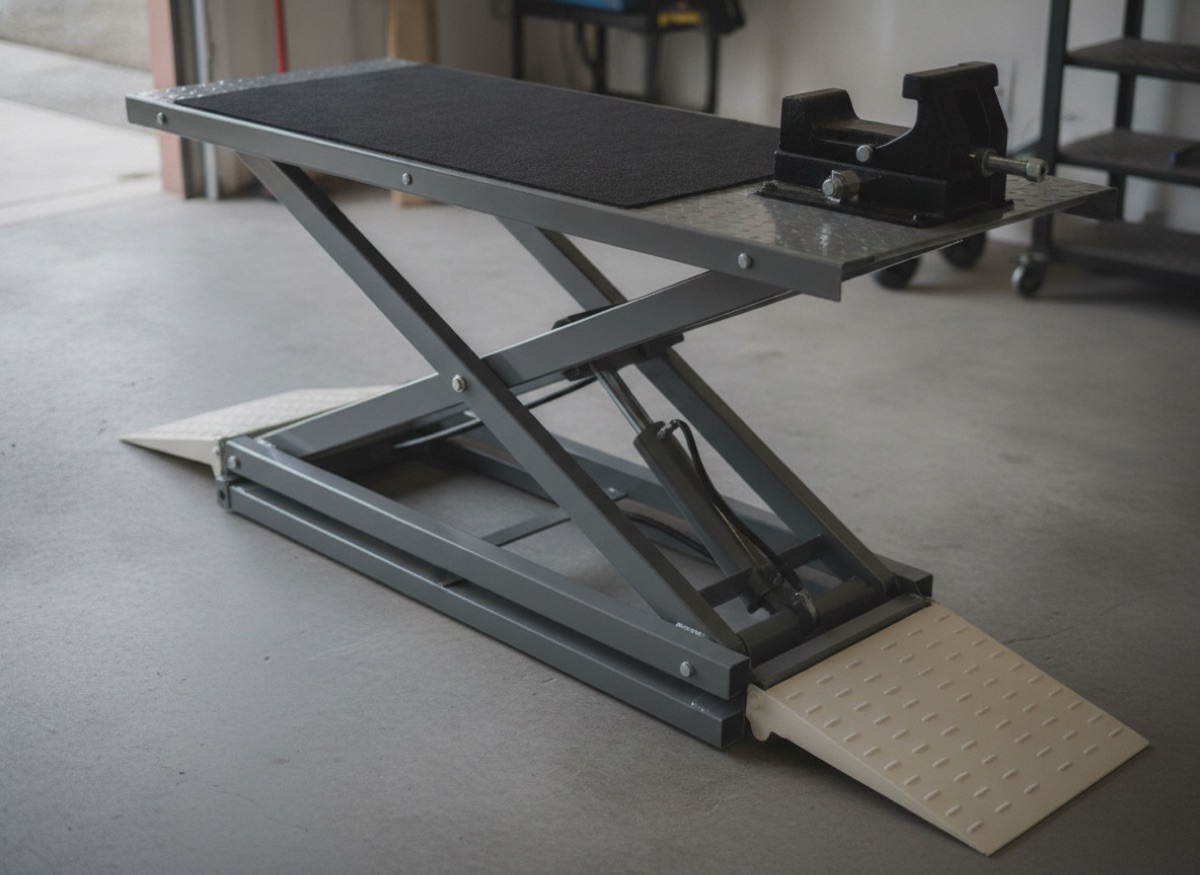
The Atlas AML-1000 at around $449: 1,000 lb, a 46 by 22 inch deck, 8 to 34 inches, a positive-lock bar, industrial powder coat, 155 lb, two-year warranty. Same rating, same range, 2 inches less deck, one fewer safety item (no check valve listed), $100 less. For a home garage with a sub-650 lb bike, the Atlas is the better buy.
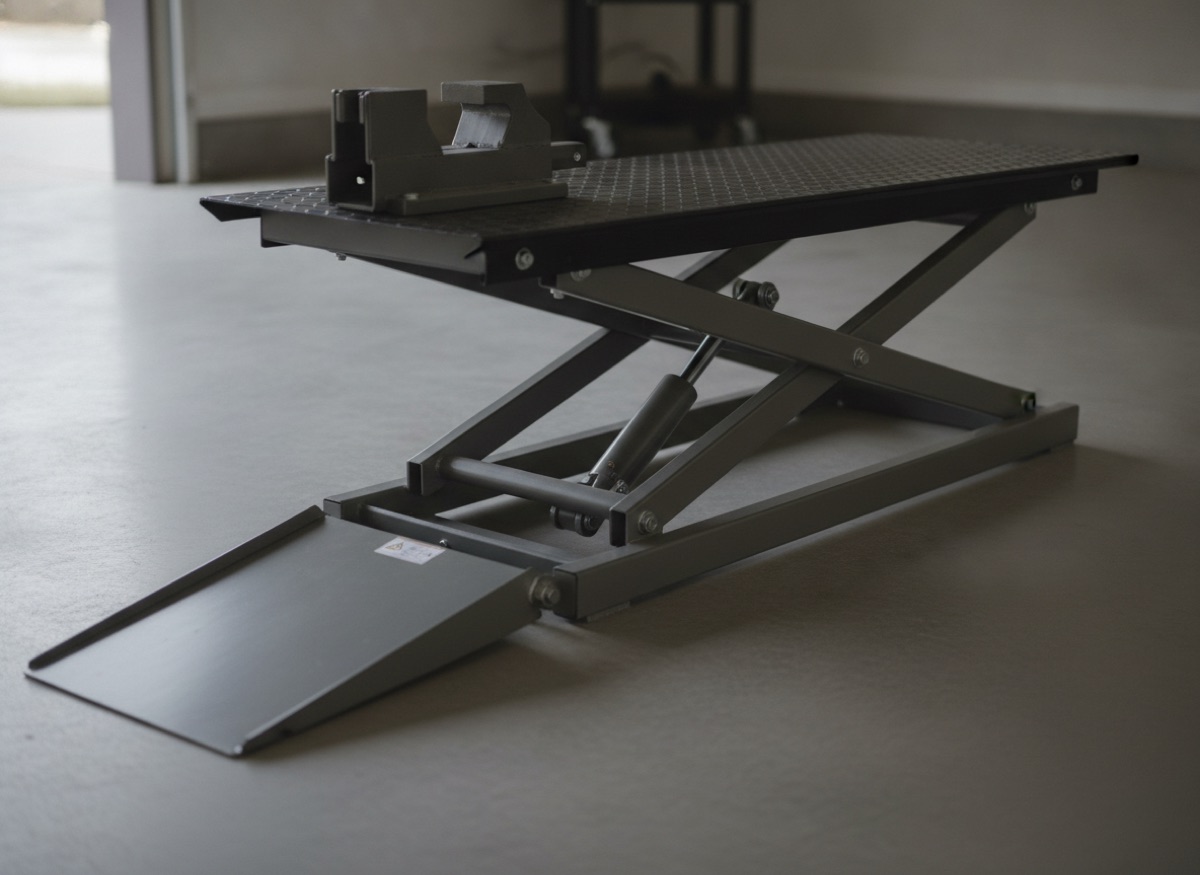
The Dannmar DML-1200 at around $529: 1,200 lb, a 50 by 23 inch deck, 8 to 35 inches, dual locks plus a check valve, 185 lb, two-year warranty. For $20 less than the Rotary it has 200 lb more rating, a bigger deck and a second lock. Its only deficits are the plain deck and a smaller dealer network.
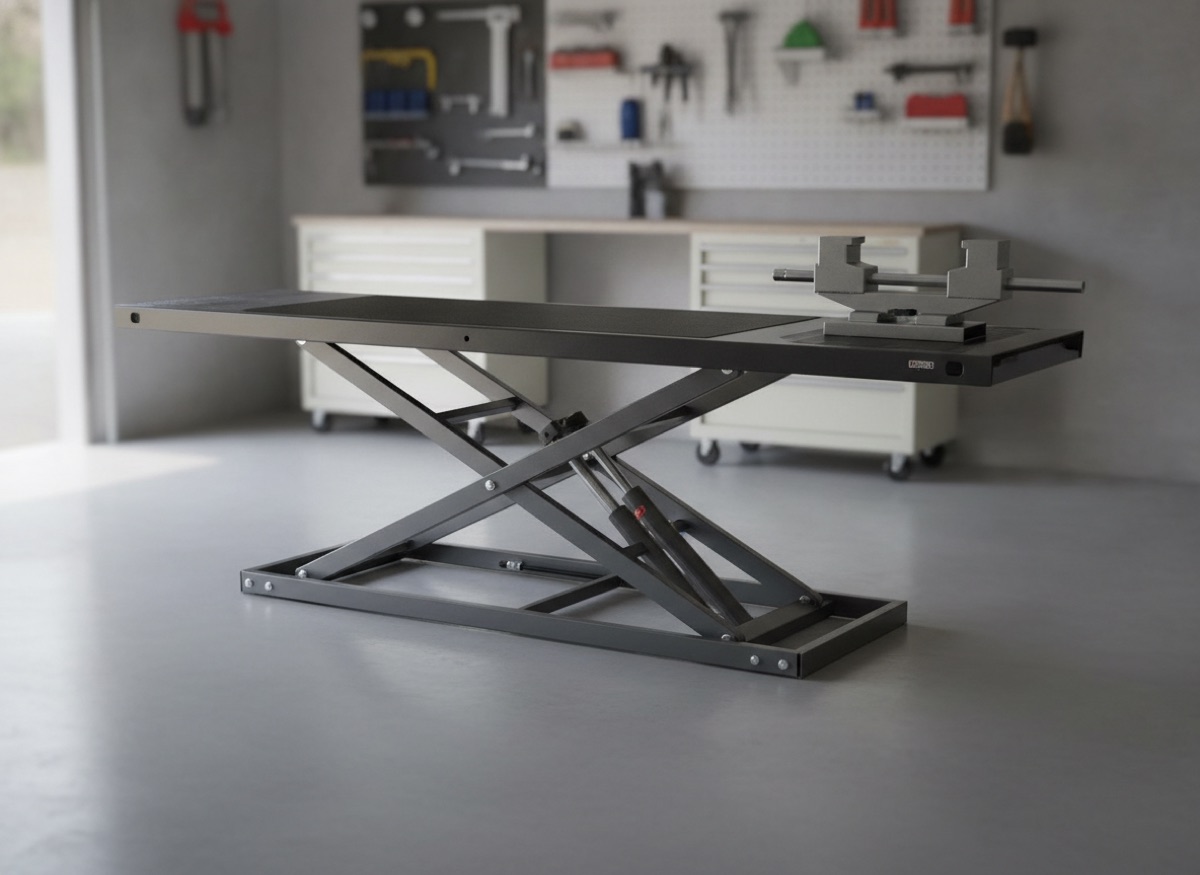
The Triumph NML-1500 at around $599: 1,500 lb, a 52 by 24 inch deck, 7 to 36 inches, air-hydraulic with a lock bar, check valve and straps, 225 lb, two-year warranty. For $50 more it is a different class of table.
On specifications the Rotary loses all three comparisons. On brand support it wins all three. Which of those matters is the whole decision.
Recommendation
Buy the RML-1000 if the table is going into a commercial shop that already runs Rotary equipment and wants one service relationship, or if the buyer values a dealer-supported product over the spec sheet and the bikes are under about 650 lb. In those cases the anti-skid deck, the powder coat and the network are worth the premium, and the table will outlast the shop.
Skip it for a home garage with a budget. The Atlas AML-1000 does the same job for $100 less, the Dannmar DML-1200 does more for $20 less, and the Titan 1500 does more for $250 less. Skip it too for any bike over 650 lb; that rider should look at the Rotary RML-1500 Pro Moto or the Triumph NML-1500.
Our recommendation is that the RML-1000 is a shop table, and shops should buy it. Home buyers who want the Rotary name and have a heavy bike should save for the RML-1500.
Final Verdict
The RML-1000 is a well-specified 1,000 lb table sold at a 1,500 lb price. The anti-skid deck, lock bar plus check valve, industrial powder coat and Rotary's service network are all real, and for a shop that already runs Rotary automotive lifts it is the obvious motorcycle table. For a home buyer it is hard to justify: the Atlas AML-1000 has the same rating for $100 less, and the Triumph NML-1500 has 500 lb more and an air pump for $50 more. Buy it for the dealer support. Skip it if the bike is over 650 lb.
The Rotary RML-1000 1,000-lb Moto Lift isn't currently sold on Amazon. Here's our top-rated motorcycle lifts pick that is:
Our top-rated motorcycle lifts currently available on Amazon.
Price incl. tax, excl. shipping.
* Affiliate link - we may earn a commission
Specifications
- Lift Capacity
- 1,000 lbs
- Lift Type
- Hydraulic Table
- Pump Type
- Hydraulic Foot Pump
- Table Dimensions
- 48" x 22"
- Height Range
- 8" to 34"
- Weight
- 175 lbs
- Material
- Industrial-Grade Steel
- Safety Features
- Lock Bar, Hydraulic Check Valve, Anti-Skid Surface
- Finish
- Industrial Powder Coat
- Warranty
- 2 Year Limited
Wheels off? Check the tires
A lift puts every tire at eye level, so it is an easy time to check pressure. Fanttik makes cordless tire inflators.
See Fanttik tire inflatorsTags
Related Reviews
Atlas AML-1000 Bike Lift Table Review: Reliable Mid-Range Performer
Est. $449 MSRP
Dannmar DML-1200 Motorcycle Table Review: Professional Quality at Mid-Range Price
Est. $529 MSRP
Triumph NML-1500 Motorcycle Lift Review: Professional Grade Air-Hydraulic Power
Est. $599 MSRP
Need Help Choosing?
Use our comparison tool to see how the Rotary RML-1000 1,000-lb Moto Lift stacks up against other lifts, or read our buying guide for expert recommendations.